Human society has entered the age of intelligence, and the development of society in the age of intelligence has generated a large number of intelligent applications, which have imposed unprecedented demands on the level of cognitive intelligence of machines, whose realization depends on knowledge mapping techniques。
The knowledge map, which has evolved rapidly since 2012, has become one of the most topical issues in the field of artificial intelligence and has had a better impact on the ground in a range of practical applications, with significant social and economic benefits. The symbolism represented by the mapping of knowledge is showing signs of renewal, as it is becoming a synergeticism represented by deep learning in another promising direction after the development of artificial intelligence in recent years。
The development and application of big data depends on symbolic knowledge
As a result of a large data wave that began in 2012, a great deal of data has been accumulated across industries. However, the data have not created the value we expect, as we imagine, and in many cases have become a burden, requiring not only more transport personnel, but also more equipment to store them. If data are not available, they are negative assets. However, large data are difficult to realize, as is anti-aircraft fire against mosquitoes, which is of little use. The lack of effective intelligence is the underlying reason that prevents the realization of large data values。
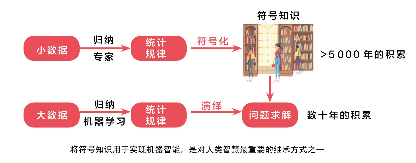
So, what kind of smart tools do we need? Computer solutions have been based on two basic concepts: statistical management, and symbolic reasoning. For example, if the question is three times four equals what? Many people can speak out and answer 12. This is because, as a child, you all remember the 99 times scale, which has established a very strong statistical link between three times four and 12. The so-called theme-based tactics are essentially to create a stronger statistical link between the subject and the solution. There are, of course, many times when symbolic reasoning is needed to solve the problem. For example, if the question is 345 times 123 equals what? It is estimated that very few people are able to provide immediate answers. At this point, you usually take out a pen and paper, write down the symbols, and then solve them one by one using the multiplication rules that you have learned, which is actually the use of symbol reasoning to solve the problem。
In fact, the development of artificial intelligence, which began in the late 1990s and is dominated by the development of statistical models in statistics, is also an achievement of today's machine learning. However, statistical learning alone is not enough to support intellectualization. Symbolic knowledge is essential to the achievement of intellectualization, as it equips machines with interpretable capabilities and also with language “understanding”. We must therefore allow machines to learn to use symbolic knowledge to solve problems and achieve cognitive intelligence。
At the heart of the cognitive intelligence of machines is their ability to understand and interpret. The realization of this capacity is inextricably linked to the knowledge base, the symbolic knowledge. For some time now, social scientists have been unable to answer precisely what is understood and what is explained. However, artificial intelligence research urgently needs to define these issues. In my view, so-called understanding depends on the knowledge base, and machine understanding of data is to some extent a mapping of entities, concepts, relationships from data to the knowledge base. The interpretation of data refers to the process of interpreting phenomena using entities, concepts, relationships in the knowledge base。
Knowledge engineering is the core of cognitive intelligence
Now that symbolic knowledge is so important, what exactly is the master of symbolic knowledge in its application? A series of symbolic knowledge applications is embodied in a new generation of knowledge engineering. Knowledge engineering is a discipline built around expert systems to study knowledge expression, processing and application, and to develop tools. In the big data age, knowledge engineering is actually led by knowledge mapping. Knowledge maps contain information about entities, concepts, attributes, relationships, etc., making it possible for machines to understand and interpret. In short, knowledge mapping is a large semantic network, one of the important expressions of knowledge in the big data age. However, the knowledge map has evolved today not as a semantic network, but as a technological system, a representative advance in knowledge engineering in the big data age. In retrospect, knowledge maps have evolved from symbolism, which was one of the earliest thinking and genres of artificial intelligence. The main points of symbolism include: cognitive is computing; knowledge is a form of information that forms the basis of intelligence; and the expression, reasoning and application of knowledge is at the core of artificial intelligence。
Traditional knowledge engineering has been a great success in terms of rules, clear boundaries and closed applications. Alphogo, for example, was successful precisely because chess was closed, and it simply needed to use chess rules and never other open world knowledge. So, why are artificial intelligence applications so demanding? This is because traditional knowledge engineering relies heavily on expert and human intervention. However, hidden knowledge, process knowledge, etc. Are difficult to express. For example, how to express the knowledge of cooking? What is used by old chinese doctors to see the disease? It is also difficult to formally express knowledge of the field. Expert knowledge inevitably has subjectivity and may be inconsistent between different experts. There is a theory of family resemblance in cognitive psychology that, for example, a cup may be called a cup short, and it is not clear whether it is called a cup or a bowl to some extent. In other words, it's not the same conclusion that people see the same thing. In addition, knowledge expression is ambiguous and incomplete, and gaps are common。
Traditional knowledge engineering, by the time of the big data age, no longer responds to the application needs of the big data age. So, what are the characteristics of big data age applications? In google, the 100-degree search engine, for example, is a typical large-scale open application, and we never know what the next key word for a user is, and users are constantly creating new search needs. However, the precision requirements of users are low and the search engine is never required to ensure that every search is understood and retrieved correctly. Moreover, most searches are understood and answered only by simple reasoning。
So what is needed for large-scale open applications in the internet age? The answer is that there is a need for sufficient quantity, wideness and coverage, but also very simple, very light-weight knowledge expression. As a result, google has produced knowledge maps to meet the need for knowledge applications in search. The essence of the knowledge mapping is that it makes it possible to acquire large-scale, automated knowledge。
Smart upgrading and transformation of knowledge mapping support industries
The emergence of large-scale knowledge maps has largely heralded the advent of an era of big data engineering, and bottlenecks in traditional knowledge mapping will be broken. The knowledge map has grown to the point where it has increasingly taken on the task of upgrading and developing in all walks of life, and it can be said that there are unprecedented opportunities and, of course, many challenges for a large-scale intellectual engineering。
So, what does knowledge mapping do for all industries? First, for many industries, it can fill the missing causal chains. Everything is in a complex web of causes and consequences. The data generated by many business systems are only data on the end-of-life behaviour of users, but the background or cause for the data is not known. For example, a survey of a large supermarket in the united states found an interesting phenomenon, where customers buying diapers often buy beer at the same time. So the supermarket put beer next to the diapers, and the diapers went up, and the beer was empty. Beer and diapers, two things that seem unrelated, actually have a strong statistical connection and a huge business opportunity. It would be more interesting if we did not simply find a strong statistical correlation between beer and diapers, but rather to ask why. We will find that there is a statistical link between beer and diapers for a reason, that the purchase of diapers means that there is a newborn in the family, that the mother is just having trouble giving birth, and that, therefore, fathers are buying diapers. A new father who was going to buy diapers, who had just had a newborn baby, was naturally nervous and was likely to buy beer to relieve stress. If it is known for what reason the users produce these data, their full power will be realized. It follows that data can be very valuable if scenes and background knowledge are built up, and that is what the entire internet industry is doing. Second, knowledge maps can link and integrate debrisified data. Knowledge mapping provides metadata for integration, making it possible to integrate autonomously and universally. In addition, knowledge mapping can deepen understanding and insight into industry data. Based on industry knowledge mapping, industry data understanding capabilities can be developed to achieve physical, conceptual, thematic and visual insight into data。
Ai can be an essential model for the upgrading and transformation of traditional industries in the process of intelligent development of industries. Traditional industries face a wide range of opportunities, and a number of core issues, such as increasing income, reducing costs and improving efficiency and security, will benefit from smart technologies。
Increased income
Through the construction of a manufacturer's cognitive knowledge map that links users-situations-goods effectively, more user labels can be extracted and the perception of user scenes can be refined, thus making electricians more accurate in searching and recommending and effectively increasing the conversion rate of goods. A business profile based on bid information, and a similar bid project based on a business profile are recommended for users, enabling them to identify business opportunities. Based on knowledge mapping reasoning, it also helps clients to identify more secondary business opportunities. This would increase both the business volume of the enterprise and its revenue。
Supermarket cost reduction
Smart passenger service systems are now being applied on a large scale in many industries, particularly finance, electricity and telecommunications. It is precisely through industry knowledge mapping that smart customer service is achieved, so that machines can truly understand users and greatly reduce the cost of passenger labour in enterprises. A number of large enterprises and government agencies produce a large number of work orders on a daily basis, and there will be significant duplication of procurement for the same products and repetition of failure sheets for the same products. Build product profiles of suppliers, automatically excavate extracting worksheet information and detect duplicate worksheets through correlation analysis. For example, the nordic sector experienced a product failure, which occurred simultaneously in north africa and was resolved. This experience can be reused through double-checking of worksheets, thereby reducing human costs。
Increased efficiency
The judicial knowledge map presents information on legal instruments in a structured form, by extracting information from case documents, judging the complexity of cases and their diversion. This will enable practitioners to quickly access relevant legal content online and improve the quality and efficiency of court proceedings。
The integration of intra-enterprise data, the accessibility of data to isolated islands and the construction of enterprise knowledge maps can link people, projects, products, etc. Semantic search capabilities based on knowledge maps make the results more accurate and complete. A personalized referral system based on mapping allows for accurate and proactive dissemination of knowledge, allowing knowledge to be found. These applications have contributed to the effective use of sedimentary knowledge and have greatly improved efficiency。
Risk reduction
Banks use knowledge maps to borrow against fraud. All data sources relating to borrowers are accessible and knowledge maps containing multiple data sources are constructed, and the borrower's consumption records, behavioral records, relationship information, online log information, etc. Are integrated into the anti-fraud knowledge profiles, which allow for analysis and forecasting and allow the identification of fraud cases, such as identity fraud, group fraud, proxy packaging, etc。
Knowledge mapping also allows for contract risk identification. Automatically generate comparative results reports by extracting critical information about the content of the document and assisting business staff to complete work such as content consistency checks. Knowledge mapping automatically identifies dozens of common built-in risks and supports customized risk audits based on industry characteristics. Knowledge maps are now widely applied in a wide range of text-intensive industries, such as finance, manufacturing, communications, law, audit, government and so on, effectively helping to identify risks。
Of course, we now face many challenges. Making machines “take” a certain amount of knowledge and using it to better serve humanity has been a major challenge to the further development of the robotics industry and the ai industry as a whole. First is the difficulty of expressing knowledge. For example, how can data and knowledge be expressed in a uniform expression space? How can vector expressions of knowledge be integrated with symbol expressions? The problem is essentially a massive symbol site, and this is what we're doing right now, and it has to do with pictures, voice, video. Second, there is a long way to go to acquire knowledge. While the big data age has led to quantitative increases in knowledge acquisition, there is considerable room for qualitative increases. Access to meta-knowledge is still lacking in effective methods, and the scarcity of common sense in the language has created enormous difficulties in obtaining common sense. In addition, the application of the knowledge base still needs to be deepened, and automatic adaptation of knowledge remains difficult. How to develop effective mechanisms of reasoning in concert with different types of knowledge is to be studied further。
In short, the sanctuaries and the legacy of knowledge have shaped the glory of human civilization and will become the necessary path for the continuous upgrading of machine intelligence. Only for machines, the deposition of knowledge becomes an expression of knowledge, and the transmission of knowledge becomes an application of knowledge。
Xiao yihua, professor at the faculty of computer science and technology, university of jordan, doctoral student mentor and head of the knowledge workshop laboratory。