I. Nature and purpose of examinations
(i) nature of examinations
The higher school teacher qualification system, which is a system of professional qualification for the vocational access of higher school teachers, is important for regulating the criteria for the appointment of higher school teachers, promoting the professional specialization of higher school teachers and improving the quality of education in higher schools. The theoretical examination for the qualification of teachers at the guangxi higher education institute is the vocational qualification examination organized by the department of education of the guangxi autonomous region under the prc teachers law, the state council regulations on the qualification of teachers and the ministry of education's means of implementation. The results of the examination will be one of the conditions for applying for the qualification of teachers in higher education。
(ii) purpose of the examination
Through the examination of this subject, examine the understanding and mastery of the basic theory and basic knowledge of higher education by applicants for the qualifications of teachers in higher education, and use the theoretical analysis of higher education studies, solve problems of teaching higher education, enable applicants to develop a scientific vision of higher education, master basic theories and methods of higher education, develop the capacity to analyse the phenomenon of higher education, discover the patterns of higher education and solve the problems of higher education, combine the knowledge of higher education studies with the expertise they have learned, and develop the educational specialization required of teachers in modern institutions of higher education。
Ii. Context and principles
(i) mandate
In accordance with the outline and instructions for examinations in higher education studies, reference is made to the pre-service training material for teachers in higher education, higher education science (pedagogical university press, guangxi, 1st edition, june 2019), which takes into account the actual situation of new teachers in higher education institutions in our region。
(ii) adjudication principle
1 the principle of orientation. Reflecting the requirements for the professional development of teachers in higher education, preparing candidates for the post-graduate examination, giving them full guidance in the theoretical examination of the qualifications of teachers, promoting the study of basic theories of higher education, developing the educational specialization required of modern teachers, and fully developing the role of higher education teachers in teaching teachers, scientific research, social services and cultural heritage。
2 scientific principle. It is in line with the nature, characteristics and requirements of the theoretical examination of the qualifications of teachers in higher education; it follows the level of knowledge, patterns of knowledge and development of the candidates; it focuses on the basic and developmental nature of the content; it closely links the practical work of teachers in higher education with the selection of materials; it contains scientific, rigorous, linguistically precise and precise answers。
3 principle of objectivity. There is a certain level of representativeness and wider coverage of the subject, reflecting the main contents and basic requirements of higher education disciplines. The subject matter of the test is appropriate, difficult and effective, allowing an objective assessment of the level of study of the candidates。
Fundamental principles. It focuses on the ability of candidates to master the basic concepts, rationales and basic skills of higher education science and to analyse, diagnose and solve higher education problems. The objectives of the examination are to understand, understand and apply three levels of knowledge and competence. Putting an end to myths and myths。
5 principle of equity. For all candidates, due consideration is given to the actual situation of candidates of different professions, so as to avoid the impact of economic, historical, cultural, geographical, ethnic and gender differences on the candidates ' regular responses. It is consistent with the realities of the life of the candidates and guarantees fair and equitable examinations。
Six principles of humanity. The purpose of the examination is to ensure that the psychological needs of the candidates are fully taken into account and that a liberal environment is created, that the relevant instructions are properly set in the examination papers, that the candidates are properly performed and that they are given human care。
Iii. Context and requirements of the check
(i) description of examination level
The level of knowledge and competence in the subject of higher education requires a low to high level of understanding, understanding and application, and the high level of testing requires a low level of testing。
1 understanding levels. There is a need for a preliminary understanding of the basic concepts, perspectives and theories of higher education as listed. Knowledge of the definition of the relevant concepts, the content of the basic points of view and the underlying theory, and related facts. The main behavioural verbs involved in this level are: knowledge, knowledge, description, speech, brief description, etc. 2 level of understanding. There is a need for a more profound and rational understanding of the basic concepts, perspectives and theories of higher education as listed. It is possible to express what has been learned in its own language or in a different way than in its original form, and it is possible to interpret, describe or summarize the basic concepts, basic points of view, basic theories of higher education. The main behavioural verbs involved in this level are: understanding, description, expression, speculation, judgement, interpretation, comparison, etc. 3 application level. Using the theory and knowledge of higher education, it is possible to interpret, analyse, extrapolate and predict the phenomena and problems of higher education, correctly explain the causes, implications and effects of specific educational events and propose solutions to the practical problems of teaching higher education. The main behavioural verbs at this level are: mastery, use, application, problem solving, etc。
(ii) examination content and requirements
1. Overview of higher education and higher education。
(1) subjects and basic content of higher education. (d) knowledge of subjects of higher education. Knowledge of the basics of higher education science research。
(2) the nature and characteristics of the subject of higher education. Briefly describe the nature of the subject of higher education. Describe the academic characteristics of higher education。
(3) research methods in higher education. Knowledge of research methods at the philosophical level in higher education. Knowledge of research methods at the general scientific level in higher education. - understanding specific research methods in higher education。
(4) learning requirements for higher education. To understand the learning requirements of higher education。
(5) the concept and characteristics of higher education. Understanding the concept of higher education. Describe the characteristics of higher education。
(6) historical development of higher education. Understanding the historical development of higher education in china. Understanding the historical development of higher education abroad。
(7) the purpose of higher education. Understanding the concept of the purpose of higher education. The function of explaining the purpose of higher education. Describe the type of purpose of higher education. Describe the purpose of our higher education at this stage。
2. Functions of higher education and of higher education institutions。
(1) functions of higher education. (b) a mastery of the individual function of higher education. (c) to master the social function of higher education。
(2) functions of higher schools. Mastering the three main functions of higher education institutions and their historical development. (c) the relationship between ownership of the functions of higher education institutions。
3. Subjects, specializations and curricula of higher education institutions。
(1) the subject of higher education. Understanding the meaning of discipline. Classification criteria for knowledge of disciplines. (c) to master the basic principles and main elements of the construction of higher education institutions。
(2) specialization in higher education. Understanding the meaning of the profession and its relationship to disciplines. (c) knowledge of the content of higher education institutions. Describe the trend of professional reform in our higher education institutions。
(3) the curriculum of higher schools. Understanding the meaning, performance and characteristics of higher school curricula. The system and structure of higher school curricula. Describe the general trend in the reform of higher school curricula。
Teachers and students in higher schools。
(1) teachers in higher schools. Understanding the main elements and characteristics of the work of teachers in higher education. Understanding the role of teachers in higher education and their conflict and coordination strategies. (c) mastering the concept, content and strategy of professional development of teachers in higher education institutions. Describe the stages and methods of professional development of teachers in higher schools. (b) to gain access to the structure of the teaching staff in higher schools and to the development of the teaching staff in higher schools。
(2) students of higher education institutions. Briefly describe the physiological characteristics of students in higher education. Briefly describe the psychological characteristics of students in higher education. (c) a mastery of how students in higher education study。
(3) teacher-student relations in higher schools. (c) to learn the manifestations of teacher-student relations in higher education institutions. (c) mastering the strategy of building a good teacher-student relationship at the tertiary level。
5. Teaching in higher schools (up)。
(1) an overview of the teaching of higher education institutions。
Understanding the concept of higher education teaching. Describe the significance of higher education. (c) mastering the basic tasks of teaching in higher schools. Learn about curriculum thinking and teaching reforms。
(2) principles of teaching in higher schools。
Understanding the teaching principles of higher education. (c) knowledge of the basic principles of higher education. The principle of integration of science and thought, of inspiration and innovation, of professionalism and integration, of theory and practice and of teaching and research can be effectively applied in the teaching of higher education。
(3) forms of teaching in higher schools。
(b) a mastery of the forms of teaching in higher schools. (b) knowledge of the content and requirements of the course, basic requirements of the course and the content and requirements of the course. Knowledge of the “internet+” teaching in higher education institutions。
6. Teaching in higher schools (low)。
(1) teaching methods in higher schools. (c) a mastery of classroom teaching methods. To learn how to teach in the field. The method of self-learning guidance. Knowledge of methods of scientific training. Access to “internet+” methods。
(2) teaching evaluation in higher education institutions. (c) understanding the meaning of teaching evaluation in higher schools. To understand the function of teaching evaluation in higher schools. (c) knowledge of the elements of the evaluation of teaching in higher schools. (c) a knowledge of the type of teaching evaluation in higher education institutions. (c) to learn about the general procedure for evaluating the teaching of higher education institutions. Understanding the evaluation of the quality of external teaching in higher schools. (c) to obtain an evaluation of the work of teachers in higher education institutions. (b) learn to assess and evaluate students ' academic performance。
(3) teaching management in higher schools. Understanding the school year and credit system. Describe the day-to-day teaching management of higher schools。
7. Scientific research in higher schools。
(1) characteristics and role of scientific research in higher schools. Understanding the concept of science and scientific research. Describe the characteristics of scientific research in higher schools. To understand the role of scientific research in higher education。
(2) types and principles of scientific research in higher schools. Indicate the type of scientific research in higher schools. The principle of scientific research in higher education institutions。
(3) procedures and basic methods of scientific research in higher schools. Describe the procedure for scientific research in higher schools. Basic methods of scientific research in higher schools。
(4) declaration of scientific research in higher schools and presentation of scientific research results. (b) to obtain a declaration on the subject of scientific research in higher schools. Presentation of the results of scientific research in higher schools。
8. Social services in higher schools。
(1) overview of social services in higher schools. To learn about the historical development of social services in higher schools. (c) mastery of the social services of higher education institutions. To understand the significance of social services in institutions of higher education。
(2) the content and form of social services in higher schools. Describe the content of social services in higher education institutions. Access to social services in institutions of higher education. To understand the new changes in social services in higher schools。
(3) management of social services in higher schools. - the principle of access to social services in institutions of higher education. To understand the government's management of social services in higher schools. Understanding self-management of social service activities in higher schools。
9. Current situation and trends in higher education in the country。
(1) the status of higher education in the country. Understanding the structure of our higher education. Know the scale of our higher education. Understanding the quality of our higher education. Understand our investment in higher education. Describe the current state of internationalization of higher education in our country。
(2) trends in higher education in the country. Describe the general trends in higher education in the country. Describe the development of the quality of higher education in the country. Describe the development of technological applications in higher education in the country. Describe the trend towards internationalization of higher education in our country。
Iv. Format and structure of the examination papers
(i) form of examinations
Examinations are closed and written。
The full volume is divided into 100 points and the examination time is 120 minutes。
(ii) text structure
1. Topical and semi-values。
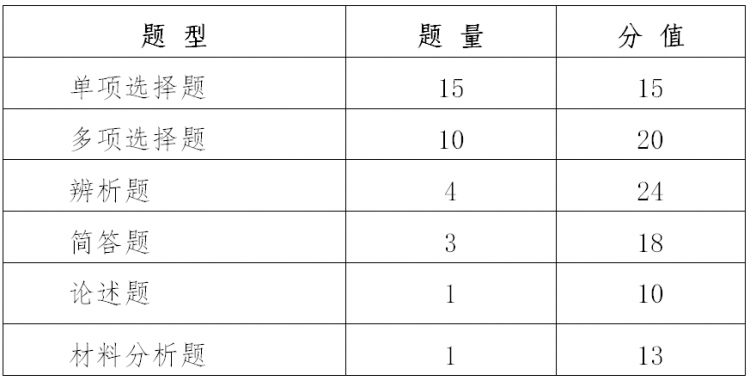
2. Content structure。
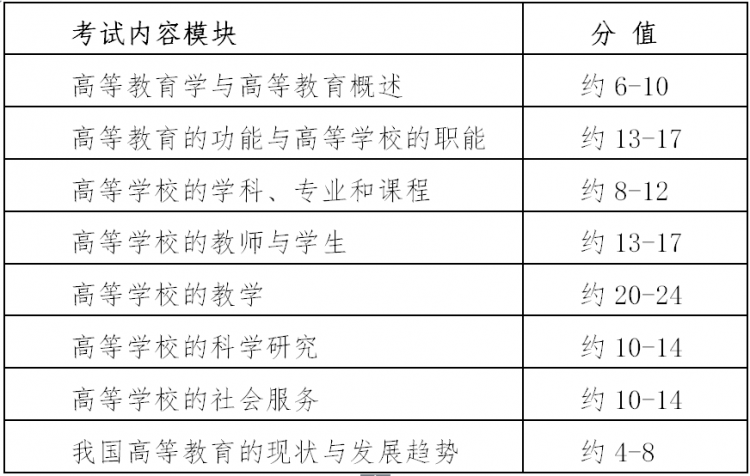
3. Ratio of scores for different difficult questions. The easy-to-problem, medium-problem, and more difficult-to-problem ratio is about 6:3:1. 4. Proportion of fractions at different levels. About 30 per cent is understood, about 40 per cent is understood and about 30 per cent is used。