An analysis of the various classes of chinese society is one of the key representatives of the period of the maoist democratic revolution. In this article, mao used marxist class analysis for the first time to carry out an in-depth autopsy of the complex social situation in china at the time, analysing the economic position of the various classes, and thus determining their class and their attitude towards the upcoming chinese revolution storm, resolving major theoretical issues such as the subject and the main forces of the chinese social revolution, and providing important guidance for concrete revolutionary practices. The editor of the mao zedong syndicate, referring to its writing significance, said: “the mao zedong text was written to counter two tendencies that existed within the party at that time. The first tendency within the party at that time, represented by chen soo-soo, was to work with the national party, forgetting farmers, which was right-wing opportunism. The second trend, represented by zhang guoqiang, is to focus only on the workers' movement and to forget farmers, which is `left' opportunism. Both opportunisms feel powerless and do not know where to look for strength and where to reach the vast coalition. Mao zedong stated that the largest and most loyal allies of the proletarian class in china were farmers, thus resolving the issue of the main allies in the chinese revolution.”
The analysis of the various classes of chinese society was first published in revue no. 4 (published on 1 december 1925) under the auspices of the second army command of the chinese national revolutionary army. The text was slightly changed and later published in issue 2 of china farmers, hosted by the central farmers department of the chinese national party (published on 1 february 1926). The author has made a number of changes and published them in chinese youth (published in march 1926). The author has made additional changes and additions to the mao zedong selection. As a result of several changes, there are large or small differences in the content of the analysis of classes in chinese society. The author has chosen the version currently in use (people's press 1991 edition) and its original version (1 december 1925 edition) to be compared and read in order to deepen his understanding of the changes that have taken place in modern chinese society。
The author finds that there are more differences between the two versions of the analysis of classes in chinese society. As a general rule, during the editing of the collection, the compilers perform a number of general editorial additions, deletions and refinements. The difference between the two versions is not just a change in text, but also a change in content, perspective, etc。
In terms of the context of writing, in addition to the above-mentioned “mao zedong text was written to counter the two tendencies that existed within the party at the time”, there is also the context in which, in the first paragraph of the original version, the author clearly stated: “the declaration of the first national congress of the national party was the decision to declare this strategy and the distinction between enemy friends. But that declaration was extremely simple." however, this paragraph was not retained in the later version and, in fact, first-time co-operation is an important background for mao zedong's writing, which is better understood。
In terms of content, the original version is slightly more extensive than the current version. The original version, referring to the contents of the article, said, “we need to recognize this important strategy, to distinguish between our true enemy friends, and to make a general analysis of the economic status, class, size and attitude of the various classes of chinese society towards the revolution”. The two words “class, number” were deleted from the gross selection of income. The discourse on classism is reflected in specific language, but the estimates of class sizes are completely deleted. The original version contained a great deal of talk about the size of the classes and their attitude to the revolution, and a special table was included. In addition to the deletion of the discussion on class sizes, a large part of the original discussion on middle class segmentation has been deleted. Why are these elements deleted? Without a clear record, we are unable to ascertain the reasons for it and can only speculate. By way of example, it is difficult to find a relatively accurate figure over a longer period of history, given that the author's figures are estimated in terms of his or her class size and his or her class size changes over time. Instead, the deletion of these figures would make the original text more concise, not only in its entirety。
In addition to these complete deletions, there have been significant changes in the discussion of many issues in the text of the “suspend”. In general, there are the following aspects。
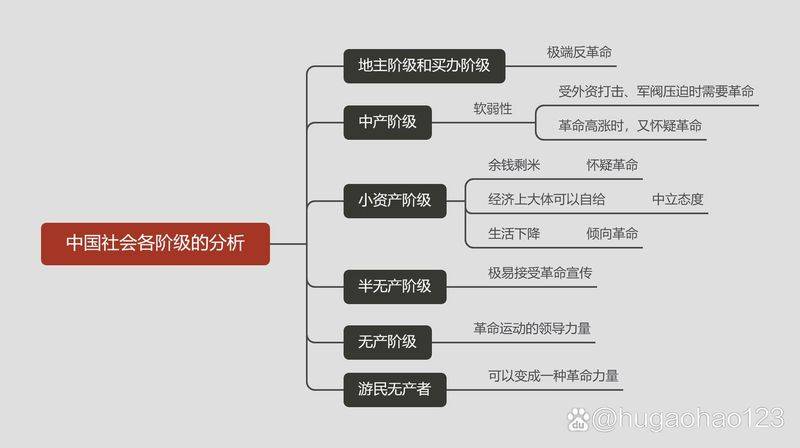
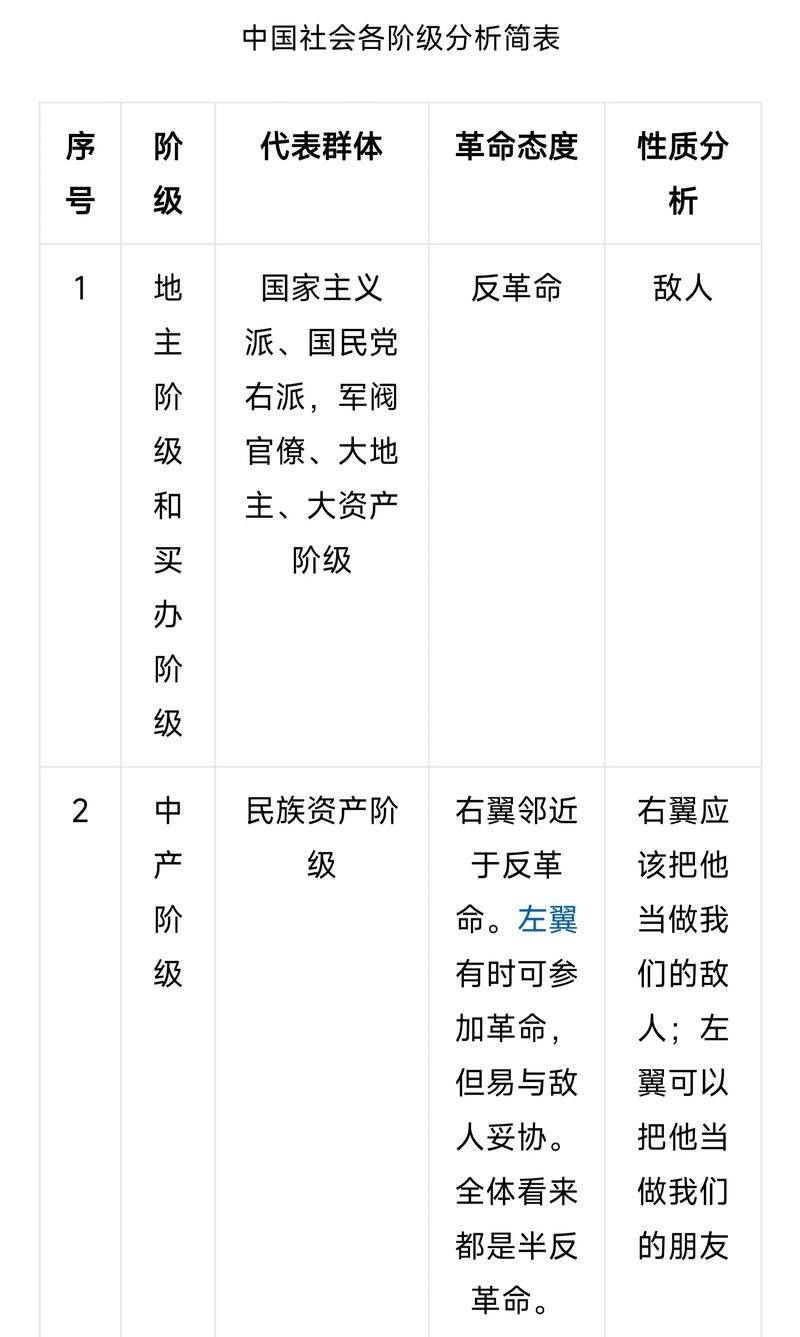
First, in terms of specific class analysis. With regard to the large bourgeois, the original version was “big bourgeois”, while the “muffy selection” was directly referred to as “landlord and buyer class”. In its analysis of its class nature, the mao chosen, in addition to continuing to point to its “subsidiarity to imperialism”, stressed that “these classes represent china's most backward and reactionary productive relations and hinder china's productivity development. They are totally incompatible with the aims of the chinese revolution”. As for the political representation of this class, the original version was presented as follows: “the buying class - bankers with close ties to foreign investment (e. G., lu, chen, etc.), commercialists (e. G., tang, ho, etc.), industrialists (e. G., zhang, shen, etc.); landowners (e. G., zhang, chen, etc.); bureaucrats (e. G., sun, yan huiqing, etc.); warlords (e. G., zhang, cao, etc.). It also includes the “rebel intellectual class” attached to the above four individuals. In the maoists, the political representatives of this class became “nationalists and the right of the national party”. On the middle class, the “magic selection” would have said that, at the height of the revolution, “the middle classes will be divided quickly”. Here, mao is referred to in general terms only as the “middle class”; in fact, mao has a specific description of the middle class in the original version, “those middle classes, in the western ocean, such as the so-called second international category, and in china, such as the so-called nationalism, must quickly divide”. According to the original version, the right wing of the national party also belongs to the so-called middle class of mao. The nationalists and the right of the national party, from the “middle class” in the original version, to the “middle class” in the mao chosen, became “extreme anti-revolutionary” and became the worst enemy of the chinese revolution. This change reflects the significant changes that have taken place during this historic period in the chinese revolution. The presentation of the mao chosen book shows that the author has gained a deeper understanding of the problems of chinese society and, while pointing to the role of this segment of the population in the revolution, emphasizes its “destructiveness”。
Second, there have also been some changes in intellectual discourse. In the original version, which dealt with the large bourgeois class, it was considered that “the reactionary intellectual class - which is attached to the above four persons, such as the superintendence of banking, business and industry of the buying nature, the higher clerk of warlord governments, politicians, some east and west students, some students taught in specialized schools, barristers, etc.” when it comes to the middle class, it is considered that “small landowners, many high-level intellectuals - business and industry practitioners at the bank of china, most east-west students, most university-specialized students, junior lawyers, etc. Are in this category”. With regard to the small bourgeois class, the author argues that “the small intellectual class — the small division, the small clerk, the secondary school students, the primary and secondary school teachers, the small lawyer, etc. — all belong to this category”. In the final part of the article, the author states that “all warlords who collude with imperialism buy the intellectual class of the main reactionaries, the so-called chinese bourgeois class, are our enemies and our true enemies”. A large part of the text was deleted from the text of the "suspend" and only one specific reference was made to intellectuals: “the small intellectual class — the student community, the primary and secondary school teachers, the junior division, the clerk, the junior lawyer”. The formulation of intellectuals in the concluding remarks has also been changed: “we are enemies of all the imperialist warlords, the bureaucrats, the buying class, the land masters and part of the reactionary intellectual community attached to them.” by comparing the two versions, it can be seen that in the original version, the author's perception of the class attributes of the intellectuals is still relatively vague, and in the “selections” the intellectuals were explicitly referred to as a “class”. The text of the “suspend” substantially simplifys the narrative of intellectuals and may not be relevant to this change in the author's perception of ideas。
Thirdly, the revolution leadership discourse has changed. The original version of the text did not address the leadership of the revolution, but, in the case of the proletariat, referred to the fact that “the industrial proletariat is so small that it has become the backbone of the national revolutionary movement”, without mentioning that the industrial proletariat is the “leadership” of the revolutionary movement. And in the final part of the "suspend," the author added "the industrial proletarians are the leader of our revolution." such a sentence clearly states that the leadership of the chinese revolution belongs to the industrial proletariat。
In conclusion, it can be observed that while the essence of the articles between the two versions has not changed significantly, there has been a considerable change in their discussion of many specific issues and that such changes are not limited to additions or deletions. The original version was more like a specific survey report than the original version, while the maostamp was more systematic and theoretical and “classic”. From the point of view of academic research, a deeper understanding of historical truth can be achieved only if the various approaches, including the version survey, are applied in a solid and realistic manner, to distinguish the author's thoughts from those of the time and the changes that have taken place since then, and to identify the trajectory of evolution。
(by beijing teacher training university, history school)
"syle" means "display:none."