In recent years, wang hae-lin, an entrepreneur who returned home to antu county, jilin province, has worked hard on local resource advantages to develop specialty chinese medicine-growing techniques, set up professional cooperatives for mountain taro-growing, promoted the industrial development of specialty chinese medicine, and led the rural communities out of wealth。
At the foot of white hill, the director of antu county, the forest is rich and the mountain pharmaceutical industry is known throughout the country. The local villagers have the habit of picking veggies in the spring, picking mushrooms in the autumn and digging for medicine. Wang hae-lin had travelled to large cities to do business, and many years of struggle had laid a certain economic foundation for him. On a visit to his village, he learned from his chatting with the villagers who were running the hills that there was a medicine called taroheads, also known as mao tzu, shan tzu and hockey, which were particularly resistant to cold and belonged to the lanco plant. It's full of treasures, leaves to make tea, and raisins to be rare, and roots to be precious chinese medicine. As its value is increasingly recognized, it leads to over-exploitation and the depletion of resources. As the unintentioned listener intended, wang hae-lin was keenly aware of the vast commercial opportunities in which the drug was hidden. Information on taro (magic tzus) was then examined, with a view to exploring techniques for artificial cultivation of the drugs in the taro。
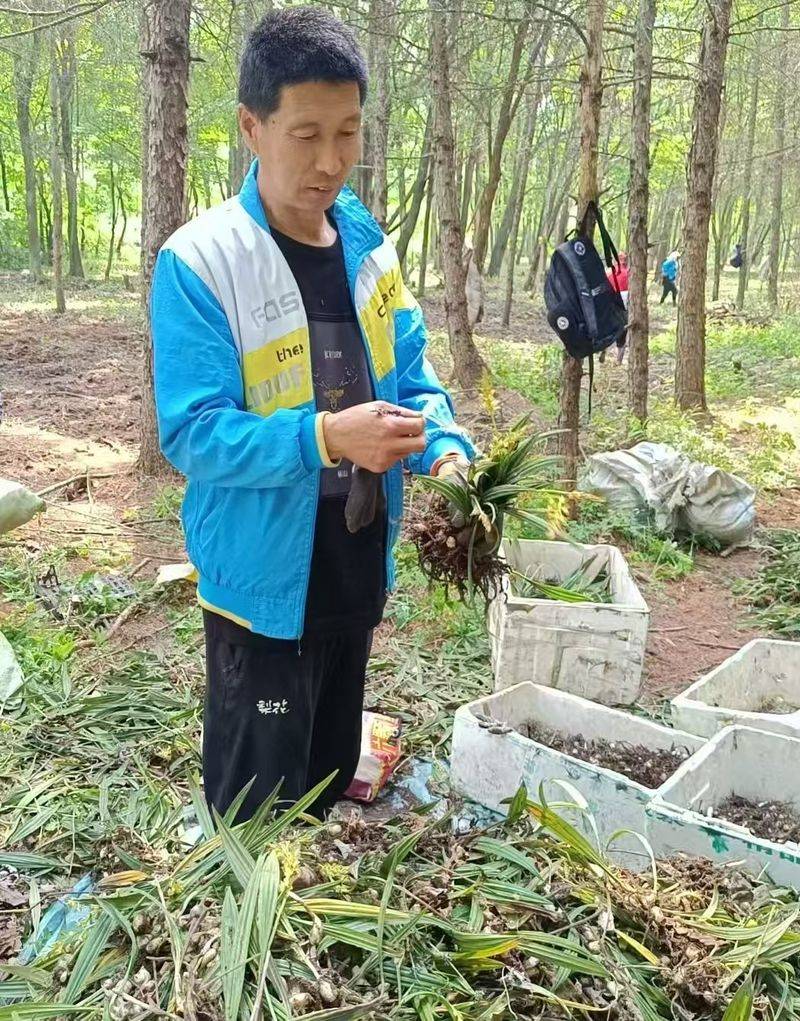
The figure is wang hae-lin's taro-growing base。
In order to study the growth habits of wild mountain taro, he travelled through mountain forests in several counties, villages and villages in jilin province. Under pressure, and despite the opposition of his family, he had taken the wild mountain taropods home, where they had been planted in the wild. After several years of searching, the planting experiment was successful in 2019, resolving the problem of artificial cultivation of the taro. Wang hae-lin has successfully mastered the technique of artificial planting of taro. In an effort to open up the market to wider distribution, he made market visits and research to well-known drug markets in anhuizhou and hebei-antxian, to find that the mountain taro-head market was not in demand, which increased his confidence and began to expand the area under cultivation。
In 2021, he rented 20 acres of land and built a taro-head and a pharmacological nursery in goriegua, the pre-plant being planted. He has a comprehensive set of nursery and growth management techniques in post-plant management. At the end of 2023, while initially completing the construction of a seedling base for tara, he contracted a group of sheds to carry out the test of growing the shed. At present, seedlings and finished medicines are being re-sold, with an average land income of over $100,000. After paying off his friends' loans and bank loans, wang hae-lin realized his dream of becoming rich on the land。
The news of wang hae-lin digging for a “gold doll” in the ground has spread, and the villagers are impressed by him and are coming to him to learn how to enrich himself. He hoped that more villagers would be enriched by the development of the project through taro-based cultivation, which was the dream and purpose of his return to entrepreneurship. Under his leadership, a number of villagers have joined the taro-growing army. For the community members who come to the base to study, wang hae-lin not only provides free training and technical guidance, but also provides seedlings detailing the hardware facilities needed to grow mountain medicine. He even gave technical guidance at the door and taught them how to grow tara。
Wang hae-lin has also led the families to form a professional cooperative for the cultivation of tacoheads in mount kimberly in jilin province, which has now grown to almost 200 acres and is moving out of the common income-generating path. Wang hae-lin indicated that it was his next intention to establish a planting base as a model plantation for the cultivation of pharmacists in mountain tara, benefiting more villagers and making new contributions to the development of their homes。