Recently, the voice of the rejection of the value of labour seems to have risen to some extent. The apparent reason is that artificial intelligence, robotics are developing at a very rapid pace and are becoming more and more widespread in all areas. It seems that if this phenomenon is not used to negate the value of labour, it would be like i'm sorry for artificial intelligence and robotics. Some of these arguments against labour values may be motivated by animosity towards marxist theory, but others may be based in part on ignorance or mere superficiality of thinking。
It seems to those who maintain the marxist theory today that although the use of artificial intelligence and robots is widespread, in any respect, there is always a part of human work that artificial intelligence and robots cannot replace. At least, as some imagine, there will be only artificial intelligence and robots everywhere in the world, and humans can do nothing. To be honest, human beings would not be very far away from their own extinction if this type of situation were truly present in this world. Chinese talk, work, work, work?
I also have a lot to think about, and some questions may not be answered. But i thought i could offer some kind of thought and inspire more people to think about these issues。
If we start with the simplest topic, let us imagine that during the period between the use of stones and the use of copper, it is clear that the tools made with copper are more efficient than the stone tools. Thus, the productivity of the labour force means that at the same time, more material products will be produced. Or produce the same amount of products, which takes less time. So this efficiency was created by the brass instrument itself, and there might be two answers to such a question, if it were put today. One view is that the increase in labour efficiency is not the result of the copper instrument itself, but of human labour. Another answer might be that the state was indeed created by a brass instrument. Of course, we know that copper tools cannot produce material on their own and that human labour is inevitable. But it does not seem that it is that simple to say what is the answer to this question that is essentially a satisfactory solution。
Similar problems exist from copper to iron tools. The productivity of labour created by the use of iron and steel is also greater than that created by the use of copper. It's not possible to think like this. From stone to copper, the latter creates higher labour productivity than the former, because people spend a great deal of labour on the invention and manufacture of copper. This condensed copper instrument, and later the workforce condensed in iron, became key elements for later creation of higher labour productivity. I don't know if this is a valid argument, but in my view, this pre-frontal labour condensation, which is objective in the case of more sophisticated tools that were later produced, does exist。
In the industrial revolution, there is also a labour force condensed in the design and manufacture of steam engines compared to previous manual tools. The huge labour productivity created by the machine driven by steam engines, which cannot be created by manual labour, includes labour that condenses in the process of building steam mechanisms. It is on the basis of the great labour productivity created by the widespread use of steam engines that marx's labour value theory was studied and explored during the industrial revolution. Why is it that the workplace industry is far less efficient than the one created by the big machine industry, not because it uses steam machines? And is it because it is much more efficient than manual work that the steam engine itself created。
Later, steam engines were replaced by internal combustion engines and then by electric motors, all of which had the same or similar processes. Condensing pre-manufacturing labour in the manufacture of internal combustion engines or electric motors is a key factor in creating significant labour productivity by replacing steam engines。
Following the invention and use of computers, in the field of production, we have invented a new production device, the digital control machine. The numerically controlled machine bed does not require workers to operate directly by manipulating the handles, wire bars, the amount of knives, the angle of knives, so that all processes are designed by the workers through the program before they open, with all the parameters of the shape, size, etc. Of the parts to be produced. When the number-controlled machine bed is running, the actual operator only looks at one side. However, the calculation and input of the prior period still require the worker to operate. It is also the condensation of an advanced workforce。
From the stone age to the copper age, to the iron age, to the steam machine age, the inner fuel age, the electricity motive age, and in the work of creating value, the role of the pre-manufacturing labour force in condensing these tools and devices, as well as that of the workers who use them. These then functioning labour forces are similarly condensed in the products produced. In the process of production, which is carried out exclusively by artificial intelligence and robots, the workforce still needs to be monitored, tested and maintained。
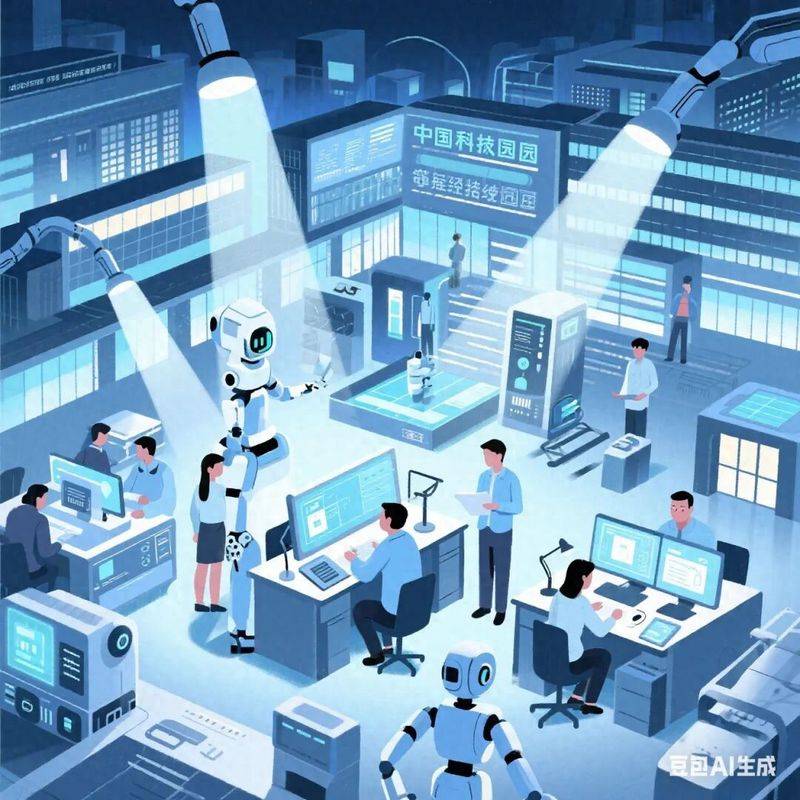
Today's artificial intelligence, robotics, also require the condensation of a large number of people's intellectual or manual labour. Without this massive human labour, artificial intelligence or robots are not only ignorant but also helpless. Artificial intelligence and robotics, which produce the labour that binds them, play a significant role in the subsequent production processes. On the face of it, the production of the back process does not need to be handled by people, but without the labour and creativity of the first people, the back process will not be able to do anything with artificial intelligence and robots. It is particularly important to know that artificial intelligence and robotics need to be trained in human diversity before entering production. Such training is human labour. Human training in artificial intelligence and robotics is also the process by which human labour condenses into artificial intelligence and robotics. In addition to training, there are also tests, which also involve the participation of people in labour. In a sense, the value of products produced at a later stage is pre-defined or directed by the labour force condensed in human intelligence and robotics. The production of subsequent products is only the result of compliance with these provisions and directives. At the same time, the ability of artificial intelligence and robotics to produce products was created after human training. Humans have trained artificial intelligence and robots, and artificial intelligence and robots are trained to produce products. The creation of this value is, of course, due to the condensation of human labour。
In addition, artificial intelligence and robots are not absolutely reliable and must require human maintenance and maintenance and, in particular, repair. Such human labour is absolutely indispensable. At least human labour is a necessary guarantee of this automated production。
There is always a distinction between the necessary working hours and the remaining working hours of human production. The value created by the necessary working time is the transferred value needed by human beings to regenerate and regenerate their own lives. What is created during the remaining working hours is the added value needed for social growth and development。
The scope of human activity today is mainly on land. On the ground, too, there are still many regions that have not been reached. Humans need to develop and build if there are mountains that people cannot climb, large deserts and gobi. Any work in these vast areas, any work that is not carried out without the direct participation of human intelligence and physical abilities, is simply impossible. Some technologies, equipment or equipment could not be designed or manufactured without practical operation in these areas. In addition to land and oceans, technical equipment or equipment suitable for those oceans is also required. It also requires considerable and hard labour. All of these technologies, equipment, and the products that are produced using them, are the least capable of creating human labour, the value of which always exists and never disappears。
In the future, humanity will also enter the various bodies of the solar system, and in the future it will be possible to leave the solar system. There is no end to human progress. All tools created by human labour are equally unending. Is there a limit to human labour in the face of so many circumstances? The value of labour cannot be denied, nor can it disappear. In that year, chairman mao said that manual labour could not be eliminated for 10,000 years. Value-producing work combines physical and intellectual work. Neither stone tools, copper tools, iron tools, steam engines, internal combustion engines, electric motors, nor the automated production systems that today are controlled by artificial intelligence control systems, can replace human labour。