


Collaboration between product managers and technical teams is often challenging during the landing of ai products. From the precise alignment of demand communication to consensus building in programme evaluation, to the dynamic control of synchronization of progress, each link has a hidden trap. This paper will deepen the three core scenarios of ai-product collaboration and reveal how `common goals' can be used to bridge the gap between business and technology perspectives and to achieve win-win efficiency and effectiveness。

In a previous article, we broke down the technical boundaries and landing limits of large models and multi-mode models, and identified the need for “awesome techniques, appropriate boundaries” for the design of ai products. Whether the technical boundary is controlled, model effects optimized or products land from 0 to 1, the core is bound by the ai product manager and algorithm, the efficient collaboration of the engineering team — the technical chain of the ai product is long, the uncertainty is high, and any communication deviation, review slippages, and the lack of progress may lead to project extensions, less than expected, or even premature。
Unlike traditional product collaboration, ai product collaboration needs to take into account the four dimensions of “business value, technical feasibility, model effects, data conditions”, which are more demanding for communication precision, evaluation depth and progress control. Today's article, we focus on the three core scenes of ai-product collaboration, breaking down the core pain points, collaborative skills and pit avoidance points of each scene, helping you to break down barriers to collaboration with the technical team and achieve “business and technology win-wins with frequency, efficiency and effectiveness”。
I. Break-up: core pain points and bottom logic of ai product collaboration
The contradiction between the collaboration of the ai product team is essentially “the difference between business and technology perspectives” - the product manager is concerned with “user values, business objectives, online cycles” and the technical team is concerned with “technical feasibility, model stability, computing costs, engineering complexity”. First, the core pain points can be identified in order to address the problem:
Core collaboration logic: aligning “common goals” with both perspectives, eliminating information insecurity with “precision”, and addressing uncertainty with “flexible mechanisms” — all collaborative actions are centred around “aai products that meet business needs within manageable costs, cycles,” rather than unilaterally shifting to business or technology。
Scenario i: demand communication - from “mixed description” to “precision alignment”
The focus of demand communication for ai products is “to translate business needs into technology-friendly targets” and to avoid “head-to-head demand” “defining effects in adjectives”. The communication logic of “defining borders, quantifying targets and adding details” needs to be followed as follows:
Prior to communication: 3 preparations to reduce communication costs 2. In communication: alignment with “precision language” and two-way confirmation
Avoid communication in purely operational or technical languages, learn to “bilingualize” and establish a two-way validation mechanism:
After communication: formation of “written records”, synchronization of interested parties
The demand for ai products is frequent and requires written documentation to ensure consistency of information among all relevant parties. The records include requirements targets, quantitative indicators, technical feasibility conclusions, alternatives, time nodes, synchronization to algorithms, engineering, testing, etc., and, if necessary, organization of simultaneous needs meetings。
Scenario ii: programme review - from “drill games” to “consensus building”
At the heart of the ai product programme review is the “balance between business value and technology cost” to avoid falling into the “business push effect, technology control costs”. There is a need to clarify the focus of the evaluation and to establish an evaluation process that would make the evaluation a “co-program” rather than a “confrontation”。
1. Pre-review: clear focus for evaluation, early distribution of materials
Avoiding unpurposed discussions during the reviews and clarifying the core focus in advance, while allowing technical teams to prepare programmes and materials in advance:
In the review: focus on “core contradictions”, speaking in data
The evaluation process should lead to a focus on core contradictions and avoid entanglements in detail, supported by data and business values:
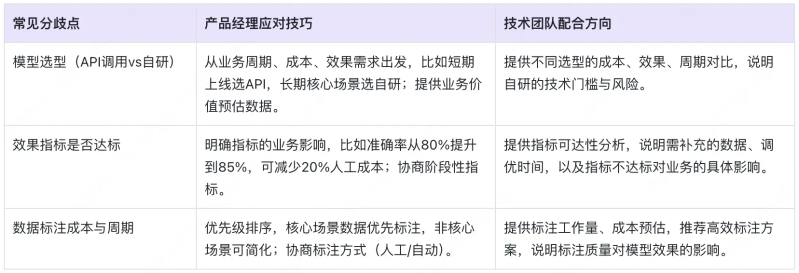
The findings of the evaluation need to be clear: final programme, responsible person, time node, risk response, and avoid “decided”。
3. Post-review: synchronize programme adjustments and update product planning
Based on the results of the review, the product programme was aligned with the road map for all parties concerned; for issues on which no consensus had been reached, the follow-up discussion time and responsible persons were identified to avoid affecting project progress. At the same time, records of evaluation findings and programme adjustments are archived as the basis for subsequent overlaps。
Scenario iii: synchronization of progress from “passive follow-up” to “active control”
The progress of ai products is influenced by uncertainties such as data labelling, model training and optimization, and the traditional “fixed-time node” approach to progress management is not appropriate, and a “milestone + elastic buffer + dynamic adjustment” progress synchronization mechanism needs to be established。
Establishment of “ai product exclusive milestones” to dismantle key nodes
In conjunction with the ai technology link, break down the core milestones, each of which sets clear delivery and acceptance standards to avoid `wild progress':

2. Fixed synchronized rhythm, timely exposure of problems
Create a stratification synchronous mechanism to balance efficiency and detail and identify and resolve progress card points in a timely manner:
3. Active risk management, with flexible buffers
There is a high degree of uncertainty about the progress of ai products, and product managers need to proactively anticipate risks and respond in advance:
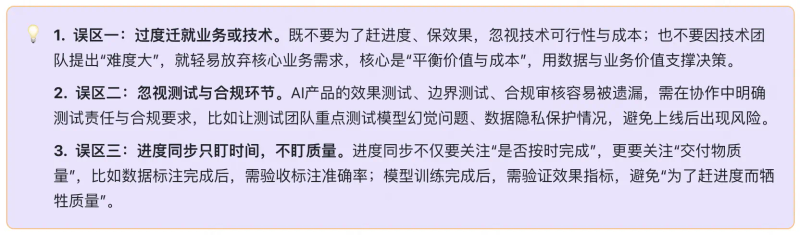
V. Ai collaborative hole avoidance guide: these 3 error zones must be avoided
Summary: the core of collaboration is “co-benefits”
The ai product manager's collaboration with the technical team is not “one-way demand transfer”, but “co-building based on common goals”. Product managers need to understand technological boundaries, communicate demand in precise languages and support decision-making with data; technical teams need to understand business values and offer alternatives and exposures。
Remember that good ai products have never been created unilaterally by product managers or technical teams, but that the parties find the best solutions between “business values, technical feasibility, cost controls” and that, through efficient communication, consensus-building and dynamic adjustments, they eventually lead to product landing and value creation。
In the next article, we will focus on the technical feasibility assessment, how to break down the fast-track determination of a demand “can” or “can” to help you avoid technological risks at an early stage of the demand and increase the success rate of the project。
Thank you for reading the last part. If you like, if you like, if you like, if you like, a little red bag



