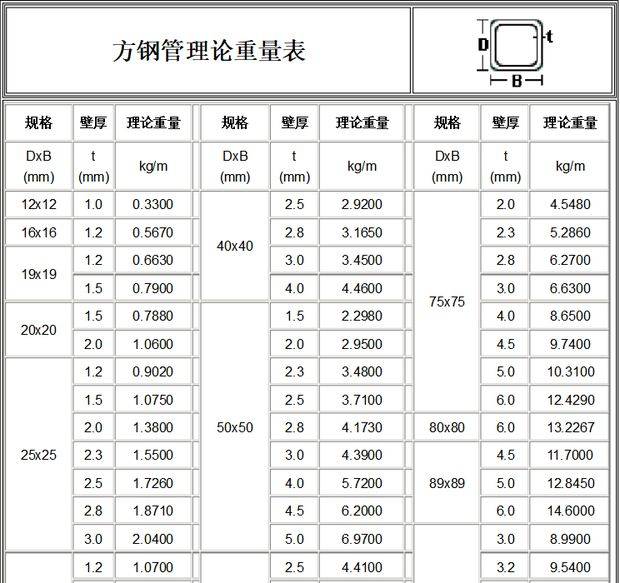
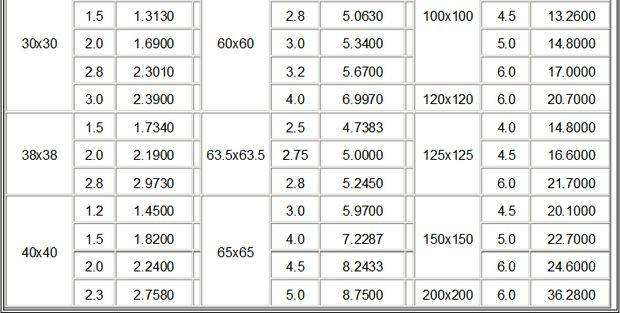
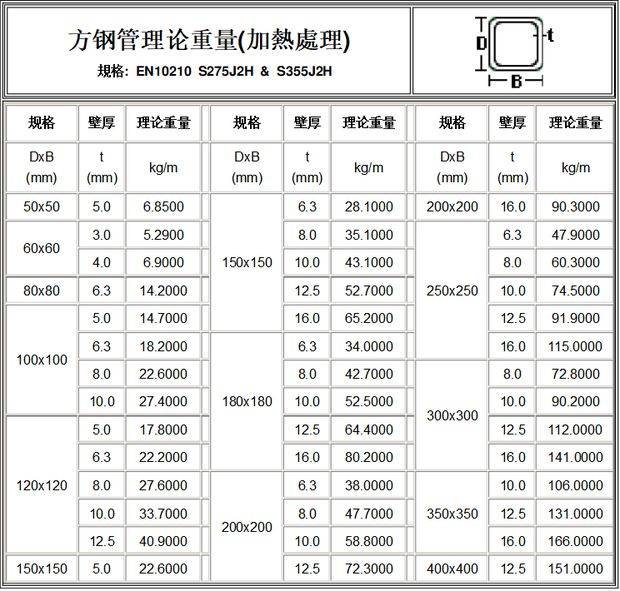
Rectangular steel management weight calculation table:
Square and rectangular (retail) cross-sectioned carbon steel steel tubes: per metre weight: kg/m (kg/m) & lb/ft (pound/foot)
The formula (long + wide) for the calculation of a rectangular tube for convenience is: (long + wide) x 2 ÷3. 14 - thickness x thickness x 0. 02466 = kg/m
Formula ii: kg/m = (oc - 4wt) *wt * 0. 00785
Of which: oc is the outer length of the pipe and wt is the wall thickness of the pipe; square oc=4*a; rectangular oc=2a+2ba, b is the long side
Common interpretation: 4x wall thick x (long-wall thick) x 7. 85
Of these, the length of the tube and the thickness of the wall are in millimetres, and the value is directly given to the above formula, resulting in the weight of the tube per metre in grams。
If 30x30x2. 5mm square tubes, the same formula is used to calculate the weight per metre as follows:
4x2. 5x (30-2. 5)x7. 85=275x7. 85=2158. 75 g, or approximately 2. 16 kg
When both the wall thickness and the length of the edge are millimetres, the 4x wall thickness x (side long-wall thickness) calculates the size of the tube per metre length in centimetres, multiplied by the weight of 7. 85 g/m3 of iron, which is the weight in grams per metre。
Data on construction materials density, volume, weight, etc
1. Concrete weight 2500 kg/m3
2. Steel bands 0. 00617 xd
3. Dry sand weight 1500 kg/m3 and wet sand weight 1700 kg/m3
4. Stone weight 2,200 kg/m3
Around 525 red bricks per cubic metre (wall thick)
Six, a cubic metre of hollow bricks, around 175
7. Clean sand on one side requires 1. 3 ordinary sands
- - - - - - - - - - - -
1 cement: the weight of ordinary cement is 3:1 and the weight is usually 1300 kg/m3。
Construction waste: 1. 5 ~ 1. 8 t/m3
- - - - - - - - - - - -
Natural granite: 2500-2800 kg/m3
C35 concrete: 2400-2500 kg/m3; 24kn/m3
3 cement slurry: 1800-2000kg/m3; 20kn/m3
4. General paste: 1000 kg/m3
5. General sand mats: 1400-1700 kg/m3
6, clay bricks, grey bricks 1600-1800 kg/m3
7, clay hollow bricks: 1000-1400 kg/m3
8. New light bricks: 150-250 kg/m3
9 normal clay: 1500-1800 kg/m3 (water content)
10, corrosive soil such as peat: 200-300 kg/m3 (mixed ratio)
11, ceramic or pearl rock: 20-30 kg/m3
How much is a ton
Density of oil: 0. 81 * 1000 kg/m3, which is smaller than the water density, so it can float on water. Theoretically, 1 cubic metre of water equals 1 ton because m=old*v (i. E. Mass equals density multiplied by volume) and the volume of 1 ton of oil = 1000 cubic metre/0. 81*100 kg/m3 = 1. 235 kg = 1235 litres, so 1 ton of oil = 1235 litres
How many cubics is a ton of asphalt concrete?
(b) the tarcrete density of the load instruction is 2. 4t/m3; the quota is 2. 36
How many tons of rock a cube
The smaller the granules, the greater the mass; the average pile density is about 1. 8 tons/m3.
The amount of soil on one side equals 1 cubic metre on the other. The amount of tonnage depends on what the soil is, 2 tons of sand, 2. 5 tons of clay and about 3 tons of concrete。
* wall thickness * 7. 85/1000
Original