3. 2 perspectives
In indoor performance maps, visualization is used to determine the depth of space on the image, i. E. The space position of the object and its parts in the picture, as an essential factor in expressing the stereotic perception of the object and creating space effects. Therefore, the lens approach is an important basis for the actualization, and mastering the basic principles of the lens is the basis for accurate observation and a true depiction of space relations。
3. 2. 1 definition of perspective
What we see in nature is a near-narrow spatial phenomenon, a perceptive phenomenon. Using the principles and methods of science to accurately present the perceiving phenomenon in the image, location, space and scenery, that is to say, perspective. The insights used in indoor performance maps differ from those used in painting to require a more faithful reflection of space relations and a scientifically sound basis for the construction of indoor engineering。
3. 2. 2 ideas for indoor design applications
The theory of vision is to study the three-dimensional stereotyping principle on a 2-dimensional plane: it's to study how to project what we see on a hypothetical transparent plane between the eyes and the object, which is called a linear or geometric perspective. The lens view is a mapping technique that transforms the shape of a three-dimensional space into a two-dimensional space image with a stereotic sense, allowing designers to actually recreate their designs. It is commonly seen as having parallel visions (one per cent), an angle view (two per cent) and three per cent visions。
1. Parallel vision
In the case of cubes, for example, the cube has three main axes in three directions, where the main axis in both directions is parallel to the picture or horizon, and the main axis in the third direction has a point of disappearance, known as a parallel lens, or a point of view. As shown in figures 3-8a, a point of view of a cube is sought for the geometry of the painting method. As shown in figures 3-8b, a parallel view of the interior was drawn using a little perspective。
2. Angle vision
When the main axis of one direction of a cube parallels the picture or horizon of vision, the main axis of the other two leads to two disappearing points, also known as an angle perspective and a two-point perspective. As shown in figures 3-9a, a two-point perspective of a cube is sought for the geometry of the drawing method. As can be seen in figures 3-9b, an angle view of a stand-alone dwelling drawing from a two-point perspective。
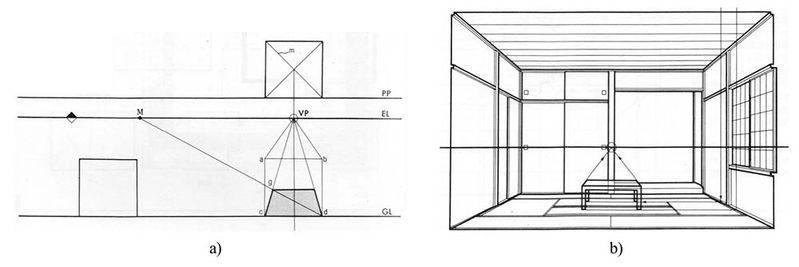
Figure 3-8 parallel perspectives
(a) parallel visions b) parallel lenses in the interior
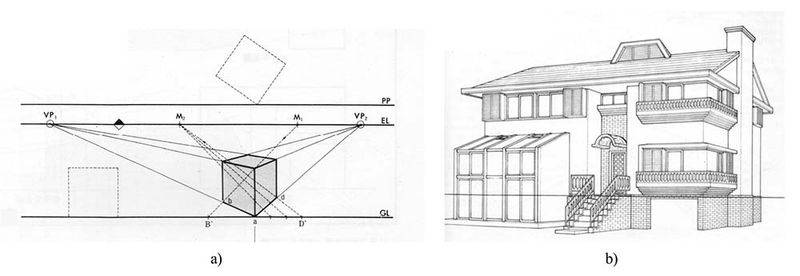
Figure 3-9: angular perspective
(a) angular viewing principles b) angular view of dwellings
Three points of perspective
The main axis of the three directions of the cube is not parallel to the picture or the horizon and forms three disappearing points on the picture, which is called a three-point lens. As shown in figures 3-10a, a three-point perspective of a cube is sought for the geometry of the painting method. As shown in figures 3-10b, a three-point view of the outer surface of a high-rise building drawing from a three-point perspective。
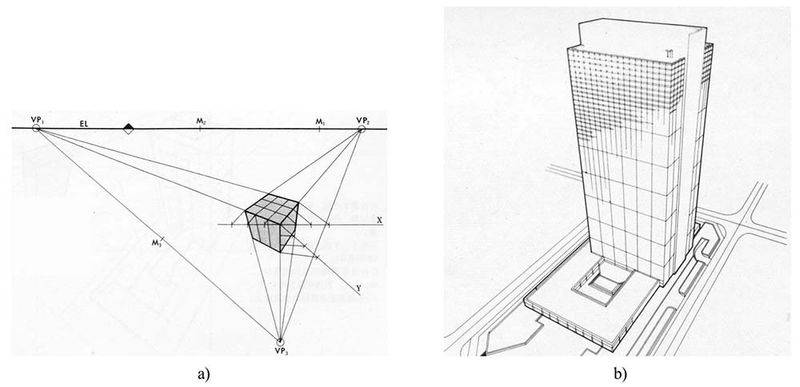
Figure 3-10: three points of perspective
(a) three points of perspective, b) 3 points of view of the upper buildings