Perspective principles
Basic terminology for perspective
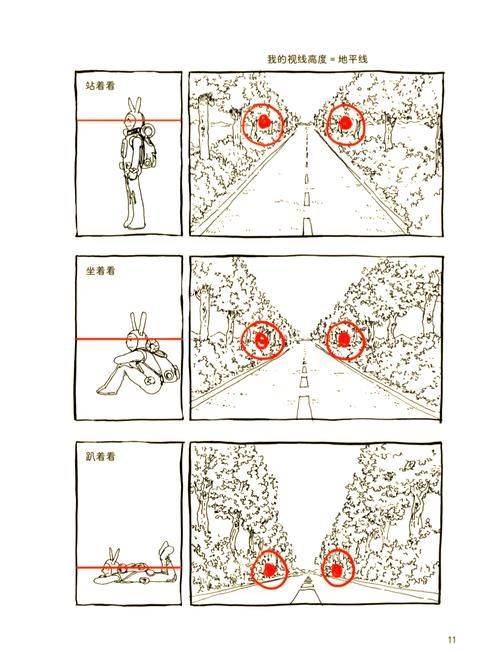
One, horizon: the horizontal line parallel to the painter's eye。
Two, heart: is the point where the painter's eyes are on the horizon。
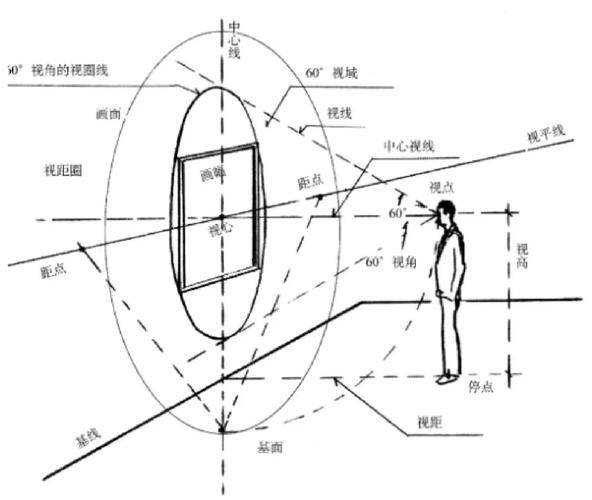
Three, point of view: the location of the painter's eye。
4 mid-vision: is the line where the point of view is linked to the point of the heart and the line of the horizon is a straight angle。
5 disappearing point: is an angled object that is not parallel to the picture, stretching in perspective to the point of disappearance on both sides of the horizon。
6 day: is the point where the near-high, far-low tilt objects (in front of the roof of the house) disappear above the horizon。
7 location: is the near- and very-low tilted rest (back of the house covers), which disappears below the horizon。
8 a parallel vision: a vision of a square or rectangular object that parallels the picture. This vision has a sense of integrity, peace, stability and dignity。
Nine, angular perspective: an object that does not form a rectangular perspective with a parallel square. This perspective can change the picture。
A visual drawing
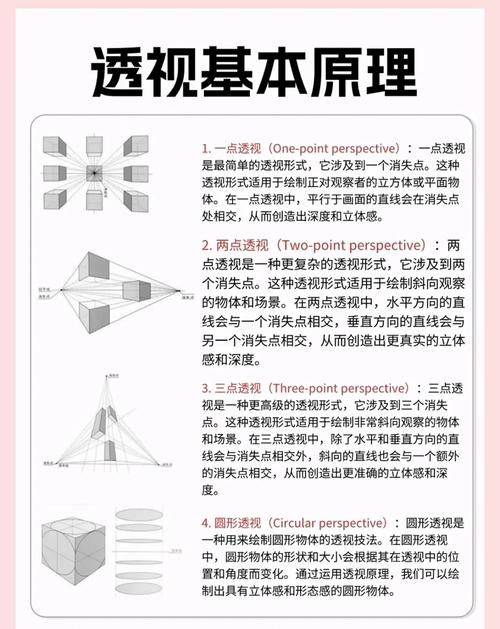
The most basic form in the sketch is a cube. Most of the sketches are based on observations of three sides to determine the performance of the cube. In addition, the depth of the object can be implied by using the angle created by the dividing line between the surface and the face, which involves a perceptive pattern。
One point of perspective (also known as parallel vision), two points of view (also known as an angle perspective) and three points of view。
A point of view is that the cube is placed on a horizontal side, and the four sides of the front side are parallel to the four sides of the drawing paper, and the parallel line at the top, in the depth of the top, corresponds to the height of the eye, disappears to a point, while the front is square.
Two points in perspective are the drawing of a cube into the picture, and when the four sides of the cube are tilted in a certain angle against the picture, two disappearing points are created by a straight line at a deep parallel. In this case, parallel lines vertically to the two horizontal surfaces have also resulted in a reduction in length, but with no point of disappearance.