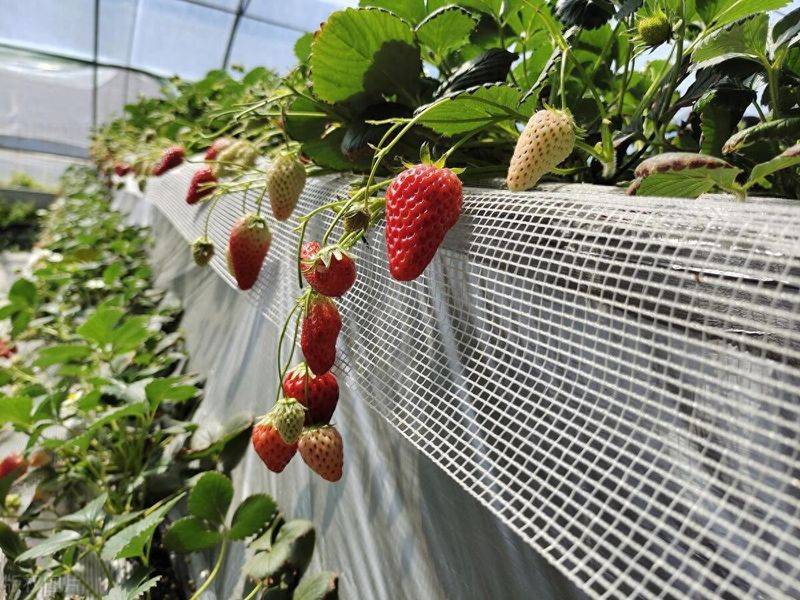
Traditional strawberry cultivation is mostly high (20 cm) cultivation, with relatively poor soil drainage and water accumulation, which is detrimental to root growth and disease prevention. The root of strawberries is placed in a relatively dry environment by raising ultra-high (80 cm), which effectively improves drainage conditions and reduces root disease due to excessive moisture, while at the same time contributing to deep rooting and increasing resistance of plants. At the same time, the greenhouse-street ultra-high-strength strawberries can also be produced for the anniversary year and meet the market's annual demand for strawberries. The following is a summary of the technology for the super-high strawberry cultivation in greenhouses, in conjunction with farming practices in the city of duncho, hebei province。
I. Strengthening methodology
The size and width of the planting cells are determined by the width of the greenhouse shed. For example, the 6-metre cleavage can be made of 5 planting tanks and 8-metre troupe can be made of 7 planting tanks. Cults are generally set at 34 to 36 centimetres in width, 80 to 90 centimetres in length, 80 centimetres in width and 114 to 116 centimetres in length at the centre of two planting cells。
Samples were carried out at both ends of the shed to determine the location and direction of the planting tanks. Thermal zinc plating steel tubes with a diameter of 2. 5 cm are used as pillars. Installation of poles at horizontal intervals of 34 to 36 centimetres at both ends and in the middle of the planting tanks. Fifty centimetres are left above the ground and the rest is penetrated vertically into the ground. 1 m interval is reinforced by a screwdriver of the same size or by an old thermal zinc plating pipe. *stand to the inner side of the pillar evenly pulls 4 floors 14# or 16# thermally plating wire. The top barbed wire is 5 cm from the mouth of the trough, the bottom barbed wire is 5 cm from the bottom of the trough, and the remaining two wires are evenly distributed。
Refilling soil and matrix in installed planting tanks. The 50-centimetre limitr fills 30-centimetre-high soil with 20-centimetre-high matrix. The heap is significantly higher than the shelf, forming a condensed shape similar to “bread” to prevent the sedimentation of the root under the soil below the heap and to avoid the loss of production as a result of the break-up。
Ii. Key elements of cultivation management
(i) choice of varieties
The selection of short hibernation periods, early maturity, relatively low-temperature, well-developed roots, and disease-resistant strawberry varieties, such as the "books" and "springs" and "springs" and "charlie's" and "sweet" are shown to be more adaptable, productive and quality in super-high cultivation。
(ii) sapling specifications
It is proposed to select a plant with more than four stretching leaves, a full-bulleted centre, thick roots, thick green leaves, a single mass of about 30 grams, and developed roots. Such trees grow and bloom faster in super-high plants。
(iii) plantation
The greenhouse strawberries are usually planted in september, depending on the weather conditions in the city. Ultra-high plant cultivation, due to the high height of the gills, can increase the established density appropriately by measuring 7000 to 8300 strawberries per acre (667 m2). Each planting cell is set at two lines, 20 centimetres from 20 centimetres from 20 centimetres from 10 centimetres from the edge of the plant, and two rows of strawberries are ranked in a triangle. Strawberry requirements for planting depth are stringent and should be “deep and shallow”. When planted, the strawberries bow will be directed towards the gutter in order to light up the fruit and improve its quality。
(iv) post-plant management
1. Water management. In super-high roofs or sides, drip belts are laid according to the planting density and spacing of strawberries. The drop-tip spacing of the drip zone is usually selected at 20 cm, corresponding to the distance of the strawberry strain. The drip belt will be connected to the main channel to ensure that the connection is sealed and that leaks are avoided. The entire drip irrigation system consists of dry pipes, bronchies and hair pipes. The five to seven-day dripping of strawberries, 20 to 30 cubic metres per acre, and midday weather, which covers the cooling of the sun-covered net, contribute to survival and reduce the slow-growing period. The water is properly controlled before the drop. 6-10 cubic metres per acre in the medium-growth period; 8-10 cubic metres per acre during the maturation of strawberry fruit to avoid excessive wetting leading to disease and bad fruit problems。
Fertilizer management. Strawberry seedlings are established and 10 kg of three-dollar composite water solution (10-5-10) is applied per acre, with one application at 10 days ' intervals and two follow-up times to promote strawberry plant growth. After the first flowering, the three-dollar complex water soluble fertilizer (10-10-10) 3-5 kg per acre and the three-dollar complex water soluble fertilizer (10-10-20) 4-8 kg per acre at the time of strawberry berries and hair white. It should be applied in small quantities because of the rapid loss of super-heaviness。
3. Temperature management. Strawberries have an appropriate growth temperature of 25-30°c. In the early stages of strawberry growth and during flowering periods, high temperatures should be maintained to promote strawberry growth and flowering. At this point, the temperature should be kept at 25-30°c and at 12-15°c at night. During the growth of strawberry fruit, the temperature should be reduced appropriately to promote the growth and maturity of the fruit. At this point, the temperature should be kept at 20-25°c and above 5°c at night. When the temperature reaches 30°c, ventilation measures, such as opening the vents on both sides of the shed and increasing the ventilation to reduce the temperature in the shed, should be taken. When temperatures are reduced to 5°c, measures should be taken to protect against the freezing of strawberries. The usual temperature protection measures include double cover, grass cover, etc。
4. Plantation adjustment. In strawberry and fruit seasons, tectonic berries are reasonably performed in accordance with the growth and production requirements of the plant. Weak and loosely sequenced bouquets should be removed from flowering. When strawberry fruit begins to develop, it is reasonable to perform a eutrophication based on the nutrient supply capacity of the plant and the quality of the fruit. Deformation, pests and pests, and too small or too large fruit shall be removed from the fruit. In two weeks, leaves, sick leaves and dead branches will be removed in a timely manner, 5 leaves will be kept open and a ventilated light will be maintained to reduce the incidence of pests and diseases。
Iii. Pest management
Strawberry ultra-high cultivation is mainly directed against pollinosis and red spiders. To reduce the incidence of diseases and pests by strengthening cultivation management and improving the resilience of strawberry plants. At the same time, sanitation in the sheds is being carried out, weeds and leaves are being removed in a timely manner and the breeding environment for pests and diseases is being reduced. Powder disease control has the option of using more than 3% anticinogen water, 600 times more or 2% more, 200 times more, once every 7 days, 2-3 times more. The red spiders can use biological control, releasing 150,000-200,000 dictums per acre, and if the field is more harmful, they can be released one more time, depending on the situation。
Collection
Strawberry harvest started in december and continued around may of the following year. The fruits can be picked mostly when they are red. Strawberries collected are graded according to size, colour, etc., and then packaged。