


The female health track is being viewed by a large number of medical practitioners。
According to the acumen research & consulting analysis, the overall market size of women's health reached $25. 3 billion in 2021 and is expected to expand to $97. 3 billion in 2030, with a combined annual growth rate of over 16 per cent between 2022 and 2030, with a clear trend of growth。
Behind the rapid expansion of industry is 688 million market demands and the emergence of diversified product services. The large population base means that there is sufficient market space for the vast majority of female health segmented tracks. The discovery of hidden needs and the provision of product service systems that meet life-cycle management have increasingly become a source of continuous innovation in health-care enterprises。
Thus, the guangxi red medicine industry group (hereinafter referred to as “the flower medicine industry”) and the chinese society for the promotion of medical research and research in china's gynaecology division and the chinese women's journal published the blue book of 2024 women's gynaecology in china (hereinafter referred to as “the blue book”). In view of the understanding and strangulation of women's health over the past 50 years in the flower red medicine industry, the blue book seeks to provide a broad sample of research into the current common needs and clinical pains in the area of gynaecological inflammation and women's health, to establish an accurate concept of women's health in china and to explore trends in women's health industries。
Insight on “neglected gynaecology needs”, providing guidance on gynaecological inflammation throughout the female life cycle
Gynaecology has long been a major disease affecting women's health and has a wide potential market. Data from the world health organization (who) show that 40 per cent of chinese women suffer from gynaecological diseases such as reproductive tract infections to varying degrees, and that the prevalence rate among married women is as high as 70 per cent. Thus, it is estimated that there are about 300 million females in china. Also, the china health and health statistics yearbook 2020 shows that we have over 400 million visits per year to obstetrics and obstetrics。
There are deep-seated problems behind the large sick population. Primary gynaecology has long been confronted with inadequate patient visits, delays in accessing and low re-diagnosis. It is essentially the result of insufficient public awareness of the dangers of gynaecological diseases, high levels of stigma, misunderstanding of privacy protection and a lack of overall health awareness。
In order better to trace the problem, the blue book relies on china’s dynamically developing internet-based medical and health applications, which capture the public behavioral trajectory and interactive content of women’s diseased populations on large-flow platforms, and obtain millions of data covering medical consultations, online searches, health studies, and interactive discussions among patients. The collection and cleaning of these public and anonymous data, using technical means such as the processing of natural languages, provides a comprehensive analysis of the perceptions, needs and pains of women with illnesses in terms of images of the population, behaviour awareness and therapeutic drugs, as well as recommendations on the key points of medical treatment, taking into account the general contents of professional doctors。
On the one hand, with the rapid development of the medical ecology of the internet, the problem of gynaecology, which runs throughout the female life cycle and is often neglected, is being exploited. More patients ' perspectives, feedback in their language are seen through data media
On the other hand, thanks to the health-care environment of the internet, we can look at the “hidden corners” of women's gynaecology diseases, combining the voices of patients with expert opinions and the science of science, to create a well-documented and modern chinese open knowledge map of gynaecological inflammation。
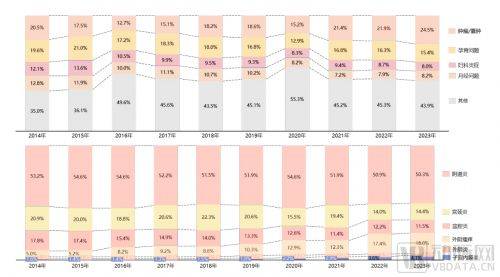
(summary of the evolution of gynaecological disease among women in previous years)
According to the blue book, gynaecosis includes vulva, vaginal, cervical, pelvic, etc. (the pelvic disease consists mainly of intrauterine, tubal, ovarian ovary swollen, pelvic peritoneitis, etc.), which may be caused by bacteria, fungi, viruses or parasites。
At the same time, the blue book provides a detailed description of the patient's picture, and according to clinical feedback, there is a strong demand for women's diseases. However, owing to the complexity of the disease, its risk of error and delay, its taboos and the irregularity of products and services, gynaecology has been a major area affecting the physical and mental health of women. The demand for diseases such as larvae and endometrifitis continues to increase。
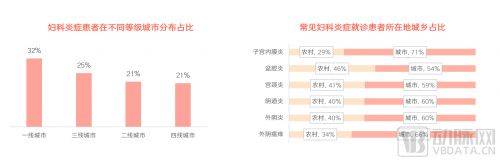
(gynaecology prevalence and rural/urban ratio)
In terms of geographical distribution of diseases, first-line cities account for more than 30 per cent of the needs of patients, and second-, third- and fourth-line cities for more than 20 per cent. As a result, the number of patients in the first-line cities is significantly higher and the demand is higher in the second-line cities, although the ratio of demand is slightly lower than in the third-line cities, and because the population base is larger, the number of patients and demand is higher in the second-line cities than in the third-line cities. Studies have also shown that women in urban areas not only have lower incidence rates than in rural areas, but also have far higher rates of attendance, and that the current status of feedback on this data is linked to the economic situation of the region, the level of health care, the conditions of transport and the awareness of the disease。
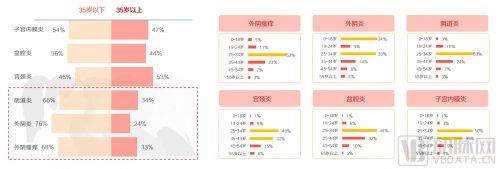
(age and type distribution of gynaecology patients)
According to the above-mentioned developments in women's diseases, vaginal infections are most prevalent among the common gynaecology diseases, followed by cervical, pelvic, etc. In this study, the blue book is based on 35-year-olds and analyses the relationship between female diseases and age groups. Among them, upper reproductive tract infections are predominantly chronic diseases, longer periods of illness and older patients ' average age; lower mean ages for lower reproductive tract infections, concentrated in the 25-34 age group, are also closely related to reproductive behaviour。
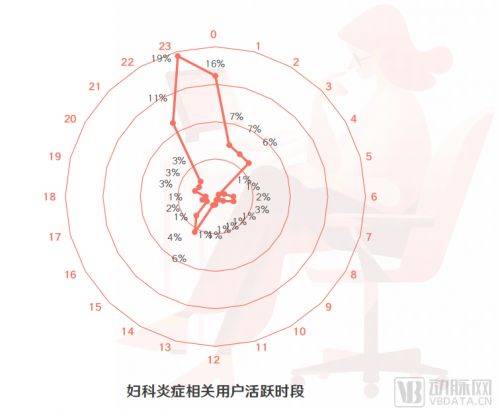
(gynaecology related user session active time)
Since the symptoms of gynaecological inflammation are more pronounced at night, research has found that related studies and discussions in social media often take place late in the night. In the traditional perception of high levels of gynaecological disease, patients have become accustomed to sharing their cases and experiences with treatment in social media, as can be seen from the easier and more private access to information available on the internet。
However, the gap between patients ' access to information via the internet and their knowledge of authority and professional opinions remains significant, which may lead to particular problems such as delays in access to health care, lack of guidance for self-diagnosis and free medication, and excessive cleaning. The underlying reason is that there is not yet a good system of synergy between patient needs and specialized channels such as consultation platforms, pharmacies and pharmacies. Thus, in-depth and sustained health education, awareness of safe medicine and guidance on appropriate medications are key to helping women to properly understand their gynaecological health problems。
In the blue book, the florist industry devotes 80 per cent of its content to the depth of gynaecology - the answer to the patient's greatest concern and clinical needs. From high frequency clinical performances to symptoms - itches, symptoms - pains; to clinical symptoms: can itchs like the external acne? What about scratching the skin? How can the type of vaginal inflammation be judged? In turn, there is systematic knowledge-sharing: it includes characteristics of common gynaecology and recommendations for specialist treatment。
Based on a first-line data combing and demand analysis of patients, the flower medicine industry, through the blue book, has uncovered a large number of unresolved questions about diseases. After understanding the deficiencies in the management of women's health, four major trends have emerged in the construction of precision, science and companion product services。
Trend insight to effectively construct product service systems in the area of women's health
Trends i: the immediate demand for product services and professional responses to queries should be fully met
The study found that the target groups for products related to gynaecological inflammation were becoming younger. Young women's access to information and product links have strong internet properties - - the topic of gynaecology is discussed through social media, which directly shapes the natural flow of the products in touch and jump. At the same time, the expectations of young women for gynaecology products and services are rising, and it is hoped that the demand for products, diagnostic services, health counselling, etc. Will respond quickly and yield efficient feedback。
In the internet environment, the means of informatization have become the dominant mode of connecting products and services for young women, in o2o (o)The product service model represented by nline to offline will no doubt lead to an upsurge in growth, while pharmacies and related practitioners, channel operators are actively embracing informationalization and the immediate needs of patients will be fully met when pharmacies have a professional and comprehensive response capability。
Trends ii: drug-based care programmes will tend to be disaggregated and refined as the demand for treatment of diseases evolves
The demand for treatment continues to evolve over time, along with increased access to disease science, increased frequency of interaction between patients and patients and increased diversity of topics. The gynaecology patients are no longer satisfied with individual diagnostics, general treatment programmes, and generic washing products. For enterprises, there is a need not only to provide products that are tailored to different sectors, but also to be complemented by a professional medically oriented and customized drug-based care programme to meet patients ' needs for precision treatment。
In an interview with the artery network, the vice-president of the florist industry mentioned that “the field of female health extends from physical to mental health to social identity and social identity. We look forward not only to the development of a long-term regulatory and systematic health-care system for products and services, but also to the development of a multi-dimensional and deep eastern concept of women's health”。
It is understood that the florist industry has developed a multi-dimensional health management system around caring for women's health, combining chinese medicine with modern science. In response to the different treatment needs for gynaecology, the florist industry has set up a whole product line, including exterior washing fluids, cervical embolisms and oral preparations. Products are treated in a moderate and systematic manner to eliminate inflammation, and studies such as control of reproductive toxicity are strictly applied to avoid damage to the reproductive system and body. With regard to the construction of product channels, the florist industry has set up a whole chain of product-attraction strategies, with a line-down traditional pharmacy, a b2c pharmaceutical electrician and an o2o pharmaceutical platform to meet patients ' demand for immediate and professional pharmaceutical services。
Trend iii: the shift from “treatment to cure” is clear, requiring full-cycle product solutions
Health management had risen to a national strategy, and women were undoubtedly more concerned with their own health. As the understanding of “greater health” becomes stronger, it is believed that a number of women also conduct self-censorship tests without significant symptoms. From watching to consulting online to actively seeking solutions, women patients are showing a tendency to take initiatives. This reflects the fact that women's health needs are extending from mere diagnosis to prevention, from “treatment” to “treatment without disease”, and from monotherapy thinking to comprehensive health management and lifestyle improvement. In response to this change, enterprises need not only to provide therapeutic products, but also to set up conservation and preventive products, offering full-cycle female health product solutions。
Trends iv: users take ownership of sovereignty and are eager to gain direct access to authoritative, effective and relevant health information
There is no denying that the internet’s ecology has reshaped access to health science and health management resources and that users have access to online platforms for information retrieval and product screening. While the seller's market is tilted towards the buyer's market, groups that lack sufficient awareness are eager to have direct access to authoritative, effective and relevant health information and assist with product screening. And the screening mechanism for individual products is at the purchasing stage. – users are more concerned with product composition, preferring the key characteristics of pure nature, non-addition and clarity of mechanisms。
In response to women's doubts about health awareness, product screening and so forth, the flower industry customised and developed the "home for women" program, which was officially launched on 10 june 2024, which will help women to better understand their health status and to conduct more rapid self-screening and product selection for gynaecological diseases. “we want to disseminate authoritative information in a flat form through a small process, to act as a translator between clinical, product and patient, and to help patients gain direct professional knowledge.” li emphasized that “the minor question combines the medical logic of western and central medicine, covering information on multi-dimensional parameters such as lifestyle, emotions, physical state, etc., and using ai capabilities to integrate knowledge mapping of questions and answers to provide patients with easy-to-operate, systematic health advice”
Promotion of the construction of specialized pharmacy terminals to better serve contemporary women
Starting with the blue book, which combines the need for immediate feedback and precision treatment of patients, adaptation to “unsick” trends and individual product screening mechanisms, the florist industry is concerned about critical deficiencies in the offline retail channels represented by pharmacies - a wide range of grass-roots pharmacies vary in terms of training of personnel, learning of expertise and updating of health concepts, making it difficult to comprehensively address the needs and concerns of current consumer groups。
Li said that the current retail pharmacies not only provide medicines, but also assume the role of providers of health needs for potential patients and upgrade their social functions in the distribution of medical resources and the supply of products. For example, the combination of information technology and traditional education training has been used to improve the professional knowledge of practitioners in the field of gynaecological health and the quality of pharmaceutical services, to improve the understanding and identification of patients'state of health and to develop more accurate product advice on demand。
In response, the florist industry has proposed a joint project with pharmacies to improve the professionalism of front-line practitioners, to allow for the general spread of gynaecologists in pharmacies, to improve the depth of the sub-line terminal and to optimize the consumption experience。
The florist industry has a long-standing commitment to promoting awareness of women's health, working with women's federations and grass-roots health centres to promote two cancer screenings, gender literacy, girls ' education, domestic violence education, female employment assistance, etc. Thanks to the publication of the blue book, and thanks to a keen understanding of the value of the internet and a deep insight into the market, the florist industry is giving new solutions to the problem: the introduction of a small program called "women's health of the hungred", the introduction of the little red book account number to reach 200 million women users, and the promotion of a co-construction programme for the underline pharmacies, which remains a contemporary strategy for better serving women. The real state of women's health that emerges from this will be a win-win path to market education and social responsibility。



