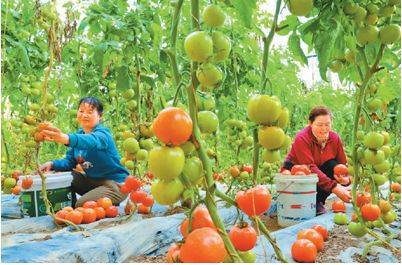
In recent years, the ganzhou district of zhang xuan, gansu province, has been making significant efforts to develop facilities agriculture and help revitalize villages. At present, the area under vegetable cultivation amounts to 415,000 acres. In the vegetable sheds in chen zai village, the ganzhou party, the growers are busy picking tomatoes。
The king
Cultivation is the first stage. Within the yang town seedling base of the yugura high-quality agricultural production company ltd. In beijing, fully automatic spray vehicles are watering the seedlings. There are eight greenhouses, with mobile seedlings isolated from the ground soil to avoid endemic diseases. In the first month of the year, the nursery base received a large number of orders from nearby farmers。
Central i of 2023 proposed “development of modern facilities agriculture” and for the first time included “creation of vegetable intensive nursery centres” “concentrations to promote the upgrading of old vegetable facilities”, as well as “scientific use of gobi, desert and other facilities to develop agriculture”。
What will happen to facilities agriculture? Interviews were conducted by the press。
The seedlings are in the open shed
What's modern facility agriculture like
“modern facilities agriculture, using new production equipment and modern technologies, regulates the climatic conditions, such as temperature, light, water, soil, gas, fat, etc., necessary for plant and animal growth in protected facilities such as greenhouses, plastic sheds, etc., improves the animal and plant growth and development environment, so that the plant and animal growth is not or rarely conditioned by natural conditions, and establishes a continuous production system for the anniversary of flora and fauna and achieves efficient and quality production.”
Compared to daejeon agriculture, it overcomes the uncertainty of traditional agriculture's “food by heaven” by mechanizing, automating and intellectualizing agricultural production through modern facilities and technologies, to a certain extent breaking the high dependence of traditional agriculture on arable land and water resources and becoming a key player in alleviating food and food disputes。
China is a truly large agricultural country with facilities. In terms of layout, china has evolved into five major facilities-precedented vegetable-producing areas in the huang huai sea and the riinghu sea, the yangtze river downstream and downstream, the north-west, north-east, and south-east china. Jiangsu, shandong, liaoning and hebei are four facilities in china. At present, about 40 million acres of the country's facilities are agricultural, accounting for more than 80 per cent of the world's facilities, of which more than 80 per cent grow vegetables. More than 30 vegetables, such as cucumbers, tomatoes and peppers, have been freed from “food by heaven” with the help of facilities agriculture. In recent years, new vegetables have become more accessible through the interaction of facilities with “north rope” bases such as guangxi and yunnan, as well as the development of multiple wholesale markets, e-commerce and cold chain logistics。
The development of facilities agriculture has not only been an effective solution to the national food problem, but has also made vegetables the most internationally competitive of all major types of agricultural products in china. At present, china is the world's largest vegetable producer, producing more than 50 per cent of the world's total, and its average annual vegetable production of 515 kg is 3. 4 times the world average. The annual trade surplus for vegetables was over $10 billion, and for many years it had been the largest agricultural exports of china。
At present, spring seedlings and seedlings are advancing in an orderly manner. In beijing, 13 intensive nursery productions in the hao yi district entered the peak of the year, providing over 30 million high-quality seedlings for spring farming. Over 3,000 square metres of nursery sheds in the quantuan vegetables specialized cooperative in nanjing city, jiangsu province, have been fully ploughed with green seedlings, and five intensive nursery centres have been built throughout the city to provide quality seedlings for the quality development of the vegetable industry. Facilities agriculture has become a key link in chinese vegetable cultivation。
Low production of traditional facilities
What are the considerations behind this year's central document's initiative to modernize and upgrade facilities agriculture
According to quellin, “the increasing level of urbanization in the country, the accelerated food consumption structure of the population and the increased demand for vegetable guacamole, while increasing constraints on water and soil resources place higher demands on facilities”. Although china has made significant progress in terms of extension areas, technological advances and so on, there are still large gaps compared to developed countries such as japan, the netherlands and the united states。
There is an urgent need to upgrade the facilities. At present, facilities agriculture in china is largely dominated by small and medium-sized plastic sheds, operating in small-scale farmers and with high labour costs. “as a whole, chinese facilities agriculture is under-inputted in terms of equipment, leading to a low level of modernization of the facilities and low capacity to regulate their production.”。
Cultivated soil is of low quality. After many years of cultivation, problems of soil quality are beginning to emerge in some greenhouses, such as the concentration of insoluble minerals in the soil and the reduction of microbial content, which can result in the deterioration of soil quality and thus affect the production and quality of plant agricultural crops。
Science, technology and innovation are not sufficiently supported. Compared to international advanced levels, chinese facilities agriculture has insufficient innovative capacity, low levels of monolithic production and low mechanization rates. China, for example, produces only one quarter of its cucumber acre in developed countries and one third of its tomatoes in developed countries. High-end vegetable varieties such as tomatoes and peppers are heavily dependent on imports for the development of varieties。
In addition, some of the old vegetable facilities in some areas are no longer productive or even empty, causing waste of land space; others are built at an early stage, with some safety risks; and some of the traditional vegetable facilities that are still being produced are difficult to mechanize, resulting in undercapacity. This requires the rehabilitation of old facilities。
Make the shed more intelligent and efficient
What will be the big move this year to “upgrad” facility agriculture
Facilities in traditional niche areas will become more “smart”. It is understood that old facilities will accelerate the upgrading of equipment and promote modern information technology. These include the upgrading of shed structures, the promotion of new composite thermowalls, the optimization of the roof structure, and the improvement of temperature and heat retention performance; the promotion of integrated auto-control equipment for water fertilizers, energy-saving operational equipment such as pharmacists, logistics transport machines, and the improvement of the mechanization, automation and intellectualization of the overall facility agriculture。
Modern facilities are being built. Journalists have learned that more than 70 per cent of china's facilities agriculture is run by small-scale family-based farmers, with mechanization levels ranging from 30 to 40 per cent. This practice is deficient in terms of seedling breeding, variety selection, etc. The construction of modern facilities for nursery centres will effectively address the problems of poor, costly and poor-quality small-scale farmers by expanding the quality of vegetable seedlings and increasing the supply coverage of quality seedlings。
“about 50,000 acres of plant vegetables require a modern facility for nursery centres. Therefore, in the future it will be scaled up from the area where the facilities are concentrated and modern facilities will be built based on density。
This year's central document also contains a new reference to facilities agriculture — “the development of facilities agriculture using gobi, desert, etc.”. How do these places develop agriculture
“agriculture in gobi, deserts, and local facilities such as salin lands, beaches, etc. Are developed to make better use of soil and water resources.” the zhue ling analysis, technology and technology have transformed land resources that were previously unable to produce agricultural products or very low productivity. In gansu, xinjiang and others, for example, significant progress has been made in the development of gobi agriculture through the introduction of modern agricultural facilities. In gansu's gobi beach, hundreds of thousands of acres of gobi agriculture have been created through the construction of solar greenhouses and the introduction of such technologies as foundational cultivation, water fertilizer integration and network control; xinjiang, after breaking water constraints, has fully exploited the power of light and heat resources to produce high-quality agricultural products。
Modernized facilities agriculture is an important safeguard for stabilizing the urban “basket”. Large cities have a concentrated population, a high consumption of vegetables and a strain on land resources. The experts described modern urban-type smart facility agriculture as a way forward, including the construction of year-round production stereoculture, smart-regulated greenhouses, plant plants, etc., leading to a standardized agricultural park with a rational, high-yielding and efficient structure that would guarantee certain product needs。