


According to the supreme people's court, the intellectual property court of the supreme people's court has gone seven years since its establishment on 1 january 2019. In seven years, the tribunal has handled a total of 24602 cases and completed 23,069 cases. It has achieved significant results in terms of harmonizing standards of adjudication, improving the quality of trials, enhancing the credibility of the judiciary and serving the state's innovative-driven development strategy。
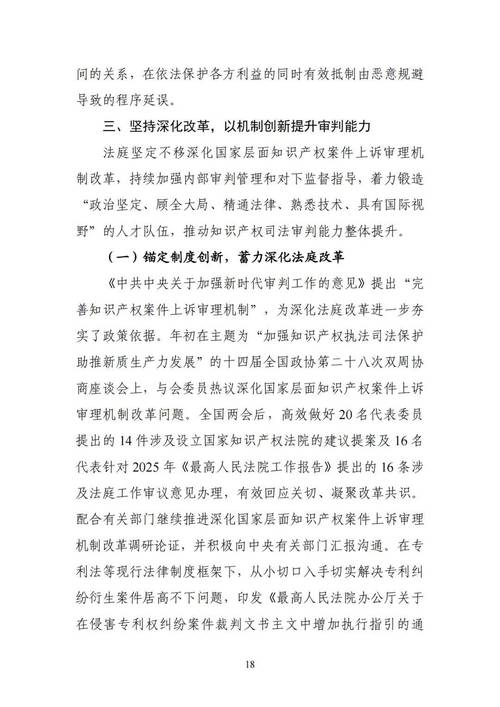
First is the further harmonization of standards for adjudication. By concentrating on the national technical category of intellectual property rights and monopolistic appeals, the tribunal has institutionally resolved the issue of inconsistent adjudication standards. Over the past seven years, nine guiding cases have emerged. 369 cases have been entered into the case bank of the people's court, and the periodic issuance of the decision has cumulatively covered 510 cases in 453. The tribunal maintained the substantive functioning of the full court by holding 558 meetings of professional judges to discuss 3803 cases and by ensuring the equivalent of cases through the establishment of mechanisms for the retrieval of case-related information。
Second is the further improvement of the quality of trials. The tribunal's trial quality indicators are clearly optimized. The rate of second-instance revision in civil entity cases, such as torts, tenure and so on, was 20. 9 per cent, and the rate of withdrawal was 37. 7 per cent, which was significantly higher than the national average for civil second-instance cases before and during the same period. The trial cycle for cases (883436) has been shortened, with the average trial cycle for jurisdictional categories (883436) in 2025 being only 25. 3 days. The tribunal has also focused on building integrity in the proceedings, with 13 judicial penalties and 17 referrals for offences。
Thirdly, there has been a further increase in judicial credibility and international influence. A large number of cases before the tribunal have had a wide-ranging impact, of which 4 have been selected as “ten major cases in the new era of promoting the rule of law” and 10 as “ten major intellectual property cases in chinese courts”. The courts provided equal protection to persons with intermediate and foreign rights under the law, handling 2546 cases involving foreign nationals, or 10. 3 per cent, an average annual increase of 18. 7 per cent. Its adjudicative instruments have received international attention and nearly 80 have been recorded in the jurisprudence of international organizations such as the world intellectual property organization. The total number of visits to the tribunal's english-language website exceeded 620 million。
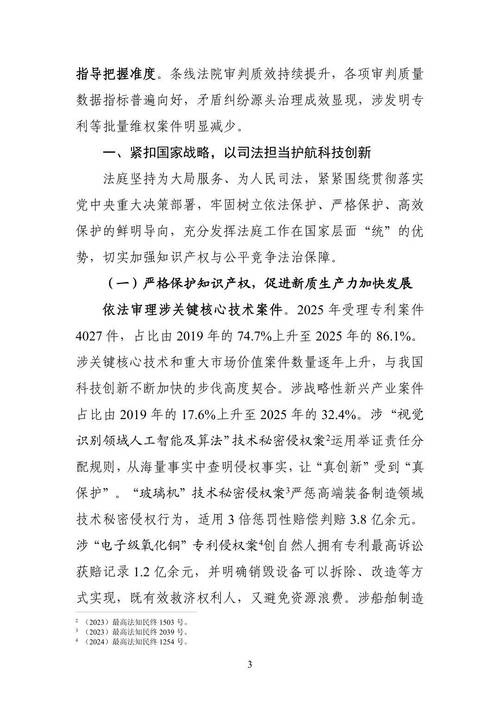
Fourth is the further strengthening of judicial safeguards for the implementation of national innovation-driven development strategies and intellectual property strategies. Effective court service guarantees the development of new quality productivity, with the percentage of cases involving strategic and emerging industries increasing from 17. 6 per cent in 2019 to 32. 4 per cent in 2025. The average annual increase of 31. 8 per cent in the number of administrative cases authorized to receive patents. Effectively increased protection is provided in 58 cases, where punitive damages were applied, totalling 2. 05 billion yuan; and in 73 cases, over 10 million yuan, totalling 5. 24 billion yuan. The effectiveness of the judicial antimonopoly system has been effective, and 203 cases have been brought to an end, of which 66 have been found to constitute a monopoly。



