


On 8 june, journalists were informed by a team of experts from the otoke flag in ordos city on the use of technology for research and demonstration projects, which combines ecological-production functions, that, after 13 years of exploration, field research and testing by several experts, the technology used to support the cultivation of desert lemon strips was successfully tested in the otoke band of maususadi, with a survival rate of 97 per cent。
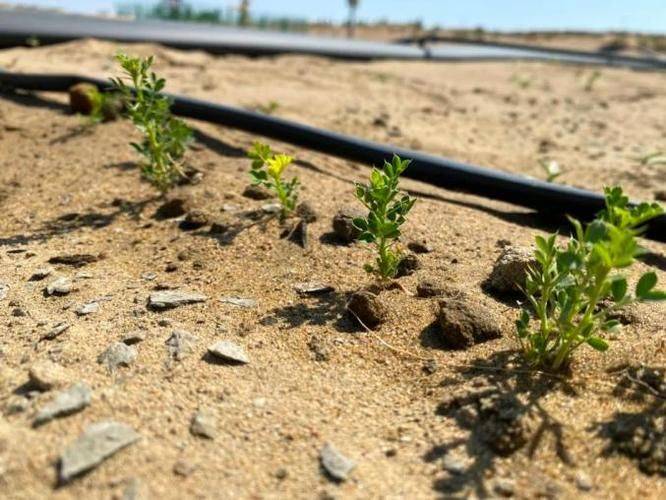
On 8 june, journalists at the project's sujigacha test base in the town of ulan, the otok flag, saw a line of wide black micro-flushing bands in the sand-flowing field, with crystal beads slowly dripping from a small hole and a 10-cm wide wet sand belt coming a few minutes along the belt. The drop of water and the formation of a seedling of lemons into a green plant belt are particularly visible in the white sand。
The team of experts on the project, huang bin, chief engineer of the otoke flag agricultural and livestock administration, who was crouched to say to the journalist, “look, this is the lemon strip we planted in april this year, which has grown to about 3 cm”. And he said, "that's what we planted on september 7, last year, after two springs of freezing, and now three centimetres high, which is a sign of our success in supporting the development of desert lemon strips!" this technique saves 50 per cent of the cost of planting seedlings, such as emeralds or seedlings, and we sow in caves, yielding 5 to 6 seedlings at a time, which is several times or dozens of times more productive than single seedlings.”
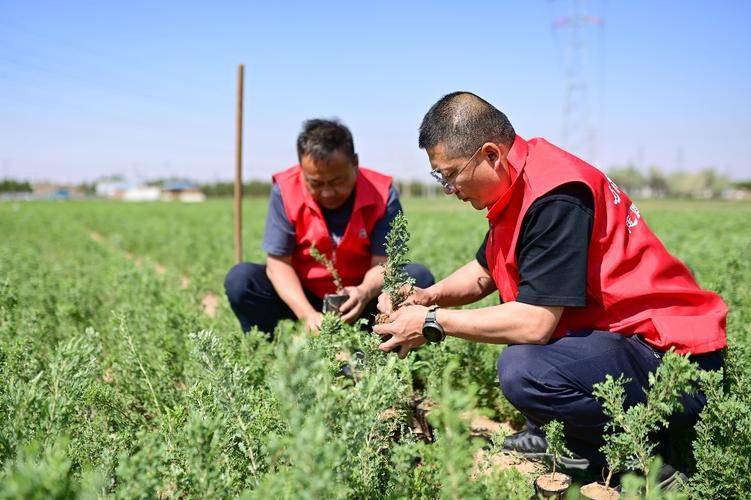
The oktok flag is located in the north-west of the city of ordos, on the northern edge of the maususa land, a typical steppe desertification transition to desertification grassland, and the largest flag county in the city of ordoz, with a total bare sand area of approximately 60 square kilometres, representing 8. 9 per cent of the total flag land area。
In 2021, general secretary xi said during the deliberations of the delegation of inner mongolia, during the two national conferences: “synthesizing the governance of the mountain forest and lake lawn and sand system by adding the word `sal'”
In 2022, experts from within and outside the region organized by the otoke flag agricultural authority to consolidate the mountain water and lake lawn and sand system, tackle the challenges of the ecological safety barrier and resolve to trade sand technology for high-quality pastures and find new paths for the enrichment of pastoralists. In november 2022, the office of science and technology of the autonomous communities was presented with a declaration of a project for the development and demonstration of technologies for the use of sandlands that combine ecological and productive functions。
The consultant for the project, the expert expert from the group of experts, and the director of the work station of the varanchabu cold vegetables institute, guan hye ming, said: “as early as 2010, we were discussing with hwang bin the use of the desert for the development of the pasture industry in order to incorporate the core technologies of modern agriculture in order to accelerate the transformation of the desert. In the process, we have discovered new phenomena, such as the conservation of sand, among local scientists and pastoralists. The water under the sand was protected by the fact that it was covered with sand that did not form a rainbow to evaporate. And we used to think that the amount of evaporation of sand can reach 2,000 mm, and through our multiple measurements, less than 2,000 mm evaporation below the surface of the sand. Also, an examination of the 20-year-old lemon strip found that the groundwater table would not decline under certain density conditions. Thus, we have come to the conclusion that only 0. 5 to 1 ton of water is needed for an acre of land to plant lemon strips in the sand. Last year's test seeding was successful this year, and the mechanized seeding was significantly more efficient and suitable for large-scale expansion.”
According to huang bin: “in the years, we have travelled almost all over the mausosha fields and the kubushi desert in ordos, visiting nearly a thousand pastoralists, using water-spacing instruments, conducting more than 60 tests and finding that, in general, water is available under three centimetres of sand, and that the thickest of the sand is not more than 17 centimetres, with a water content of between 11 and 12 per cent, which leads to sand having water-protective properties. So we started planting on the basis of this conclusion."
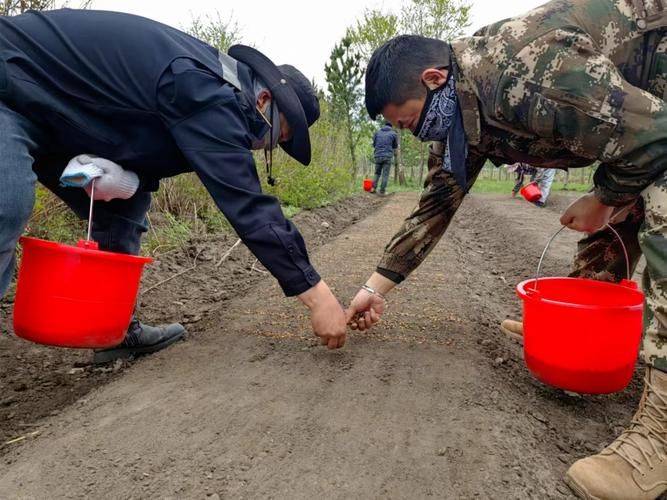
So what's it gonna be? According to huang bin: “in 2021, 2022, the oktok flag was droughted, and in our research we found that, in the old greened lands, all the remaining plants had died, except the lemons, and only the lemons had turned green, which meant that only the lemons were more suitable for desert cultivation.” as a result, from september last year to spring, they were tested eight times through plastic-covered cultivation, swipe-cover cultivation, grass-painted farming, etc., and eventually found the use of micro-fill belts to infiltrate the 3 cm dry sand layer, then the seeding machine to sow seedlings and fertilizers together, and in only two days the lemon strips will germinate. Like the three-centimetre-high seedling of lemon strips now, it is 7 centimetres long to go down to the root of the sand, and it is growing an acre with only 0. 5 tons of water。
Guan hye ming said: “in his visit to inner mongolia, general secretary xi jinping pointed out that the construction of an important ecological security barrier in the north of the country is the `big man' that internal mongolia must remember. Integrated protection and system governance of mountain water fields and lakes is to be firmly advanced. There is a need to further consolidate and develop the momentum of "greening the sand" by clustering approaches, focusing on the scale of priority areas to combat sand and sand, and continuously developing innovative models to improve the combination of sand and sand management. This places greater demands on our technologists and, next, we step up our experiments to map the symbiotic distribution of sand water in the mausoshad and kubushi deserts, to further experiment with improved planting techniques in such areas as water fertilization and seeding, to provide technical support for the expansion of planting areas to improve the quality of sowing, and to green up these deserts as soon as possible and to enrich the population.”
It is known that, to date, 400 acres of lemon strips have been planted in the otoke flag with the technology of supporting the cultivation of desert lemon strips, with a survival rate of 97 per cent, and that a 2,000-acre test base is being built at the core of the maususha site in sumitumu mahhegacha, the flag. (reporter, father mei-yeon, wang yu, navy)



