The tide of the spring has set in motion two meetings to promote justice. In anticipation of the success of the two national councils and in response to the concerns of all sectors of society about the work of the courts, the supreme people's court launched a series of press conferences on the theme of “welcoming the two fairness and the new path”, which systematically introduced the people's courts' deep application of xi jinping's philosophy of the rule of law, with a view to safeguarding the peace, safeguarding the development of justice and safeguarding the living practices of the people, using well-documented data and lively cases, and comprehensively displaying the new ideas, initiatives and achievements of the people's courts. Attention。
On the morning of 28 january 2026, the supreme people's court held a press conference on the seventh anniversary of the functioning of the mechanism for the review of intellectual property cases at the national level, the annual report of the intellectual property court of the supreme people's court (2025), the mediation work of the intellectual property court of the supreme people's court and typical cases, and answered journalists ' questions. The press conference was attended by the vice-president of the intellectual property court of the supreme people's court, chu li, vice-president of the intellectual property court of the supreme people's court, and senior judge zhang xuanbing, senior judge of the intellectual property court of the supreme people's court, and was chaired by the deputy director of the press bureau of the supreme people's court。
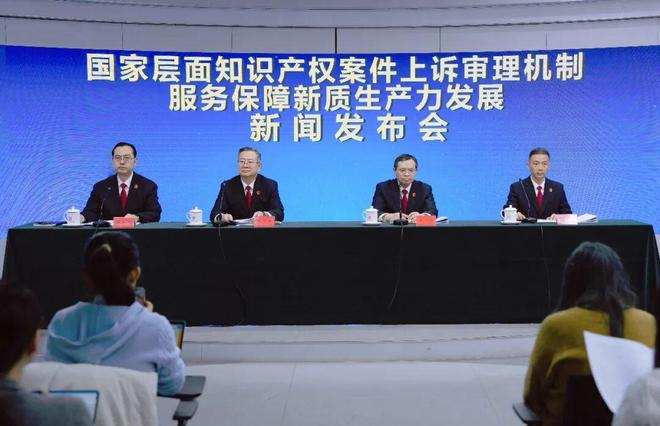
This is the site of the launch。
With the central approval of the party and the relevant decision of the standing committee of the national people's congress, the supreme people's court established the intellectual property tribunal on 1 january 2019, and the appeals mechanism for intellectual property cases at the national level began to operate on a pilot basis. In its seven years of existence, the tribunal has been guided by the chinese socialist ideology of the new era of xi jinping, studying in depth the idea of xi jinping's rule of law, actively implementing the concept of “protecting intellectual property is protecting innovation” and achieving significant results in stimulating scientific and technological innovation, preserving fair competition in the market, opening up services to the outside world and deepening judicial institutional reforms. A total of 24602 cases were processed and 23069 cases were completed, largely meeting and consolidating the “four further” reform goals proposed by the central party。
First is the further harmonization of standards for adjudication. By concentrating on technical-type intellectual property rights and monopolistic appeals throughout the country, the problem of inconsistent adjudicative standards was addressed institutionally and concerns about local protection were effectively addressed. A large number of adjudicatory rules have emerged, with nine cases becoming guiding cases (a further six are about to be published in the near future), 369 cases entered the case book of the people's court, the main thrust of the previous year's decision has been issued on a regular basis and 453 cases have been issued, with 510 articles. Improving mechanisms for the functioning of the judiciary, maintaining the substantive functioning of the panel, holding 558 meetings of professional judges to discuss the 3803 cases. Ensure the same sentences, fully implement case-research and establish a disclosure system for related cases. (c) providing peer-to-peer monitoring guidance, establishing a case-by-case feedback mechanism for first-instance quality assurance, and issuing annual reports on the analysis of revision cases, amounting to over 1. 52 million words。
Second is the further improvement of the quality of trials. Strengthened trial management and clear optimization of trial quality indicators. The insistence on “no change” and “no change” has resulted in a 20. 9 per cent revision rate and a 37. 7 per cent reversal rate in civil entity cases, such as violations of rights and titles, which are significantly higher than the pre-reform and national civil second instance cases. The rate of second-instance revision in administrative entity cases, such as the delegation of authority, was 7. 3 per cent, almost the same as before the reform. The remand rate for second instance is well below the national level, with only 2 cases in 2024 and zero in 2025. The average trial cycle is shorter than before the reform, with only 25. 3 days in 2025 for jurisdictions. A focus on the integrity of the proceedings led to the imposition of 13 judicial penalties, the transfer of 17 criminal leads, the submission of 3 judicial recommendations, which were found to constitute 1 false and 8 malicious proceedings。
Thirdly, there has been a further increase in judicial credibility and international influence. A large number of cases have had a significant impact at home and abroad, with four cases being selected as “the top ten cases in the new era of the rule of law”, 10 cases being selected as “the top ten intellectual property cases in chinese courts”, and more than 270 cases being issued by the supreme people's court as typical cases of various topics. The law provides equal protection to persons with rights in china and abroad, with 2546 cases, or 10. 3 per cent, representing an average annual increase of 18. 7 per cent, concluding 2046 cases, and more and more foreign subjects choosing chinese courts to settle intellectual property disputes. Focusing on the international front, actively explores the jurisdiction of disputes over the global licensing of standard patents, anti-suit injunctions and anti-suit injunctions and permanent injunctions, tariff determination, etc. The work of the tribunal is of great interest at home and abroad, and nearly 80 court decisions are recorded in the jurisprudence of international organizations such as the world intellectual property organization. The chinese judicial story was well told and the annual report of the tribunal was published bilingually in chinese and english. More than 620 million visits were made to the chinese and english websites, more than 160 million to the english sites and 130,000 to the public。
Fourth is the further strengthening of judicial safeguards for the implementation of national innovation-driven development strategies and intellectual property strategies. Effective services guarantee the development of new quality productivity, with 6745 cases involving strategic and new industries, up from 17. 6 per cent in 2019 to 32. 4 per cent in 2025; 6543 administrative cases, such as patents, authorizing enforcement, increased by 31. 8 per cent annually, including 3704 administrative cases, with an average annual increase of 26. 0 per cent; 5354 patent abuse cases, with an average annual increase of 11. 5 per cent; 183 patent cases, involving standard-related requirements; 41 drug patent link cases; 923 new plant varieties cases, with an average annual increase of 46. 2 per cent; and 90 per cent of rights holders in 2025. (a) to strengthen the protection measures effectively, in 58 cases, punitive damages were applied, totalling 2. 05 billion yuan, or over $35 million, and in 73 cases, or over $10 million, totalling 52. 4 billion, or almost $72 million. The effectiveness of the judicial anti-monopoly system has been effective, with 203 cases of monopolies closed, 66 of which were found to constitute monopolies in various areas of science and technology and human life, such as medicine, communications, electronics, education, construction and burial。
These are the basic conditions under which the tribunal has operated for seven years. This joint publication of the 2025 annual report of the tribunal represents two major changes compared to the previous year's report: a presentation on the tribunal's substantive resolution through judicial mediation and a review of the tribunal's seven years of work. In addition, a summary of the tribunal's seven-year significant achievements has been presented, mainly in the form of a list of trial results。
The seven-year pilot of the tribunal has amply demonstrated the wisdom and thoroughness of the decision taken at the party centre to establish an appeal mechanism for intellectual property cases at the national level. Faced with the difficult challenges of accelerating high-level technological self-reliance, accelerating the construction of a high-level socialist market economy and expanding the strategic deployments of high-level external openness during the “155” period, and the development needs of accelerating the digital economy and technological and technological innovation, competition in the market and increased international competition, the tribunal has confronted the increasing complexity of cases and the increasing number of human conflicts, and has made a significant contribution to the reform of the mechanism for the adjudication of intellectual property cases at the national level, the continuous improvement of the quality of cases, the effective strengthening of the legal guarantees of intellectual property rights and fair competition for the development of new quality productivity, and a new and greater contribution to the comprehensive promotion of strong nation-building and national renewal in china