Introduction
Cruciferae is a variant of the radium-based cabbage sub-species, produced by green leaves for one or two years. His name is br-assica campestris l. Ssp. Chinis (l.) ma-kino. Var. Communis tsen et lee, also known as common cabbage, cabbage, cabbage, oil, etc. The cabbage evolved by b. Campestris l. Chromosomes 2n = 2x = 20. Every 100 grams of fresh vegetables contains water from 93 to 95 grams, carbohydrates from 2. 3 to 3. 2 grams, proteins from 1. 4 to 2. 5 grams, vitamin c30 to 40 mg, cellulose from 0. 6 to 1. 4 grams, and other vitamins and minerals. It is common in china. The main area of production is south of the yangtze river, which accounts for 40 to 60 per cent of the area planted in autumn, winter and spring vegetables. After the 1970s, cultivation in northern china also expanded rapidly。
Botanical, shallow, developed, renewable, suitable for seeding. Roofs are long-lived in short-duration nutrients, and can be stretched at high temperatures or overstretched. The condensed trachea is the main edible and assimilated organ. (b) the full edge, wave or sawn, light green, green or deep green, etc., of leaves round, ovulation, ovulation or elliptical, etc., of leaves; of leaves that are smooth or wrinkled, with a small number of hairs; of leaves that are thick, with flat, half-round or half-rounded cross-sections, typically with no wings, white, white, light green or green; the number of leaves is 2/5 or 3/8, and the number of single leaves is typically a dozen. The leaves of the flowers are usually of no use, holding or holding. Rhythmic curvature, full flower, crown yellow, petals 4, crucifixion; male curry 6, filaments 4 and 2; female curry 1, in the centre of the flower. Poaching, insect-brokering. Longhorns, containing 10 to 20 seeds; ripe corneas are fragile and need to be harvested in time. Seeds of near circle, brown or tan, with a mass of 1. 5 to 2. 2 g in thousands。
Type and variety, depending on morphological characteristics, biological characteristics and planting characteristics, cabbage can be divided into fall and winter cabbage, spring and summer cabbage, each including different types and varieties. 1 autumn and winter cabbage: extensive cultivation and variety in southern china. The strains are vertically or adhesively grown mainly in the autumn and winter, and are divided into the type of infarction and the type of infarction according to the colour of the leaf. Among the representative varieties of white infarction are nanjing's short foot yellow, chang's white infarction, guangdong's short foot leaves, and fertilizers. The types of cyanide are representative of the shanghai dwarf, hangzhou early oil and winter, changzhou green infarction, etc. Two spring cabbages: multicropping, with a small number of straight or thin waists. The winter is strong, cold and productive. In the morning and evening, and during the supply period, morning and evening vegetables are divided. Early spring vegetables represent white-bracked bright leaves in nanjing, white-free hangzhou winters and slow march in shanghai. Evening spring vegetables represent white-blank nanjing april white, hangzhou cabbage, etc. And green-blank shanghai slow april, may slow, etc. 3 the summer cabbage, the summer and autumn hot seasons, also known as “fire cabbage” and “cropping”, represent a variety of such things as shanghai fire cabbage, guangzhou marel cabbage and nanjing piggy one。
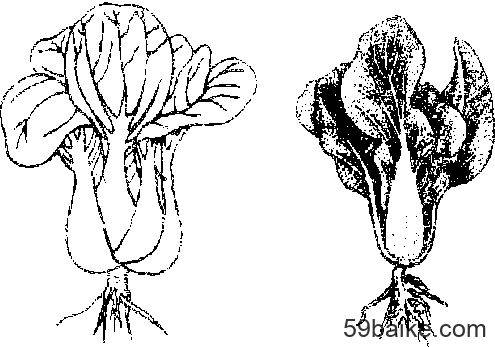
Cabbage
The growth and product formations of cabbage produce cycles with long-term nutrition and long-term reproduction. In autumn and winter cabbage, for example, nutrition has long included a guillotine period: from seed to leaf to leaf to leaf. 2 seedlings: from the real leaf to the formation of a leaf sequence. (b) the planting of another one or two leaves is the main period during which individual production takes place. Long-term reproductive life consists of: 1 withdrawal of the gestationary period: the gravitation of the bouquet and the giving of flowers. The main tubing and the side branch grow leaves and the top form buds. Two flowering seasons: the buds grow up, bloom and grow。
The cabbage is made of lichen leaves. In autumn, cabbage usually split between 1. 5 and 2 days into a new leaf. For example, single varieties such as the hangzhou oil winter are typically 25-30 leaves, of which the production consists mainly of the 9th-24th loaf. The area of seedling leaves is growing faster than the leaves; the leaves are growing faster during the lotus period. By the later stages of growth, the increase in the weight of the leaves is mainly due to the growth of the leaf handle, which often accounts for 75 to 80 per cent of the total weight of the leaves, which is the storage of organs for nutrients. The volume of production per unit area consists of the number of plants and the single weight, which is governed by both the number of leaves and the weight of leaves. Most varieties are heavy leaves, and the increase in the weight of leaves is mainly due to the increase in the area and weight of leaves。
Cabbage prefers cold weather, with average temperatures ranging from 18 to 20°c and abundant sunlight. It's safe to get through winter. High-temperature growth at above 25°c is weak and susceptible to viral disease, with only a few more heat-resistant varieties growing in the summer. Vegetable seeds and green plants at temperatures below 15°c undergo a certain number of days of springing, with seedlings beginning to split and leaves stopping. Pumping and flowering under long-day photos and higher temperatures. However, there are significant differences in the requirements for long-day photos among different varieties。
The type, variety and adaptability of cabbage are extensive, and in china's jiang and huai regions, it is possible to plant more easily than in winter and early spring; it is generally organized in three seasons: 1 autumn, winter cabbage: seedlings, harvests. In south china, seeding continued from september to december, with harvests in stages until february of the following year; in the river and huai region, seeding continued between early august and mid-october, before freezing. 2 spring cabbage: planting late in the autumn, with small seedlings rising in winter and harvesting in the spring; plants can also be harvested from cold beds in the early spring or after spring. Three summer cabbages: mainly grown and harvested, are ready to sow in the first half of may and the first half of august. Cabbage often rotates with melons, beans and field crops. (c) autumn and winter cabbage can be made or set together with condensed kale, broccoli, pickles, potatoes, etc. An anniversary supply can be achieved by seeding different varieties。
Cabbage tends to grow and grow, except in the early springs, summers and so on. It is advisable to choose the soil that is protected and well drained for seedlings, with the first harvest being followed by sunburning, cleaning of fields, application of foot-based fertilizers, and then the ground being made into high or flat. The seeding should be managed in such a way as to sow and sow properly. (b) following the seedlings, follow up fattening and watering, and pay attention to weeding and pest control during the nursery season. It's usually 25 to 30 days after broadcast. The fields are fertilized early, tanned and tanned. Plantation density varies according to species, seasons and cultivation purposes, with most varieties ranging from 20 to 25 cm. The depth of planting varies according to weather, soil, and early autumn and autumn, so as to prevent the deep heart being planted; (a) the soil is loose and can be planted in depth。
The cabbage is small and has a weak absorptive capacity and should be constantly fed during its growth. Repeated pursuit of fast-acting nitrogen fertilizer is an important measure to promote cabbage growth and ensure productivity. (a) the principle of rational fertilization: first, the timely pursuit of fat after planting and the promotion of growth; for fertilisation methods, periods, usages, etc., depend on weather, seedling, soil etc. Water is being poured in conjunction with fat pursuit. There is no shortage of water for three to five days after planting, especially in the summer and early autumn, which must be watered every morning and night for three to four consecutive days. In order to grow cabbage, organic fertilisers should be used as base fertilizers, with appropriate fertilizer being followed during growth, and leaf fertilization combined with spraying。
Cabbage plants are grown to a certain size and are readily available for harvest. (b) the colour of the outer leaves begins to fade, the leaves of the outer part of the base are yellow, the leaves are shifting from booming growth to closed growth, and the heart leaves extend to flatness with the outer leaves (commonly known as the “tunnel”). (b) spring cabbage is to be harvested before the suction. South china has only 40 to 60 days to sow。
Cropping should be strictly isolated from other cabbage and other varieties of cabbage, as well as from other growing crops with a chromosomal base figure x = 10. The space of the field is isolated at least 2,000 metres and the distance of the field for production is not less than 1,000 metres. The main method of seeding is: 1 in 1 species: planting in the autumn. Pre-harvest plants are selected as well-developed plants with the characteristics of their own species and are planted at a range of about 45 cm. The river and light areas need to be aware of the need for proper coverage of cold-resistant, cold-resistant long infarction cabbage, which can be cut to the upper part of the leaf, with only the handle and the heart of the leaf to be planted and covered with grass as appropriate. In the following spring, cold-proof cover is removed, tillage, weeding, fertilization and pre-flower care to combat aphids, and seeds are generally harvested in may and june in the river and in the small areas. Two and a half species of seedlings are grown in the river and in less than mid-october, before winter. Next spring, we'll pick the strong to grow. Seed yields are higher and costs lower, but of less quality than cropping. 3 small-scale seeding: seedlings were planted in early february in the jiang and huai districts, once or twice after seeding, seedlings were raised at a distance of about 20 cm and seeds were harvested between late may and early june. Spring cabbage is mostly produced in daejeon in the spring, to the detriment of others。
Storage and processing 1 pickled cabbage: collecting fully mature strains, removing roots and leaves, cleaning, evaporating and abating water, salt drying, coding in pottery or large drums. One layer of vegetables, one layer of salt, until full size, and heavy stones. After a few days, leach the juice and flip it up and down again, if the pressure is about 25 to 30 days later, it can be eaten. For every 50 kg of fresh vegetables, the salt is 2. 5 to 4 kg. 2 leather dry: collect fully grown plants, root and leaves, wash and boil water bubbles and dry them up。
Insects and pests, the most common diseases are viral diseases, frost, leopardism, swollen diseases, etc. The main pests are pickles, heart troubles (see cabbage, vegetable pests), moths, cabbage moths, yellow chords, vegetable butterflies, etc。
English
Pak-choi; chinese cabbage