


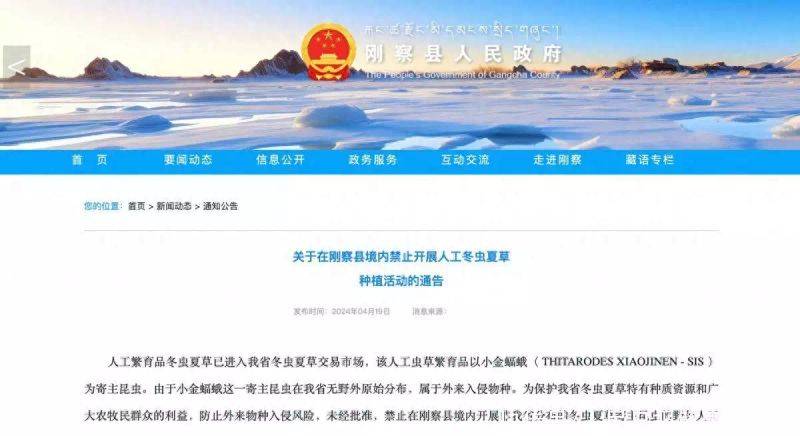
On 19 april, the department of natural resources and forestry and grasslands of goncha county, haibei province, qinghai province, issued a circular on the prohibition of artificial winterworm nasage cultivation in the territory of gonÇa county, stating that the artificial winter worm grass had entered the qinghai province winter wharf trading market and that the artificial weed had been made of small gold moths (thitarodes xiaojinensis). Little golden moths, the host insect, have no wild seed distribution in qinghai province and are alien invasive species。
Hepatic cysts, as little as possible
. Advertising x
The people's daily daily health client reporter found that in recent times, similar circulars have been issued in various places, such as jade tree city, haishi state, haidong city and county, heinhai county and guinan county of hainan state, prohibiting the cultivation of artificially bred winter grass。
Why did the artificially produced winter worm and summer grass become alien invasive species? “in the qinghai sea, such as the hokkai and haisi areas, the artificial breeding of winter worm summer grass is characterized as an invasive alien species and local cultivation is prohibited for ecological safety reasons.” meng su-sun, professor, school of eco-environment, people's university of china and deputy director of the professional committee on the protection and use of pharmacist animals of the chinese drug association, told the health client of the people's daily newspaper that the winter hyena was actually a worm complex, formed by the infestation of bat moths and larvae. As a result of historical over-exploitation and environmental changes, our wild winter worm resources have been reduced in their distribution and resource reserves. In order to increase the sustainable supply of resources for winter worm summer grass, we have carried out the artificial cultivation of winter worm summer grass. As a new bat moth species, published by our scholars in 2009, small golden moths have been successfully used for the artificial cultivation of winter moths。
“if it is established that there is no natural distribution of small gold moths in the qinghai sea, then it is an alien species. In the qing sea, if winter insect summer grass is planted, it may lead to the introduction of small gold moths into the qing sea and their entry, including through flight, into the natural environment of the qing sea, where the presence of basic ecological conditions, such as suitable distribution of the moths between the sea level and the water-hot environment, can trigger ecological invasion, with negative social, economic and ecological effects on the area.” mengsu xiang said。
Mr. Zhao li, director of the chengdushi insect museum, said that the moths were mainly located in xiao kim county, as well as in kinchuan and danba districts, bordering xiao king county. There is no significant difference in the value of the pharmacological use of this breech and the indigenous production of the qinghai sea, and there is no problem if they are raised at their origin. But the qinghai need to be heavily guarded to avoid its spreading into the wild。
“the host of winter worm summer grass is different in different regions, and at least a dozen of our bat moths can be the host of winter moths, but it is not recommended that the species not found in the region be drawn from the field to local breeding.” zhao li added that the introduction of moths from different regions into areas where they were not originally distributed was likely to cause ecological pressure on the moths and undermine the ecological balance of the site. The ecological balance of high altitudes is already fragile and can easily be significantly affected by small changes。



