


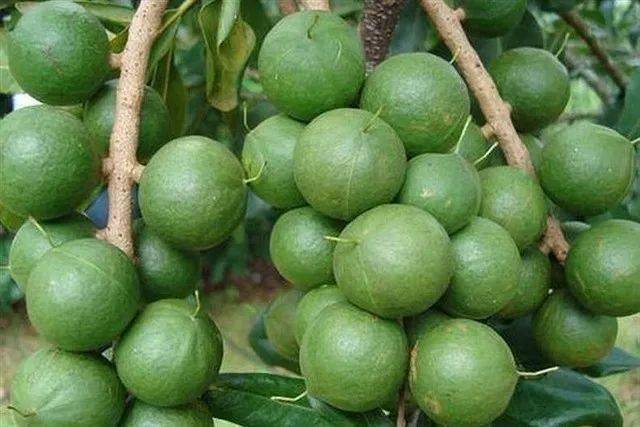
Australian nuts
I. What are the circumstances that should be avoided in selecting australia's nut plantations?
One is to avoid the wind. Australia's nut tree canopy is large, has no visible roots, has shallow roots and is prone to wind; wind-free areas are the most suitable areas to be cultivated, and wind-safe areas should be selected and protected. Large commercial cultivation is not appropriate in areas with an average wind capacity of more than 9 and up to 11, where typhoons occur. The second is to avoid the frost. The temperature is below 2°c to 3°c, and areas with continuous frost periods exceeding 7 days are not suitable for large commercial cultivation。
What are the good nuts available in guangxi for afforestation?
At present, the varieties suitable for guangxi cultivation are cream 1, oc, a16, 695 etc. Of these, the south-west asian institute of tropical agricultural sciences in guangxi selected the new australian nut type, cream 1, which weighs an average of 10. 52 grams of dried shell fruit and 3. 1 grams of nuts, with an average yield of 53 per cent and 33 per cent. Cream 1 currently accounts for more than 60 per cent of guangxi cultivation. Due to the different climate adaptations of different types of australian nuts, it is important to eliminate the use of trees that are not suitable for cultivation in guangxi from unknown sources。
Iii. What would be better to choose the plot to grow australian nuts?
Australia's nuts are coarsed and adapted to all types of soil growth, but the red, red and red, ph values of 5-6. 5 and more than 1 metre thick, groundwater levels of less than 1 metre, soil soothing and well-drained soils are the most suitable options。
Iv. How to die the ground?
The recommended range is 4-6 metres and 6-8 metres, depending on the terrain, variety and density, and the slopes can be a little more dense, vertical, dense, open and rare. When the range is fixed, the cave is dug to the 80 x 80 cm specification. When filled back, 15 kg of rotted organic fattening, 0. 5-1 kg of calcium perphosphate and 0. 5 kg of lime are distributed, which is fully modulated and then filled into earth piles about 10 cm above the ground。
V. What kind of afforestation should be chosen?
The use of good seedlings is recommended. The trees require robust growth, drying and no serious pests and pests. The matrimony interface is smooth and healing well, with no rise or tumour swelling. The seedlings are grown at a height of 60 cm and 25 cm above the marriage interface. Nutrient cups are not severely damaged and earthworms are not loose。
When is afforestation generally taking place?
The best afforestation period for nuts in australia is spring (february-april), followed by winter (october-december)。
Vii. What are the methodological requirements for planting australian nuts?
At the time of planting, the trees are placed in the middle of the planting den, the main trunk is set up, the main branch is reoriented, the earth goes up to three to five centimetres above the earth mass, the main trunk is condensed around a plate of 1 metre in diameter, and the root water is soaked and the grass is covered。
Viii. What are the requirements for the configuration of varieties?
In australia, where home-grown nut pollination is easy to breed, the first choice in planting is to mix the species that are grown in guangxi with the type cinnamon 1, a16, oc, 695 etc. The selection of early, medium, and late- and late-finishing varieties for inter-species blending (both early, medium and evening flowers meet with bouquets and increase pollination rates) is not suitable for mono-species, which can be combined at 1:3:1 or 1:31. Of these, oc is in the early flower type (with 1), cinnamon 1, a16 is in the medium flower type (with 3 or 4) and 695 is in the evening flower type (with 1)。
Ix. How to manage soil on forest land?
One is between. Light rooting and condensed legumes, vegetables, pastures or green fertilizers in the walkrooms leave 0. 5 metres of the canopy tree drip line in australia. The second is weeding. The orchards grow grass and pine soil in time for rain or water during the growing season, with depths of 5 to 10 cm, and usually weed once for three to four months, and keep the soil loose and high-strength weeds (weeds can be kept)。
X. What are the techniques for fertilization following the cultivation of australian nuts?
One is the fertilisation of young trees (1-3 years old). Two fertilizers per year, once in march and october, each time using australian nuts, apply 6-10 grammes of fertilizer (or corroded organic fertilizers) + half a pound of compound fertilizer to half a pound of topsoil (using circular, semi-cycling, stripping)。
Second is the result of fertilization (over four years of age). Two fertilizations per year, one in march and one in october, each using australian nuts to apply fertilizers (or corroded organic fertilizers) 10-18 pounds + composite fertilizers 1-2 pounds of topsoil mixing。
Three are extra fat and hormone-based nuts. Spraying of amino acid + 0. 2 % boron, 2-3 times, 10-15 days after flowering + 0. 2 % potassium phosphate + 0. 1 urea. Hormonal cone: 10-25 ppm in use; 10-20 ppm in ceroac acid; 0. 4-1. 0 ppm in use; and 10-20 ppm in use; two to three of these were selected for hybrid use on a base-specific basis。
The fourth is water fertilizer integration technology. Arid, semi-arid and irrigated areas use drip irrigation to guarantee nutrient needs at all stages of the growth of nuts, reduce labour costs and increase efficiency。
Xi. Good tree shapes are the basis for premature and productive production, and how can we do the plastic trim of young trees?
One is to remove the buds. At the early stages of planting, care is to be taken to erase the buds from the birch, and normally to remove them from the branches of the result。
The second is drying, plasticization (the first 1-3 years of tree age). After planting, the three abrasions above will continue to grow as they grow from 50 to 60 centimetres off the ground, and when the three main stem lengths up to 15 to 25 centimetres from the last branch, they will be given a high error heart (i. E., one at 15 centimetres, one at 20 centimetres and one at 25 centimetres). In the future, this method will allow for higher-level branching (austral nuts will be able to pick up fruit if they are more than four-level branches)。
Three is short. Just cut the branches. Its main role is to encourage it to develop new branches and to increase the number of branches in order to ensure that the trees are strong and to cultivate the branches of results, and that the branches of the inner chamber are the branches of the future, bearing in mind that they cannot be cut off。
Xii. How do you trim the resulting tree?
One is to open the skylight. For trees with strong growth and dense canopy, the skylight control is properly removed at the top of the canopy。
Two is trimmed. As a result, the main result was the removal of the axes left on the resulting branches from the cleaning of the worm branches, the dead branches, the overlapping branches, and the inside branches and the fallout。
Three is pull. Rational stretching not only enables the fruit tree to form quickly and to have a good skeleton structure, but also facilitates the fragmentation of the branch's polarity, regulates its forces and enables it to achieve rapid balance and stability。
Xiii. What are the requirements for harvest of fruit?
Guangxi nuts usually mature between september and october, with different varieties. When the skin colour is changed from green to light green, the skin surface from white to brown and the seed from pink to oil, it is clear that the fruit is ripe for harvest. Premature fruits cannot be harvested so as not to affect quality and credibility。
Xiv. What are the requirements for pest control?
Prevention and control of pests and diseases requires active application of the “preventive, integrated” approach. On the basis of agricultural and physical control, biological control is promoted and chemical control techniques are used in science according to the pattern of disease and pest occurrence。
One is agriculture. (b) strengthening soil-based water management, appropriate loads, rational trimping, promoting healthy growth of trees and improving their resistance to disease; in winter, they cut the branches, remove the leaves of the dead branches, scrape the trunks of the trees and dry the branches, and concentrate on burning or deep burial。
The second is physical control. Based on the biological properties of pests, the envirophage, frequency-fibration headlights, tree-dry twigs, adhesives, etc. Are used to trap or avoid pests; insect hormonals (sexual inductions) are used to induce insects to kill or interfere with insect mating。
The third is biological control. Improve orchard ecology and protect natural enemies such as wedges, grasshoppers and dictums。
Chemical control is used only in cases where the disease is severe or the infestation of the insect is high and the hazard is severe。
Australasia's main pest control methods
Diseases
Name
Hazard
Parts
Drug control
Other prevention
Recommended type of use and concentration
Methodology
Anthrax
Leaf
The handle
80 per cent of the dry manganese zinc humid powder 500 times more than 1,000 times more liquid; or 75 per cent of the bacterial clean humid powder 500 to 1,000 times more liquid; 70 per cent of the methyl tobuzin humid powder 1,000 times more than 2,000 times liquid
Spray
Keep orchard clean and weed drainage in time。
Erosion
Trees, branches
80 per cent of the dry manganese zinc humid powder 500 times - 1,000 times the liquid fluid; or 70 per cent of the methyl tobuzin humid powder 500 - 800 times liquid
And white paint
Combination of the symptoms
The park avoids water accumulation and the branches avoid mechanical injuries。
Aphids
Leaf, flowers, fruit
40% poison cream 1,000 times - 1,500 times more liquid; or 10% vermin humid powder 2,000 times - 3,000 times more liquid
Spray
Set the yellow stickers, trap them。
Ribra
Leaves, flowers
25% aphid humid powder 1,000 - 1,500 times more liquid; or 5% aphid humid powder 1,500 - 2,000 times liquid
Spray
Set the blue sticker, trap the worm。
Submarine moth
Leaf
50% lsd 1,000 - 1,500 times more liquid; or 50% parathion 2,000 - 3,000 times more liquid; or 2. 5% bcm 2,000 - 3,000 times more liquid
Spray
The winter combines the clearing of gardens, the clearing of leaves and the burning of leaves, and the elimination of winter grasshoppers。



