Learn how to manage the northern sun-sun rose grapes and grow beautiful fruit easily
Meng nuts, etc
As people's standard of living continues to rise and health awareness grows, the demand for quality fruit consumption also increases. Sunshine roses are an epochal and excellent grape variety with typical eurasian identities. To produce sun roses into truly green and high-quality fruit products, it is necessary to optimize the technology of solar rose planting. This paper is based on practical questions, drawing on years of experience in planting and drawing up proposals to plant sun roses in the north, and to provide information for a wide range of growers。
I. Elements for structure management
(i) sunshine rose frame selection and range
Sunshine roses use protected land cultivation in the north for relatively good overall returns. The rain-shield model is the most expensive for land not making earlier. It is important to determine the shape and range of the frame according to different cultivation patterns and terrain. The main types used are the “v” shelf, the flat shelf and the bird shelf。
The strength of the flat-bed is that the space is open, the fruit is largely free of the sun, the ears are of good quality as a whole, the flowers are flat and the sun burns are good. The disadvantage is to work with arms around their necks, to stand on a stool prone to fall, to be more suitable for use at the tourist pick-up park, with a range of 2 to 3 metres and a line of 4 to 6 metres。
The “v” shelf has the advantage of being robust, fast-growing, productive early and less productive. The disadvantage is that the fruit has a shade of sun and leaves are slightly less luminous and space-efficient, and the top advantage requires a strong focus on rational controls and relatively much sunburning. The corresponding line range is 1. 2 to 1. 5 metres, and the range is 2. 5 to 3 metres. The fowl shelf overcomes the weaknesses of the flat-bed labour force, inefficiency and insecurity, which effectively improves labour efficiency. It also eases tree positions, improves colour and quality, facilitates mechanization and is suitable for high-quality, low-energy and vinyl production. The corresponding length of the line is 1. 5 to 2 metres and the range 3 to 4 metres。
(ii) pre-establishment lands
Sunshine rose vineyards should choose areas where the soil is fertile, well drained and full of hydropower, and must be located away from industrial sources of pollution and prone geological areas. The soil type is best based on deep, fertile sandy sandy soil. Gravity gardens are the first to level the land, and for the less organic soils of the frontier and the sandy soil, a gutter approach is recommended: design work for the distance, shelter and water fertilizer equipment is planned for the purpose of production. A 50-centimetre wide and 50-centimetre deep ditch was used. At the bottom, the straw is laid at about 15 centimetres thick, followed by a layer of soil, 10 centimetres thick on the top, with more than 25 kilograms of corroded organic fat on the top, 40 kilograms of corrodant microbacterium, and at the top, a layer of soil to keep the established ditch flat to the surface, if low-lying water can opt for planting, the height of which should not normally exceed 40 cm。
(iii) selection of trees
Sunshine rose varieties suggest seedlings, which are later more desirable in terms of the size of the fruit grains, the thickness of the sheeting, and the prevention of rust. In the north, we chose 3309 and anti-zirconium 3, which is more robust, and in some of the more fertile soils or sandy plots, it's good to use the summer zirconium. The three gills, 3309, anti-paper 3, 5bb, matured a little later than the shaddish, beddak, so4 had larger gills and better resistance to nematodes, but matured about 20 days later than the cylindricals, while at the same time less effective against cold flows. In the summer black, in the behda lumber, the colour is yellow and several others are yellow. It's the best thing in the taste. However, the abundance of osteoporosis in the first and second years of seedlings and of the results during production is considerably worse than the sapling. The best in the early years of abundance is summer black wood, but the disadvantage of summer blackwood is that there may be a tumour or a corrosive worm and that there may be garden destruction。
(iv) tree planting
The fall planting time was recommended for early november, with a reduced rate of later survival. The spring raisins are suitable for the first half of march to the first half of april, and cold sheds can be pre-emptive, too early to determine the rate of survival and too late to affect production in the coming year。
The root is usually trimmed up to 10-15 cm before planting, and the smaller the root is, the more it is, the shorter it is, and the black-haired roots are cut off until the root base. The upper part leaves two to three full buds, all of which are cut off. After trimmed, all the trees are immersed in water for 12 to 20 hours, and when the water is humid, all the trees can be immersed in 2 to 3 hours in a diaphragm of 2000 + 2000 + 2000 + 2000 + 2000 + 2000 + 2000 + + 2000 + + 2000 + + 2000 + + 2000 + + 2000 + + + 2000 + + 2000 + + + 2000 + + + 2000 + + + + + 2000 + + + + + 2000 + + + 2000 + + + + + 2000 + + + + 2 + + + + + + + + 2000 + + + + + + + + + + + + + + + + + + + + + + + = + + + + + + + + + + + it is best to fill the roots with mud and then transport them to the fields before planting after impregnation, which is critical for the long run before water is lifted。
It is best to make a small pile of earth in the middle of the shed, to ensure that the roots begin to be filled with soil after stretching, to plant depths to cover 2-4 centimetres of the roots up (water does not leak) and to use the method of “twice and step on a seedling” to fill the ground with raw soil, i. E., soil without fertilizer. Water is poured immediately after planting, first water can be watered, then then refilled soil to the burial line after the water has been leaked, and half a set of roots (5 kg from the deep ore source + 1 kg) or 2 kg from the fertile soil + 500 g will be flushed with water after five to seven days。
Ii. Management highlights for the year following the planting of small seedlings
(i) chicken management
The normal tree can take root and agitate 15 to 20 days after its planting, after which it is covered with a black membrane or horticultural cover, increases the temperature of the earth, suppresses weeds, promotes the rapid growth of grapes, in particular adequate cover on both sides of the membrane, and increases the temperature of the ground effectively by using heavy earth pressure. A general agitation opens up a small number of unmovable retorts to prevent buds from being pressed under the membrane or the upper eye from being sprouted down. Once inspected, it should be covered again with concrete soil in a timely manner. Inhabited seedlings are replaced in a timely manner。
(ii) stereotyping
When saplings move, they remove the grafted plastic film in time, and if the film is not removed, the entangled part will be bound, and the horizontal growth of the penis (with thicker) will be hampered and the wind will break. The sprout must first be removed from the sprouts below the marriage interface, then it will normally leave two sprouts, a strong sprouts and a spare sprouts, and the rest of the sprouts must be wiped out, with a concentration of nutrients allowing the strong sprouts to grow fast, and a two to three-leaf sprouts for the sprouts. When the new leaf grows to five to seven leaves, it should be raised in time to ensure that it is not broken by the wind or when working, to ensure that the new branch is brought up to about one metre and to the first wire, and that the new branch is not broken. In addition, it is necessary to build the main chicken in a timely manner, in accordance with the planting style, and to provide four-leaved chickens, which contribute to the accumulation of foliage and thickening. Absorption can also be difficult to form if it is not regulated so as to perpetuate the nutrient-consumption situation。
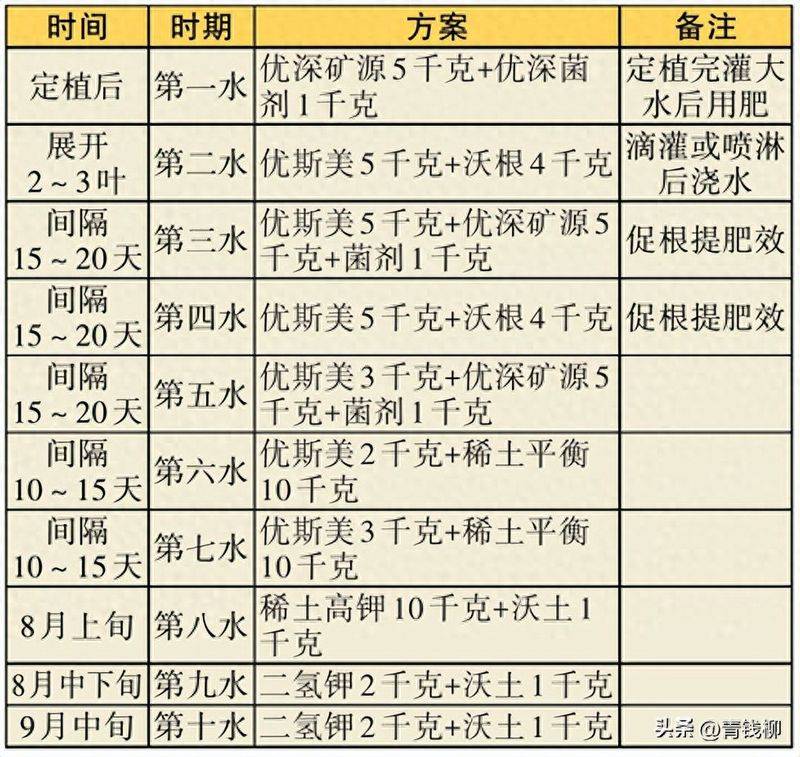
(iii) fertilizer water management