


A pilot study on the techniques used to plant tea and tea in guangxi
Liao mon-woo
Introduction
The oil tea is a tree of woody oil that is unique to our country and whose seeds extract tea oil, which is of high nutritional and economic value. In recent years, the oil and tea industry has grown rapidly as demand for healthy cooking oil has grown. As one of the major oil and tea-producing areas of the country, the guangxi autonomous region (hereinafter referred to as guangxi) has unique climatic and geographical advantages, with oil and tea cultivation and production being among the highest in the country. However, the guangxi oil and tea industry is still faced with low unit yields and low economic benefits, and there is an urgent need to improve industrial efficiency through sound breeding and scientific farming techniques. The development of the economy under forests is an important way to improve the benefits of integrated forest land. Combination of other cash crops under oil and tea forests can increase not only land use rates but also incomes of forest farmers. As a traditional medicine, mackerel is of high medicinal and economic value, and its anti-negative nature is suitable for planting under the forest. Currently, research on well-growing techniques for oil and tea is concentrated in the selection of varieties and management of cultivation, while there is relatively little systematic study of complex cultivation patterns under oil and tea forests. Based on this, the study, which targets the guangxi oil and tea plantations, systematically explores key technologies such as afforestation site selection, land consolidation, good seed selection and planting, and examines the feasibility and interaction of planting bamboo under the oil and tea forest。
Overview of the study area
The research area is located in yongsheng county, guilin city, north-east guangxi, coordinates 109°43"28" - 110°21'14, 25°29'21'-26°12'10'n; the whole territory is mountainous, with an average altitude of 700-800 m and a maximum of 1916 m. The region's subtropical monsoon climate, with an average annual temperature of 18. 2°c and an average annual precipitation of 1,500 mm, is dominated by cash crops such as sprouts, pine, bamboo, oil tea, citrus and medicinal products。
3 selection and consolidation of afforestation land
3. 1 selection of afforestation land
The selection and consolidation of plantations is a key step in determining the quality and production of oil and tea. First, the selection of afforestation sites needs to take into account the environmental requirements of oil tea in a comprehensive manner, and it is proposed that the selection be made at a sun slope or half-light slope up to 500 m above sea level and at a slope of 5° ~ 25° in order to allow the tea to make full use of light resources, while reducing soil erosion due to large slopes. Second, soil conditions are also a factor that cannot be ignored; it is recommended to select the deep, fertile, loose, acidic, yellow or yellow-tan border. In addition, the selection of afforestation sites needs to take into account accessibility, water availability and the risk of pests and pests occurring in the region in order to guarantee later management and maintenance。
3. 2 land-based afforestation
The aim is to improve soil structure, increase soil fertility and create a sound base environment for the growth of oil and tea, usually including the cleaning of forested land, deep soil conversion, and the fertilization of caves. First, the vines, weeds and various shrubs in the afforestation land will need to be fully cleaned, cut off and dryed, followed by refined mountains. Forest fires during the process should be prevented by the opening of fire lines with a width of not less than 15 m around the site. The remaining scavenging and uncombusted miscellaneous items will need to be re-fired and thoroughly cleaned after they have been re-fired. The clean-up of the afforestation land is generally carried out in the autumn of the year preceding the afforestation. For forested lands with slopes of less than 15°, a full-scale land-cleaning approach, using large-scale mechanical deep-throwing of the soil by 20-30 cm, can be used to break the soil sheeting, increase soil perforation and facilitate air and water flow in the soil. Forest belts with a width of 1. 5 ~ 2. 5 m along the contours may be used to maintain the ecological balance and to prevent soil erosion in forested areas with slopes of 15 ~ 25 °. Plantation should be dug at the predefined distance of the plant on the whole site of reforestation (silviculture zone) and cash crops under the forest need to provide a higher range, generally 2. 5 m x 3. 0 m, and the specification of the plantation should normally be 60 cm x 60 cm x 40 cm. Upon completion of the excavation, appropriate amounts of organic fertilizer are applied as base fertilizer in the planting grounds to satisfy the nutrients needed for the early growth of the oil and tea seedlings, generally using consumable farm fertilizers with a fertilization rate of 1,500-2000kg/667m2, which can be filled back at 20 cm above the ground。
4. Good selection and planting
The choice of good species should take into account the biological properties of the oil and tea varieties and, taking into account local climatic conditions, soil types and ecological adaptations, select the best varieties of high-yielding and stable properties that have been determined by national or provincial review or field certification. For guangxi, after years of practice, varieties such as zensoft 2 `zensoft 3' have better adaptive and high yield potential。
The planting time is usually chosen for the first half of the spring in march/early april or for the second half of the autumn in september/late october of each year. At the time of planting, a small pit of 20 cm in diameter and 20 cm deep was first dug in the centre of the planting den, the tree was put into the pit, the marriage interface of the tree was paralleled to the ground, then the roots of the tree were stretched to slightly more than 2-3 cm above the surface of the nutrition cup with wet soil, with light pressure to secure the tree. After planting, the water is filled to promote the close integration of the roots with the soil and to increase the productivity of the trees. When forests are larger, resulting in large quantities of water and difficult to transport, water resources can be saved by planting in the clear days following the rains when the den is completely wet. In the 30d period after planting, the rate of tree activity is checked every 10d, and if a shortage is detected, it should be replenished in a timely manner to ensure that the rate of tree activity in the year of afforestation is over 90%。
5 phenomenas of the forest plant
5. 1 optimal planting density test design
5. 1. 1 test design
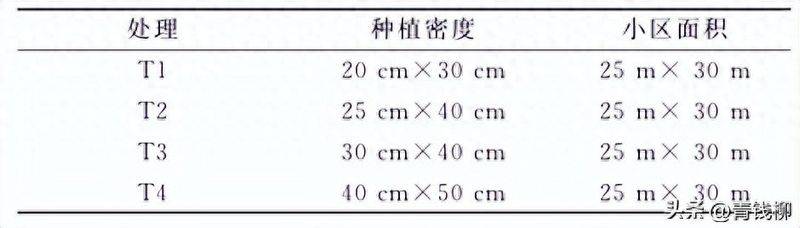
Using random group design, a total of four treatments (table 1) were set up, 20 cm x 30 cm, recorded as t1; 25 cm x 40 cm, recorded as t2; 30 cm x 40 cm, recorded as t3; and 40 cm x 50 cm, recorded as t4; and three repeat tests were performed for each processing. The size of the small area is 25 m x 30 m, and each subsector repeats it once, with a total of 12 pilot sub-areas。
Table 1 pilot design
5. 1. 2 set method
One year after the oil tea was set, the trees stabilized and the bamboo was planted in the forest. The plant is preceded by the excavation of the bamboo-planted cave at a predetermined distance from the tea tree, with a 15cm specification x 15 cm x 8 cm, and then the seed is on-demand and the soil is covered. Clean and cover inter-forest weeds in order to reduce nutrient and water competition while maintaining soil moisture。
5. 2 measurement and analysis of indicators
The mackerel has largely ceased to grow and can be measured by indicators after harvest, using steel feet to determine the height and trajectories of the mackerel in each test zone, excavating the mackerel with field electrons to determine the individual mass of the mackerel and the small weight of the underground tubers, and measuring the number of reserves and calculating the preservation rate. The excel software is then used to record data, and the spss software is used for differential analysis and multiple comparisons。
5. 3 test results
The results of the differential analysis show significant differences between the high seedlings, the earth's path and the fresh mass of the tubers at different planting densities (see table 2). Pt2 processing >t1 processing >t4 processing, with significant differences between the four ( p
Table 2 multiple comparisons of the growth of bamboo at different planting densities

Note: the data in the table are mean ± standard deviations, and the absence of any equivalent letters after the data represents a significant difference between the two (para. P
6 analysis of the impact of the bamboo crop on oil tea
6. 1 test design
Using a comparative test design, five test samples of 25 m x 30 m were set up in the mackerel and unsolicited areas, respectively. The two types of test tea are `zensoft 2' and two-year grade i container seedlings。
6. 2 indicator measurement
After the harvest, the oil and tea growth index was synchronized, and five oil and teas were randomly selected in each sample, using steel feet to determine the tree height and terrain of the tea, and the full fruit of the single harvest was weighed. The excel software is then used to record the data and the spss software to perform the t-test。
6. 3 test results
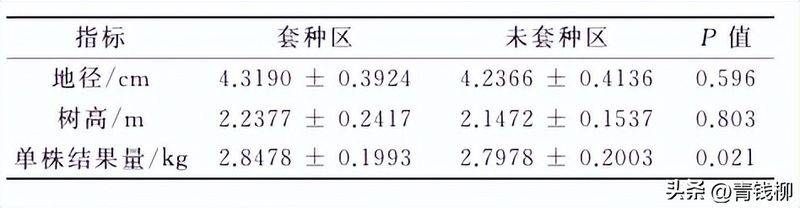
As shown in table 3, there is no significant difference between the size and height of oil and tea in the cropping area and the unplanted area, which indicates that there is no adverse impact on the growth of the oil and tea seedlings; and that there is a significant increase in single production of oil and tea in the stocking area over unplanted areas, which suggests that the cropping of masons can increase production of oil and tea to some extent, with some effect。
Table 3
Discussion
The study explored the feasibility of and interaction with the seeding model of the hot tea plant and the mackerel forest. Research has shown that 30 cm x 40 cm planting density under the oil and tea forest can optimize the growth of the bamboo and have no significant adverse impact on the growth of the tea. The feasibility of such a complex business model may be based on one of the following aspects: a reasonable planting density is key to achieving the benign development of the oil tea-cracker complex. The planting density of 30 cm x 40 cm (t3 treatment) in this study can optimize the growth effect of the bamboo, possibly because it ensures sufficient growth space and sustains moderate competition of stocks, thereby promoting individual growth. There is complementarities in space and time between the two. There is no apparent competition for resource use between the use of oil tea, which is mainly based on ground space and deep soil resources, and the use of ground and surface soil resources. This complementarities has enabled complex farming systems to make fuller use of limited land resources. Three sets of mackerel can improve soil-preservative properties to some extent. A well-developed system that increases soil organic content and improves soil structure is one of the major causes of the increase in oil and tea production in herds. However, this assumption needs to be confirmed by further studies on soil physicochemical properties. However, a number of shortcomings remain in this study: the short duration of the study does not allow for the observation of the effects of long-term crop varieties on the growth and development of oil and tea;2 there is no in-depth study of mechanisms for changing the physico-chemical properties of soils;3 there is no analysis of economic benefits. These issues will need to be further developed in future studies。
Conclusion
Scientific systems of planting techniques and rational undergrowth patterns are important for the sustainable development of the oil and tea industry. This research system explores the technical system for the cultivation of guangxi oil and tea under the forest economy. The choice of forested land and landscapes are the basis for success in the cultivation of fine oil and tea. The selection of a slope of up to 500 m above sea level, or a slope of 5° ~ 25°, or a semi-moderate slope, not only allows the tea to make full use of light resources, but also reduces the risk of soil erosion. Good seed selection and planting techniques have a direct impact on the quality of growing oil tea. The `soft 2' `soft 3' variety shows better adaptability and high yield potential in guangxi. Timing choices and post-plant management measures play a key role in improving survival rates. The 30 cm x 40 cm planting density is the most appropriate when planted in the oil and tea forest, with the largest density of 0. 67 cm and 462. 09 kg in diameter and underground tubing, respectively, and a retention rate of over 90 per cent. Instead of having a significant adverse impact on the growth and development of the tea, the planting of mackerel bamboo under the oil and tea forest has increased the production of single plants of oil and tea, which is significantly higher in the area (2. 8478 kg) than in the unplanted area (2. 7978 kg). In conclusion, the integrated business model under the oil tea-taken forest, which is relatively ecologically complementary and can improve land use efficiency, is a model of economic development under the forest that deserves to be replicated。



