


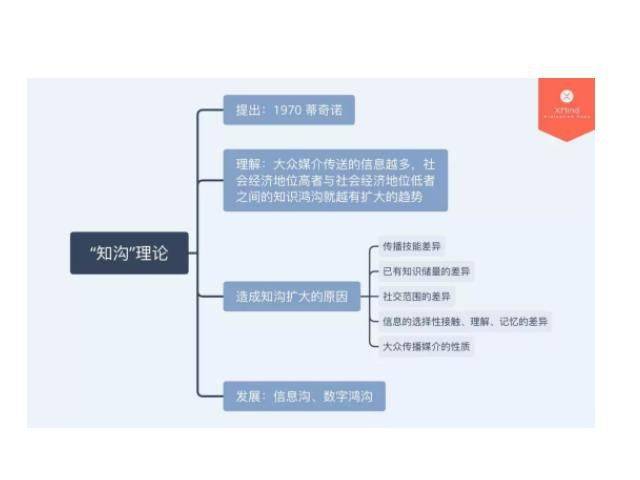
Knowledge gap hypothetical (1) the context of the “know-how theory” in american schools in the 1960s, the apparent disparity between rich and poor children in learning abilities and learning achievement was of wide concern to society. That is to say, children with economically well families often receive good pre-school education before they enter primary school, while children with poor families do not have the money to hire a tutor at the pre-school level, do not have the money to purchase enlightenment books, and when they enter primary school, they naturally have a significant disparity in learning abilities and achievement. Studies have shown that this gap widens as grades rise, leading to a transition rate, academic qualifications and even future occupational and social polarization. In 1970, tichina, donoghue and orion (université de minnesota), “the spread of mass communication flows and the widening of the knowledge gap”: “as the mass media spread more and more information to society, better socio-economically well-off people will have faster access to such information than those with poorer socio-economic conditions. As a result, the knowledge gap between these two groups will be widening rather than narrowing.” the population with high socio-economic status, the population with low socio-economic status, the knowledge time, the main point of view, as mass communication spreads to society increases, the better off people gain knowledge faster than the worse. 2. The topics that have been widely publicized by the media over time are more accessible to people with higher education than to those with lower education. Within a given time frame, the knowledge acquired is more relevant to the level of education on topics that are heavily publicized by the media. (4) the reasons for the expansion of the “know-how”1 and the fact that people with a high level of education in communication skills are more likely to have the necessary information processing capacity. 2. Different information storage capabilities and diverse background knowledge affect people's understanding and understanding of information. 3. People with high socio-economic status on the interpersonal network have greater access to people with knowledge or a wealth of information. 4. Information on science and public affairs is of greater interest to those with high socio-economic status in the selective process. 5. Media-specific mass media tend to be more responsive to the needs of those with high social and economic status. (5) the “ceiling effect” hypothesis of 1977, j. S. Etima and f. G. Klein, presented a view contrary to the “cading effect” hypothesis, namely the “ceiling effect” assumption. The basic view is that an individual's pursuit of a particular knowledge is not endless, and that when a “cap” (saturation point) is reached, the increase in the volume of knowledge slows down or even stops. The “ceiling” of those with high socio-economic status, who have gained access to knowledge at a faster rate, and those with low economic status, while slowly increasing their knowledge, can eventually catch up with the “ceiling” over time. In support of its view, etima put forward three arguments: the “ceiling” knowledge available to the “ceiling” audience itself, determined by the nature of the source of information, reached the “ceiling” b. “information ditch” theory in 1974, and n. Katzman introduced the “challengus” theory. In the context of information becoming an increasingly important means of wealth, the “information gap” theory attempts to answer a very realistic question of the information society: how to prevent and resolve the polarization between “information rich” and “information poor” and the resulting new social contradictions. The theory offers the following perspective from the perspective of new communication technologies: a. The introduction of new communication technologies will increase the flow of and access to information for society as a whole, for every member of society. B. The benefits of the introduction of new technologies are not equal for every member of society. Those who have a higher level of information available or have greater access to information have access to more information than those who have a lower level of information or have less access to information. C. Machines such as computers are much more capable of processing and storing information than humans, and the information-rich are better able to use these sophisticated information media at an early stage than others. The trend is likely to be that the “old divide” has not been filled and that the “new divide” has emerged. This is particularly evident in the use of new media. ♪ a. The performance of the information gap in a web-based environment when the internet emerged, many people began to place their hopes on the internet, hoping that the internet would narrow the divide between rich and poor countries, and that the gap between the poor and the rich would be bridged and the good news for all. However, after almost two decades of development, it has not actually eliminated the gap between the rich and the poor in terms of total knowledge, but has widened it. (6) gaps in the web environment - the expression of the “digital divide” (digital divide) (1) the international divide refers primarily to differences between the use and development of network technologies between developed and developing countries. (2) the regional divide takes the example of the country, where the level of economic development varies between regions and where the use of networks varies greatly. In the eastern part of the country, the internet and the network economy are growing relatively rapidly owing to the more developed economy, while in the vast western and central regions, the growth of the internet and network economy has been relatively slow owing to various factors. (3) the advantages of the gap between the rich and the general public in the internet are unquestionable, but expensive facilities, expensive access to the internet, hard-to-understand computer knowledge and knowledge are prohibitive to most. It seems that a watershed divides the public in two: one is a media technologist and a highly educated team, while the other is a general public. Although the number of internet users is increasing every year, the survey results indicate that internet users in china are still only a minority. On april 15, 2010, the china internet information centre (cnnic) published a survey of rural internet development in china 2009. According to the report, by the end of december 2009, the number of rural internet users in china had reached 1. 68 million, and while the number of internet users had continued to grow, the gap between urban and rural internet continued to widen in terms of penetration, network structure and network application. (1) by the end of 2009, the number of rural internet users in the country had reached 1. 68 million, an annual increase of 2. 2 million, or 26. 3 per cent. Of these, there are approximately 71. 9 million rural mobile phone subscribers, an increase of more than 30 million compared to 2008, an annual growth rate of 79. 3 per cent, which is much higher than the overall increase in rural internet users. (2) in urban and rural areas, internet penetration is 44. 6 per cent in urban areas and only 15 per cent in rural areas. The cnnic report compares the development gap between urban and rural internet in china since 2007: in 2007, the gap between urban and rural internet penetration was only 20. 2 per cent; in 2008, the gap widened to 23. 5 per cent; in 2009, the gap widened to 29. 6 per cent; rural internet development was slower than urban development; the gap between urban and rural areas was widening; and the “digital divide” between urban and rural areas was widening. The report of the cnnic compares the application of the internet network between urban and rural areas, where the use of the internet is much higher than that of rural communities. In both typical business applications, especially online shopping and online payments, urban usage was 31. 7 per cent and 27. 7 per cent, respectively, while rural use was only 17. 6 per cent and 15. 1 per cent. (7) the relevance of the ditch theory,1 and the need for society as a whole to take measures to ensure balanced access to information for all members of society. We still have gaps in both hardware and software. There are gaps in new areas of communication in the country. Governments should support less developed regions in terms of “hardware”. 3. There are differences between sectors or groups of society in terms of capacity to use the media, and the capacity to use the new media should be developed in terms of “software”. 4. Because of the different contacts with the media, the organizers of the information event are reminded of the need to look at the audience and choose different media to reach different audiences。



