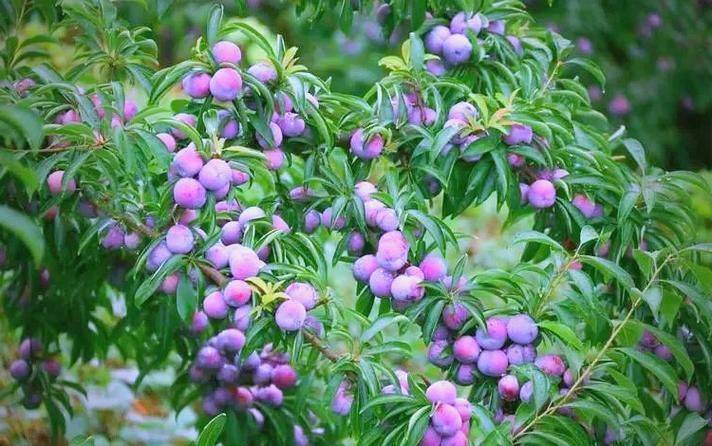
Vol. 3, no. 1, of 8th year, the performance of the chinese southern fruit tree 7-3 pearl lee in guangxi tiansai and the cultivation of the nkwe haiyan. 54 7 30 0) in the northwest of guiang, which is the subtropical monsoon climate region, chang mei yun zhang zong bin tensei county has 25 varieties of lee, according to the 1986 fruit resources survey. Pearl lee is an excellent species chosen from the local plume, which has the characteristics of production, disease resistance, quality, and late ripening. One of the main botanical properties is a year-old gray branch, a soft branch, an open tree, a dry, brown tree. Wedge wedges, sharp-tips, shallow-sorted leaves, 1. 6 cm long leaves, 10. 5 c m long leaves, 2. 5 cm wide. The sequence is four to six flowers. The horticultural nature of 2. 1 objects is sprouts around 25 february, fresh flowers around 5 march, flowers around 12 march, and flowers at the end of 20 march, with a duration of about 10 days. The consequences were ripe before august 15, and the fruit was produced for 14 1 days or so. Nutritional life lasted around 250 " days and leaves fell in late november. 2. 2 a single fruit weight of 23 g, a maximum of 35 g, a flat top of the fruit, and a shallow line of stitching. Dark purple, red, full of white thick fruit powder, beautiful looks. Jelly oranges, fine meat, freckles, sweetness, good taste, hard meat. Off the core, small nuclear. Eatability rate 9 6. 5 per cent. Soluble solids at 13. 9%. It's extremely resistant, and it can be stored at constant temperatures for 20-25 days. 2. 3. Growth results are strong, growth rates are high, branches are strong, tree positions are semi-open, argon buds are easy to form. The fruit period is dominated by the medium-term, short-term branches, which are very productive, and the results are not obvious in years and years. Z. 4 in terms of growth results over the years, pearl lee is well suited to weather conditions. High temperatures and droughts in the summer rarely lead to large leaves falling. There's no visible disease in the rain. In the winter, low temperatures meet the demand for low temperatures for gushing. Jell-o, more resistant to fruit-breeding night moths than the local plum. `3 cultivation technique 3. 1 cultivated sprout wood selection. In general, there is more choice of peach in production. Li's growth was slow for 16 months, and it was hard to reach the roughness required to get married, not to get married. Peach seedlings are growing rapidly, and in mid-may the thickness of the plumbers generally reaches 0. 4 cm or more. Early planting and timely fertilization. Peach seeding is covered with a membrane cover, which normally germinates 10-15 days before the unused membrane cover. The plant can be moved when the seed is 2-5 c m high. Clean up the nursery before planting, applying 10 ~ 50 0 k g per 667 n 12 applied to high-quality mature farmers. After planting, you take the root water, you take it one at a time, three to five days, you make sure you live. When the trees are alive, 0. 3% of the urea or screech water every 10-15 days promotes the rapid growth of the seedlings. Period and method of marriage. The marriage took place in two periods, between mid-may and mid-june, or between the beginning of august and the end of august. By mid-may, the logs were not thick enough to get married. In july, the temperature was too high and the fertility rate was low. After august, the marriage rate is high, but because of lower temperatures and slow growth, it is difficult to reach the roughness and height required to grow a seedling without better management. The method of indoctrination consists mainly of cutting and sprouts. May-june marriage is better with a sprout, which is simple, fast, has a high rate of survival, has a low cost of marriage, has a strong tree. In august, it's better to get married, to have a high rate of activity, to grow fast, to grow fast. After-marriage management. Apply compound fertilisation once after marriage, applying 150k g per 6 7 m 2. In summer, in may, once a month fertilized, mostly by nitrogen; in autumn, once every 15 days, with urea or screech water, until october, when fertilizer stopped. When you get married, you have to remove the buds of the lumber in time, you have to untie them when they're 10 to 15 c m tall, and you have to take care of the branches in time. Insects and insects are found to be treated in a timely manner. 3. 2 landing selection. Pearly is adaptable, infertile, dry, slope, hilly, limestone, red yellow, but it's best to have deep, fertile soil. We'll dig the caves and fill them back. During the first 1 to 3 months of cultivation, the caves were dug at a distance of 3 m x 4m. . 8mx0. 8mx0. 6m. When digging, the cousins are separated from the new earth. Within a month of planting, we'll have enough fertilizer. Fertilizers are grown mainly by farmers, in combination with phosphorous fertilizers, and piles of tungsten are ripe for use at the ratio of i0 ~20k g + 0 phosphorous . 5 kg. One week before planting, fill the cave back, dig up the corrosive soil around the cave and fill it in, then fill it back to two-thirds of the volume, so that the man-made man-made manure. And then we'll continue to fill the surface fertilized soil. Make it 20 to 25 cm above ground. Make sure you're alive. The choice is usually made before the spring bulge. The seedlings require development, two or three branches, and the marriage interface heals well. At the time of planting, shallow caves were first dug in the middle of the well-established cave soil, the seedlings were placed in the centre of the cave, the roots were naturally stretched,* the communications author telephone: 138 7 7 8 350 6 7, e-n m llw h 9 9 9 8 9 9 @ 126. To m square data