


Article 7. The departments administering patents in the provinces, autonomous regions and municipalities directly under the central government may refer the case to the national intellectual property authority for an administrative decision in the event that they consider the case to be a major patent tort claim within the jurisdiction。
Article 8。
Article 9
(i) is a close relative of the party or his representative
(ii) has an interest in the patent application or patent
(c) other relations with the parties or their agents which may affect the fairness of the case。
The person concerned also has the right to apply for recusal of the person handling the case. In the case of an application for recusal by a party, the reasons shall be given。
Qualification of case handlers is decided by the department responsible for the case。
Article 10. The national intellectual property authority shall, within five working days from the date of the filing of the case, send a copy of the request and its annex to the person to whom the request is addressed, with a request to submit a statement of reply within 15 days from the date of receipt and a copy of the statement of reply in accordance with the number of requests. The late submission of the respondent's statement of defence shall not affect the disposition of the case。
If the respondent submits a statement of defence, the national intellectual property authority shall transmit a copy of the statement of defence to the claimant within five working days of the date of receipt。
The national intellectual property authority may combine cases of violation of the same patent rights。
Article 11. In the course of the proceedings, the applicant who applies for an additional person shall, if the condition of the jointly requested person is fulfilled, be ordered and notified by the state intellectual property agency to the other parties, and if the condition of the jointly requested person is not met but the condition of the request is met, the additional application shall be dismissed and the applicant shall be informed of the request in a separate case. The person against whom the request is made shall be informed if the person against whom the request is made makes an addition to the other party. If the applicant agrees to the additional, the decision is taken to grant the additional. If the claimant does not agree, the other parties may be added as third parties. A request for an additional person, or a third person, shall be filed prior to the oral hearing or shall not be supported。
Article 12. The parties have a duty to substantiate their claims. Evidence that the person is unable to collect for objective reasons may be submitted in writing to the national intellectual property agency for investigation or examination, with preliminary evidence and reasons. Depending on the need to establish the facts of the case, the national intellectual property authority may also investigate or inspect the case in accordance with the law。
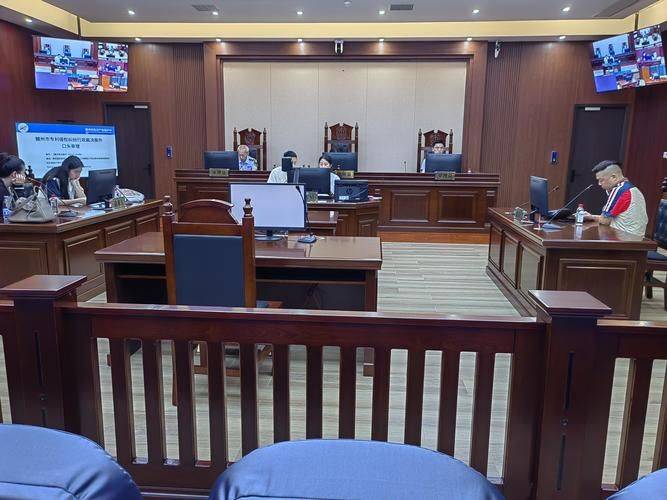
No fewer than two persons may be involved in the investigation or examination of the case, and the person concerned shall be presented with the document of the case。
Article 13. In the course of their investigation or examination, the person conducting the case may exercise the following powers:
(i) asking interested parties and other relevant units and individuals to investigate information relating to suspected patent infringement
(ii) on-site inspection of premises where the person is suspected of patent infringement
(iii) inspection of products related to suspected patent infringement。
The person or persons concerned shall assist, cooperate with and refrain from refusing or obstructing the investigation or examination。
Depending on the needs of the job and the circumstances of the case, the national intellectual property agency may entrust the investigation of the case to the local patent administration。
Article 14. Where patent infringement disputes involve complex technical issues requiring verification, the national intellectual property authority may, at the request of the party concerned, commission the examination. If the parties request an examination, the identification unit may be determined by agreement between the parties; if this is not possible, the national intellectual property authority shall designate it. The examination of the expert opinion was not examined and could not be used as a basis for determining the case。
If the parties agree on the cost of identification, they agree on it. If there is no agreement, the costs of the identification shall be paid first by the party applying for the identification and, at the end of the case, by the responsible party。
Article 15. The national intellectual property authority may appoint technical investigators to participate in the handling of cases and make technical inquiries. Relevant technical survey opinions may serve as a reference for the panel to determine technical facts. The management of technical investigators is provided for separately。
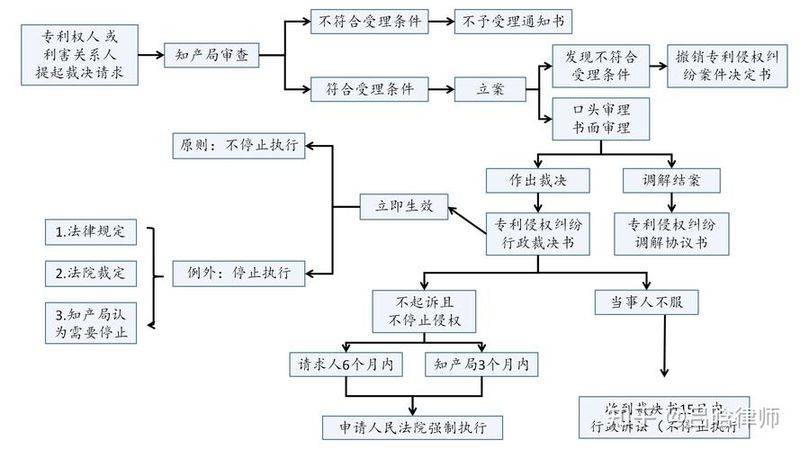
Article 16. The national intellectual property authority decides whether to conduct oral proceedings as the case may require. In the event of an oral hearing, the person concerned shall be informed of the time and place of the oral hearing at least five working days prior to the oral hearing. If the party refuses to participate without just cause or withdraws without permission, the request is dealt with in accordance with the request for withdrawal and the requested person is treated in absentia。
Article 17 a party may apply for a stay of action or the national intellectual property authority may decide ex officio to discontinue the case if:
(i) the applicant applied for annulment of the patent in question and was admitted to the state intellectual property office
(ii) the death of a party is subject to an indication by the successor that it participated in the proceedings
(iii) if a party has lost civil capacity and no legal representative has been identified
(iv) the termination of a legal person or other organization to which it is a party has not yet established the person to whom the obligation is owed
(v) if a party is unable to participate in the hearing because of irresistible events
(vi) the case must be based on the outcome of the other case, which has not yet been completed
(vii) other circumstances requiring suspension。
Article 18 the national intellectual property authority may not suspend a case if:
(i) a search report or patent evaluation report issued by the applicant does not identify deficiencies in the practical new or appearance design patent rights that do not meet the conditions for patenting
(ii) the avoidance declaration procedure has already made a valid decision regarding the maintenance of the patent for the useful new or visual design
(iii) the grounds for the stay advanced by the parties are manifestly unfounded。
Article 19 the national intellectual property authority may dismiss the case if:
(i) if it finds that the case is inadmissible
(ii) if the request is withdrawn by the claimant
(iii) the death or cancellation of the request, the absence of a successor or the waiver by the heir of the request
(iv) the person whose death is sought or who is cancelled or who is not liable
(v) other cases requiring dismissal。
Article 20 a case may be terminated during an administrative decision if the patent right in question has been declared invalid by the state intellectual property agency. If there is evidence that the decision to annul the said right has been set aside by an administrative decision in force, the right holder may file a separate claim。
Article 21 the national intellectual property authority may organize conciliation between the parties. If the parties so agree, the state intellectual property authority produces a conciliation letter with a public seal, signed or stamped by the parties. If mediation is not possible, administrative decisions should be made in a timely manner。
Article 22 the national intellectual property office deals with patent-infringement disputes, which should be closed within three months of the date of the case. If, due to the complexity of the case or otherwise, the case cannot be concluded within the prescribed time limit, it may be extended by one month upon approval. If the case is particularly complex or otherwise exceptional and the case cannot be closed after an extension, if the extension is granted, a reasonable period of extension shall be established at the same time。
In the processing of cases, suspension, notice, examination and identification are not included in the time limit for processing the case referred to in the preceding paragraph. The duration of the request for change, additional co-receivers and third parties is recalculated from the date of the request for change, identification of the co-receivers and third parties。
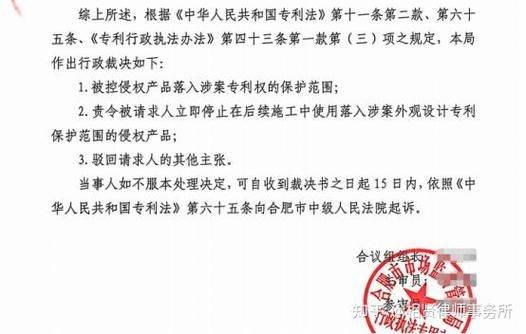
Article 23 administrative decisions by the national intellectual property authority shall be issued and stamped with administrative decisions. The administrative decision found that the patent violation had been established should order an immediate cessation of the violation and, if necessary, notify the competent authorities and the competent authorities of the local people's government of their cooperation in the timely cessation of the violation. If the person concerned objects, he or she may, within 15 days from the date of receipt of the administrative decision, bring the case before the people's court in accordance with the administrative procedure law of the people's republic of china. The enforcement of an administrative decision is not suspended during the proceedings except in cases provided for by law. The state intellectual property authority may apply to the people's court for enforcement if the applicant does not file a complaint or ceases to commit a violation。
When an administrative decision is issued, it shall be made public in accordance with the government's public information ordinance and the relevant provisions. When administrative decisions are made public, information concerning commercial secrets should be deleted。
Article 24: abuse of authority, negligence, favouritism or disclosure of business secrets known to the staff member in the course of the case shall not constitute an offence and shall be punishable by law and shall be brought before a judicial authority for any alleged offence。
Article 25 this approach, which is not provided for, is implemented in accordance with the provisions of the patent administrative enforcement scheme and the administrative decisions of the national intellectual property authority on patent torts disputes。
Article 26 this approach is interpreted by the national intellectual property authority。
Article 27 this scheme applies from 1 june 2021。



