


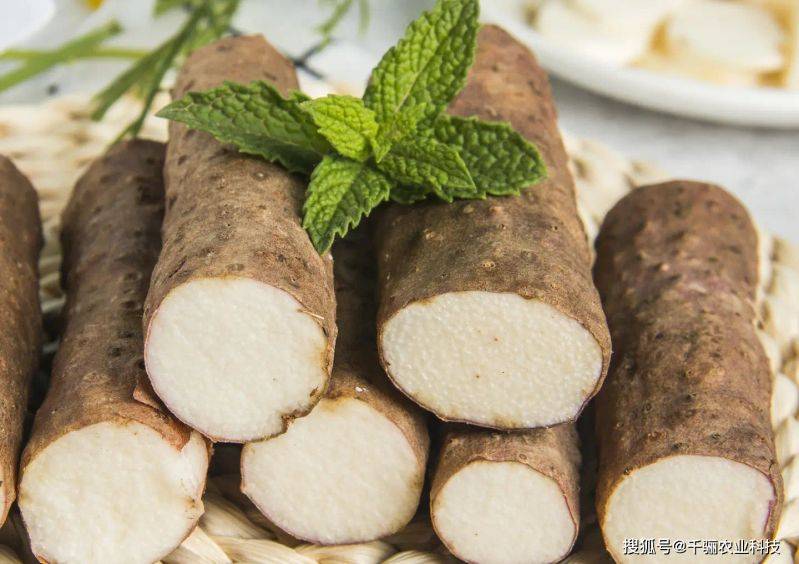
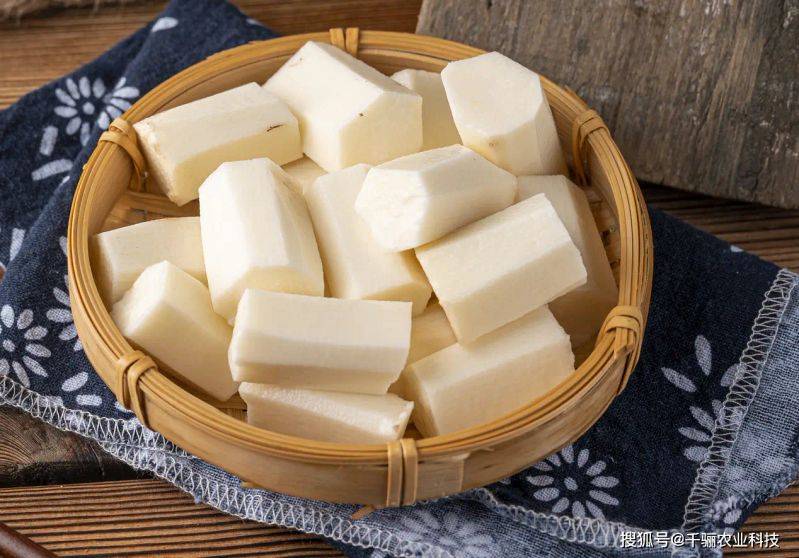
Dioscoreopposita, which has been entangled for many years in cassava, has an underground plume that is a traditional drug co-crop in our country. The tubers are cylindrical or flat, the surfaces are strewn with fine roots and the flesh is fine and fine. It is documented in this basics that the pharmacists have the capacity to replete the pulmonary pulmonary and condensate the kidneys. Modern nutrition studies have shown that mountain medicines are rich in slime proteins, starchases, polyphenol oxidation enzymes, among which mucous proteins protect the stomach mucous membranes, which facilitate carbohydrate digestion and are particularly suitable for diabetics. In addition, mountain medicine contains a wealth of potato soap and is the main raw material for synthetic hormones。
Basic conditions for mountain medicine cultivation
Climate requirements
Mountain pharmacists are warm and cold, and subterranean troughs start to move above 10°c and grow at 20-28°c. Leaf expansion requires sufficient light and a 6-8-hour sunlight per day. It is worth noting that the pharmacist is a short-sun-ray plant that expands faster and faster in the autumn of the sun. In my country, the northern part of china uses the spring-spring harvest model, while the southern part of china can grow on its anniversary。
Soil requirements
The most suitable soil for cultivation is the fertile sandy border soil, which has the following advantages: firstly, the sandy sandy soil is permeable and has the advantage of growing downwards in the tubers; secondly, the ph value is 6. 0-7. 5 and the acid soil needs lime improvement; and lastly, the groundwater table is required to be less than 1 metre and water is not required to cause decay during the rainy season. Soil testing should be carried out prior to planting to ensure that heavy metal content is not exceeded。
Iii. Choosing mountain medicine
The main plant varieties currently include:
White mountain medicine: this is represented by henan huaishan medicine, with a length of 3-5 cm in diameter of up to 1 m and suitable for cultivation in deep-soil areas。
• purple mountain medicine: it is rich in vasectomy, mainly in guangxi and yunnan, with a relatively short tubing and a high level of resistance。
The selection of varieties needs to take into account local climatic conditions, such as the choice of cold-resistant varieties in the north and wet-resistant varieties in the south。
Preparation of mountain medicine for cultivation
Land cleaning
The front line is based on grass-roots crops and avoids obstacles. In the winter, 40-50 centimetres of hard matter, such as stones, are removed. Zirconium at 1. 2-1. 5 m width and 30 cm deep in the giraffe. For long-mountain drug varieties, it is necessary to dig into a planting ditch of 80-100 cm depth。
Fertilization and soil improvement
Base fat, which is dominated by the fat of mature farmers, is applied from 2000 to 3000 kg per acre, with 50 kg of calcium phosphate. The sandy soil can be modified with additional clay and the clay can be mixed into river sand to improve permeability. The fertilization should be followed by ploughing and soil laxation。
Technology for mountain medicine cultivation
Patterns of cultivation vary from region to region:
The yangtze basin planted seeds between late march and early april
North-east sector postponed until early may
Double-line planting, 80 centimetres and 25-30 centimetres
During seeding, chips weigh 50-100 grams, with one or two strong buds preserved, and grass-grass protected. Seed depth 8-10 cm, light pressure shielding after the soil。
Vi. Management of mountain medicine fields
Water management
The soil should be kept dry and wet during the seeding season, and the water required for the bulk of the tubing (july-september) should be guaranteed at 70-80 per cent. Use drip or ditch irrigation to avoid flooding. During the rainy season, ditches are cleared in time to prevent flooding。
Fertilizer management
Fertilizer recovery takes place three times: urea (10 kg/acre) at 30 cm height; high fat (15 kg/acre) in the current cedar period; and 0. 3 per cent potassium phosphate sprayed on long-term leaves in the tuber. Note that nitrogen fat is not too big to be long。
Pest control
The most common diseases are anthrax (brown on the leaves), root decomposition (bone rotting on the troughs), and mainly subterranean pests such as vermin and tigers. Precautionary prevention, with a rotational system, was followed in the early stages of the disease by medicines such as desen manganese zinc。
Biopharmaceutical management
Combination oligarine is by definition a complex of several types. The chinese term "oligosacchariide" refers to compounds that contain a combination of 2-10 (also known as 3-10) sugar slurry keys, often combined with protein or lipid co-prices and in the form of sugar or sugar。
Combination oligarine, which is derived from plants (mether herbs) and biochemical technologies and is developed exclusively. It can activate specific metabolic pathways for microorganisms and achieve protein synthesis correction。
This technology allows for the integration of soil micro-ecological rehabilitation, the physical metabolic correction of medicinal products, the efficient conversion of drug-planting straws and ecological conservation, the provision of fundamental pathways for the decomposition of herbal herbs with self-toxic effects, endemic diseases, the spread of the nuccultary cycle of bacterial diseases, agricultural disability and contamination of heavy metals, and the coordinated regulation of technical barriers to the “high-yielding cultivation, stable material maintenance and ecological sustainability” of the production sites。
Advantages of compound oligarine:
1. Increased seed sprouts in crops and more than 80 per cent of seed sprouts
2. The effects on the root system, which are well-developed and nutritional microbolic
3. Improving the efficiency of light cooperation in crops
4. Improving the resilience of chinese herbal crops and reducing the incidence of diseases
5. Increase crop breeding sites and increase the number of solid grains
6. Improving the resilience of chinese herbal crops
7. Pre-cooking to pre-empt the content of herbal active substances
8. Improve crop quality and increase production by more than 20 per cent。
Harvest and storage
The timing of the harvest
The optimal harvest time is when the leaves are yellow and the end of the tubing is round. The north is generally before and after the fall, and the south can be extended until december. A week before the harvest, irrigation was stopped to facilitate excavation。
Harvest techniques
Artificial harvests are dug along the side of the planting ditch to avoid damage to the tubers. Mechanical harvests will need to adjust the depth of excavations, with a loss rate of less than 5 per cent. Five centimetres of roots are retained after harvest to facilitate storage。
Storage methods
The maximum storage temperature is 4-8°c and the relative humidity is 85-90%. This can be done by selecting a cool ventilated area with a wet sand layer of mountain medicine. Pay attention to removing the bruised truncheons and periodically inspecting the deterioration。
Conclusions
With the development of a large health industry, demand for mountain medicine markets has continued to grow. Through the promotion of standardized planting techniques, our mountain pharmaceutical industry is moving towards scale and branding. In the future, the development of sophisticated processed products, such as mountain powders, extracts, etc., should be strengthened to increase industry value added. At the same time, a traceability system has been put in place to ensure the quality of mountain medicine from the field to the table。



