Form features
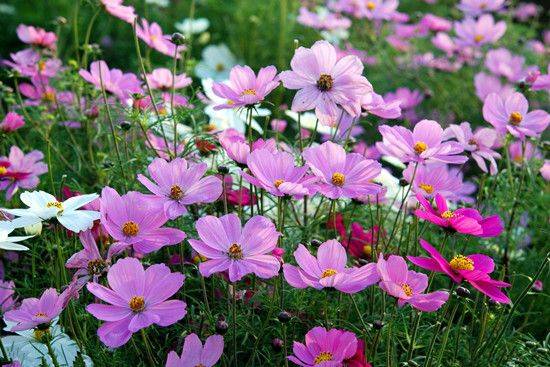
Persia, a year-old herbivorous plant, with 30 to 120 cm in heights, with a straight stem, with more branches, smooth and hairy. Single-leaved, approximately 1 0 cm long, two-fold plume fully fractured, fracturing narrow line, full-skinned. The head is lined up on a long crotch, with a primer or armpit and a tuber of 5-8 cm. Total package 2 layer, inner edge membrane. The larvae, with the tip of the petals, eight petals, white, powder, deep red. The drums occupy the central part of the florist. Thin fruit has tungsten, seeds have a life of 3-4 years and dry grains weigh 69. Summer, fall. The horticultural variants are white puss, large puss, purple puss, horticultural varieties with two systems, early and late, and single and heavy petals. Min
[growling habits] radiant soil, anti-fertilizing soil, over-fertilizing soil, anti-hot soil, anti-water accumulation, inflexible to high summer temperatures and intolerant to cold. There is a need to defusing fertile and well-drained land。
"reproduction methods."
Seeding or planting。
Persia breeds with seeds. Early spring sowing, may-june flowering, august-september hot weather, heavy rain and less flowering. After autumn, the flowers continued to bloom until the frost fell. If we sow in july-august, it will bloom in october, and it will be short and full. The seeds of persia are self-sowning and, once planted, a large number of seedlings will be produced later and, if protected, will bloom as usual. It can be broadcast in mid-april in open beds, where temperatures are suitable for around 6-7 days of seedlings。
It is feasible to incubate during the period of growth, to cut 15 cm to the left of a strong branch, to be inserted in the sandy soil, to be properly shaded and wet, and to have roots for five to six days。
The spring of april, the sprouting, the 7-10 days after the sprouts. It's also possible to grow with a little twigs, and then 15 to 18 natural roots。
It's a four-to-five-leaf transplant, and it's also live. In the case of plant-based fertilizers, there is no need for long-term fertilization, and if the soil is too fat, the leaves are too long and the flowers are less flowering. During the high temperatures of july-august, flowerers were not easily condensed. Seeds should be harvested in the morning when they mature. Persia is a short-day-photo plant, and spring seedlings tend to be small, and summer seedlings grow small, neat and flowering。
Cultivation management
Persia is strong, bright, drought-resistant and less demanding than soil, but cannot accumulate water. If planted in fertile soil, it can cause long leaves and affect the quality of flowers。
Saplings are transplanted at 5 cm height, leaves are planted at 7-8 hours and are also broadcast live. In the case of plant-based fertilizers, there is no need for long-term fertilization, and if the soil is too fat, the leaves are too long and the flowers are less flowering. Or decomposition of run-off urine every 10 days during growth. Two to three times during the drought, i. E., growing and flowering. During the high temperatures of july-august, flowerers were not easily condensed. Seeds should be harvested in the morning when they mature. Persia is a short-lived plant, and spring seedlings tend to be small, and summer seedlings grow small, neat and flowering. It grows fast and can be heartbrushed many times to increase branches。
The persian pyre is large and should be planted in the wind so as not to be inverted or damaged. The plant is usually grown into a small plant, that is, tops it up 20-30 cm high, and is subsequently removed several times from the bud, so that the plant can shrink; it also increases the number of flowers. It is desirable to plant a little fertilizer. It is appropriate to pick the seed when the thin fruit is slightly blacked in order to avoid a fall of maturity。
Cultivation:
The seedling period requires short-day photos for normal flowering, and suitable planting time should be available; it should be broadcast live in the open; it should be seeded about 1 cm and 5 - 10 days; and the 5 - 6 seedlings are transplanted at a distance of 30 - 50 cm, with a long-term graft, which can lead to branching and excessive control to avoid a later fall. The soil is not demanding, but it cannot accumulate water, it is cold and it is cold. Infertile soil。
"conservation point."
Reproduction: sowing or adhesive reproduction. It can also be used in summer。
The seeds were planted in the field seedbed in late march and in early april. Temperature may also sprout at a lower 15°c, but if seeded at an early age, it would grow into a 2 m-high strain, which could easily be reversed by typhoons or plant weights. There are also early-opening varieties that bloom 50 to 70 days after planting, so that they are planted in separate mornings and autumns。
Management: temperature-to-smooth, mild early frost, less stringent for soil. A 5 cm high is a line transplant and leaves 7-8 are planted. The requirement for fatty water is not stringent and is grown every 10 days with five times the amount of decomposition urine. High school-type varieties need to be supported in case of windfall. It grows fast and can be heartbrushed many times to increase branches. The risk of red spiders during hot heat is such that early intervention is appropriate. Like planting in late july and early august, it will take 50-60 days to bloom, with small and well-developed plants for national holidays. When the seed matures, it is possible to cut it down in a colourful order and leave it dry。
In order to grow a small, inverted large persian daisy, the following measures should be taken:
1 late in july。
When it grows to 40-50 cm after 2 springs, it takes care of its heart, so that it will bloom。
Three pillars, such as short bamboo, were raised as soon as possible。
Diseases and vices: it is important to respond to diseases such as disease, aphids and leaf mites. Spray benomyl for fungus, vermin oltola。
How do we stop persia from falling
The persian daisies are relatively tall, thin, flowery and beautiful, but they tend to turn upside down and scrambling. The reversal of persia can be prevented by:
Seeding took place in august 17th. During this period, the persian curry seeded will bloom in october and grow in small and well-developed areas。
Two hearts. Over the long term, there is a need for a number of choreographys, which, on the one hand, can reduce the whole plant and, on the other hand, contribute to increasing the number of flowers。
Water is less fertilized. Excessive fatty water tends to lead to the growth of plants and to inverts, with few flowers。
♪ the harvest ♪
The harvest is in the line of the persian daisies. When the buds are half-open and open, they can be harvested, preferably at lower temperatures in the morning. The product should be placed in a bucket immediately and pre-cooled as soon as possible。
(b) [strategic] collections of flowers should be graded before they are characterized by a typical variety of characteristics, non-destructive contamination, and good visual performance: primary cut flowers are about 60 cm long; the length of the secondary cut flowers is around 50 cm; the length of the third cut flowers is around 40 cm. The difference in the length of the cut flowers of the same grade should not exceed the standard of 2 cm。
[packaging] stabilize 10 bundles of the same grade and variety of persian pristine infarction sequences, with separate codes in the liner prism boxes marked with prototyping holes。
It's a temporary cut. Usually available, not in long-term storage, and should be used as soon as possible after collection。
In accordance with the above-mentioned method [the storage period], the infarction sequence of persia is usually capable of storage for one to two days without compromising the decorative effects。
"physics."
The main diseases and pests are often characterized by folic and powdery diseases. Fifty per cent of the tobu humid powder can be sprayed 500 times as liquid. The pests are aphids, gold turtles, and 2500 times as much as 10 per cent of the insect concentrate. The risk of red spiders during hot heat is such that early intervention is appropriate。