"it's too much trouble to wear a general near-sighted mirror in the house and to change sunglasses outside." the summer sun is getting stronger, and the light glasses, which automatically change color, become a popular choice for many near-sighted people because of the convenience of a "one-size-fits-all " . But are these glasses working? In recent days, al's ophthalmology has helped consumers rationally to determine whether they are fit for themselves by interpreting in detail the principles, strengths and weaknesses of transcolored near-vision lenses in general。
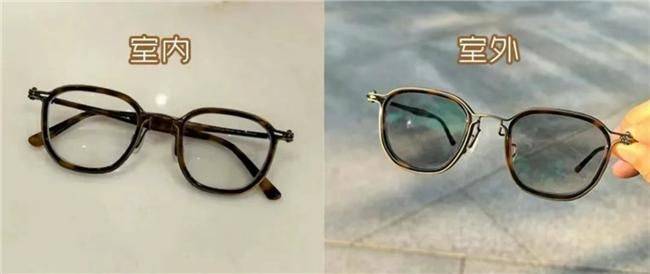
The core of the colored lenses is "lightly coloured" and their rationale varies slightly depending on the type of lens. Elephthalmic presentation, the current mainstream colour change lens is divided into two categories: “base change lenses”, which are evenly integrated into the lens material, with reactions in ultraviolet light that deepen the lenses and gradually restore transparency when they are removed from ultraviolet light, with the disadvantage that the change is relatively slow; and “film change lenses”, which are attached to special thin films on the lens surface, which are faster to change than the base change lenses, are faster to adapt to external light, but are more expensive, and consumers can choose according to needs and budgets。
In terms of advantages, the convenience and protective nature of transcolored near-sighted glasses are to be recognized. El eye has pointed out that it does not need frequent mirror changes or patches in the interior and outside, and that one pair of glasses meets the needs of a variety of scenarios, such as work, street shopping, outdoor exercise and so forth, especially for those who are often out of the country; at the same time, it effectively stops ultraviolet light and strong light, reduces the irritation of the cornea and reduces the risk of eye diseases such as cataracts; and, in addition, the colour of the lens automatically adjusts to the depth of the uv, helps to smooth the eye with light changes and relieves eye fatigue caused by sudden changes in light。
However, there are also some deficiencies in the colored glasses. El's ophthalmology reminds us that the most obvious is the restricted colour-change scenario -- when driving, the car windshield filters most of the ultraviolet light, making the lens impossible to change color or to change light to cope with strong light; in an indoor environment with a strong source of light but not uv-free (e. G. Under a strong pv lamp), the lens will not change colour. Moreover, the luminescent lens can be reduced, may affect visual clarity, and some of the lenses may have colour deviations that require careful selection by populations with high colour judgement (e. G. Designers). In addition, the price is higher than the average near-sighted lens, which increases the cost of mirroring。
"selection versus non-selection, professional matching is the key." elephthalmics emphasize that the selection of transchromic close-vision glasses is a priority for specialized ophthalmological medical institutions, which can provide full-process services from eye examination to precision mirroring, and avoid prejudice to the vision due to the lack of light. In addition to the speed and price of change, emphasis is placed on the core performance of the lens: basic performance, selection of a suitable refractive rate based on the near-sightedness (higher per cent of the population can choose a high-reflection lens, lighter); focus on the abets (higher the value, clearer the vision), millability (impacting the useful life), and long-term use of electronic screens, with priority given to blue light protection; and on the exclusive properties of colour change, with a high-quality lens capable of colour change of about 30 seconds, faded about 1 minute, and uv400 certified to ensure full protection against ultraviolet, colour based on the use of the scene (day-to-day general) or tea (to enhance outdoor contrast)。
In addition, a test link is essential. El-ephthalm suggests that the trial be experienced in different light environments, confirming the approximation of the near-sightedness (no dizziness, visual deformation), and evenly coloured mirrors (no local depths and shallowness) to ensure comfort。
El's ophthalmology suggests that the colored lenses are not “one-size-fits-all mirrors” and that their usefulness depends on their relevance to individual needs. It is hoped that, through this course of science, consumers will be assisted in their rational selection, both in terms of access and eye health, and in making every sight clear and comfortable。