Organisms enhance survival and reproductive success through a variety of colouring mechanisms, including pigmentation, bioluminescence and structural colours. These colour strategies play a key role in the ecosystem: disguise helps escape predators, alerts are used to deter natural enemies, and colour displays attract pollinators and potential spouses. Of particular note is the ability of organisms to respond to environmental incentives and dynamically change colours, which enables them to adapt quickly to the needs of communication, predatory and defensive。
Inspired by these natural phenomena, researchers have started designing dynamic colour systems that can be used in such areas as optical, sensory and biomedical fields. Professor seung hwan ko, seoul national university, published an overview article on " nature reviews bioengineering " , in which the author first explored the biological mechanisms of colour generation and dynamic change in nature, and then the system described how to reproduce these phenomena in artificial systems using structured materials such as photocrystals, liquid crystals, supersurfaces and film. The authors paid particular attention to the design rationale of artificial dynamic colour change systems responding to different incentives, such as mechanical power, electric field, chemical substances, temperature and magnetic field, and explored in depth the prospects for their application in such areas as biomedical equipment, environmental sensors and intelligent displays。
The color of nature
Colours in nature are formed mainly through three mechanisms: pigments, glowing and structural colours (figure 2a). Colours form various colours by absorbing and reflecting light, and light is generated by biochemical reactions for communication or disguise. The structure colours, through the interaction of microstructures with light, produce bright, often rainbow-effected colours that change with the observational angles. Invertebrates such as insects achieve colour change through skin cell synthetic pigments, while vertebrates change colours through chromosomal cell synthetic melanoma and other colours for humans. The colour changes of the chameleons change quickly through a combination of pigments and structural colours, and through the neurological signal, the organization of nanoclines in the body (figure 1f). In addition, many organisms rely on the chemical reactions of photon and photoenzymes to produce light, which is common in marine organisms and fireflies (figure 1g). Structural colour is achieved by the reflection and refraction of light by microstructures on the surface of organisms, such as black particles in peacock feathers, which produce rich colours through intervention effects (figure 1h). These colour changes not only help organisms adapt to the environment, but also provide us with inspiration for applications in the fields of optical, sensor and bioengineering。
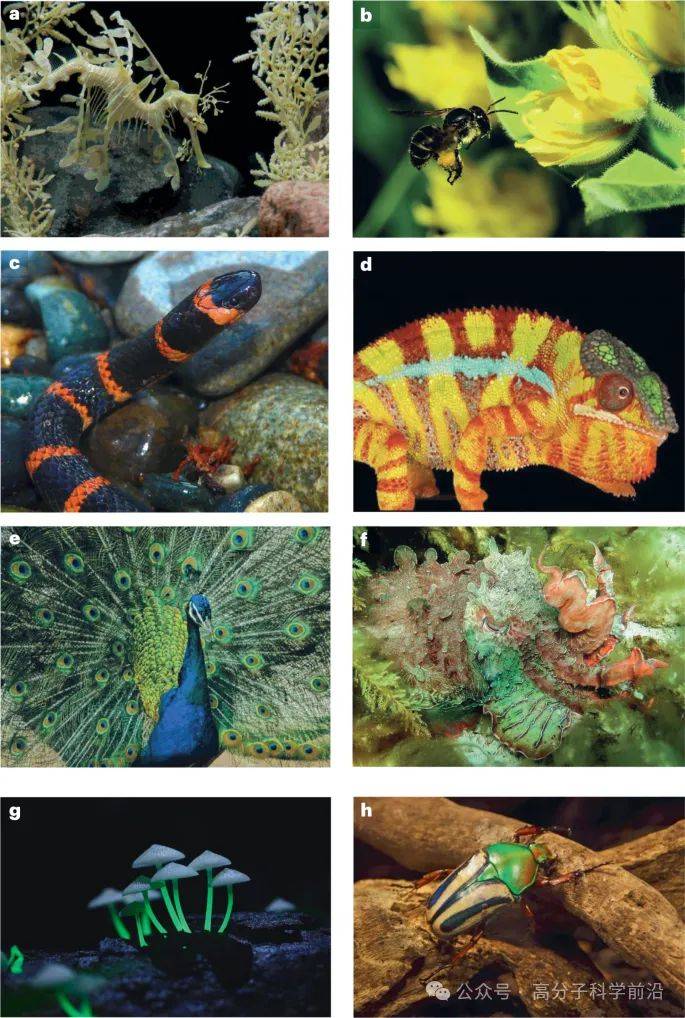
Figure 1: nature colours
Biomass colour
There are three main mechanisms for colour change in nature: color, light and structure (figure 2a). Colour colours are formed in different colours by absorption and reflection, and light is generated by chemical reactions and is widely present in organisms. The color of the structure interacts with microstructures, such as interference and distillation, to produce a colour of beauty. By imitating these natural phenomena, scientists conduct research in the fields of environment, medicine and material science. Blackin, for example, is widely used in medicine because it is not only low toxic but also uv protection and antioxidation. Bioluminescence can be used for cell tracking and sensors, especially synthetic analogues that increase stability and brightness. The colour is created by designing microstructures, using phenomena such as light interference, distillation and so forth, without coloring. This structural colour has important applications in display techniques, sensors and optical components (figure 2b). This paper then describes several ways of creating a structural colour。
Supersurface (m)Etasurfaces: supersurface uses nanostructure to regulate light transmission, generating structural colours through specific optical effects (e. G. Mie resonance, plasma effects, etc.) (figure 2f). These supersurfaces are capable of manipulating light at the sub-wave long scale and are widely used for dynamic displays and optical sensing。
Photo crystal (photo)Nic crystals: photocrystals are cyclically organized by medium or metal elements, producing a specific optical zone through the distillation and dispersion of light, thus achieving structural colour (figure 2d). This structure can be used for optical filtering and enhanced light transmission, and is widely used for light communication and efficient energy use。
Thin-fil interference: the membrane interfers through photowaves reflecting the surface of the membrane, producing colour effects, typical of the colours in the soap bubble (figure 2b). This technology is widely used in optical display and coating materials。
(b) diffracretions: the diffracing gratings: the diffracing racs uses a series of parallel lines or grooves to divulge light and produce colour effects. The characteristic is that colours can be regulated by changing the epidemiology and are widely applied in spectral analysis and laser equipment (figure 2c)。
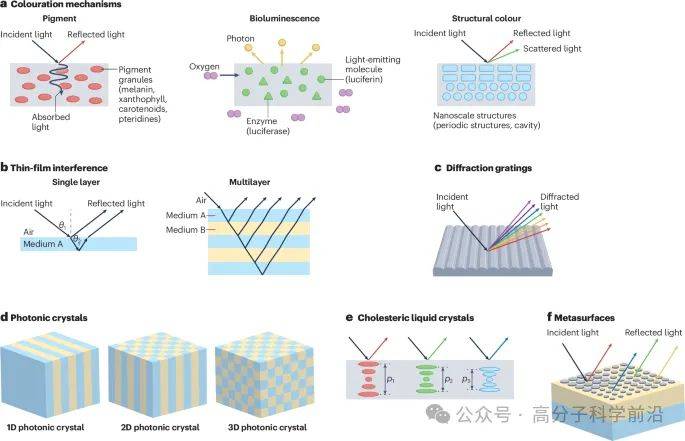
Figure 2: colour mechanisms
Stimulating responsive dynamic color changes
The structural colour in nature changes with the stimulation. This change is based on a change in the spacing between structural elements, where the colour usually moves to the short wavelength (e. G. Ultraviolet) when the spacing increases, and the colour moves to the long wavelength (e. G. Infrared). For example, the wings of morpho butterflies have nanostructures on their surfaces that create structural colours that can be combined with engineering heart tissues, respond to the morphology cycles of myocardial cells and produce dynamic colour changes. The author then presented several ways of stimulating colour change。
Mechanical irritation: mechanical deformation (e. G. Compression and stretching) can adjust the spacing of structural elements to induce colour changes (figure 3a). Compression reduces the distance and the colour moves towards the short wavelength; the stretch increases the space and the colour moves towards the long wavelength. The response to mechanical irritation is influenced by materials and design and can be adjusted to the structure colour by stretching or compressing。
Thermal irritation: thermal irritation can adjust the crystal structure or molecular sequence of thermal sensitive material. For example, heat-transforming liquid crystals lead to a reduction in the snail range at higher temperatures, resulting in a blue shift (figure 3b). Thermally responding to polymers can also cause changes in structural colours at specific temperatures. Thermal variant materials can be used in optical components and heat sensitivity display techniques。
Magnetic irritation: the magnetic field can control the adhesion of glue containing magnetic nanoparticles and adjust the structure colour (figure 3c). For example, iron oxide nanoparticles can be sequenced by super-magnetic adjustments to allow them to respond to colour changes in the external magnetic field. This method does not require contact and can quickly adjust the structure colour。
Electricity irritation: electricity irritation can trigger colour changes by regulating voltage and frequency and is applied in electronic displays (figure 3d). A change in the material's structure can be achieved through electro-simulation, atomic movement or an electrical elastic drive. Electricity stimuli have the advantage of rapid response and local applications, but still face energy consumption and stability problems。
Chemical irritation: chemical irritation causes structural changes in colour through solvent, gas or ion (figure 3e). For example, photocrystals and hydroxide reactions from ph can effect colour changes. Chemical changes can be applied in biocompatible materials, such as cellulose or melanone, through which colour changes can be used for environmental monitoring or biological sensors。
Other stimulus mechanisms, such as light response materials and combinations of different types of stimulus, are also being explored for structural change。
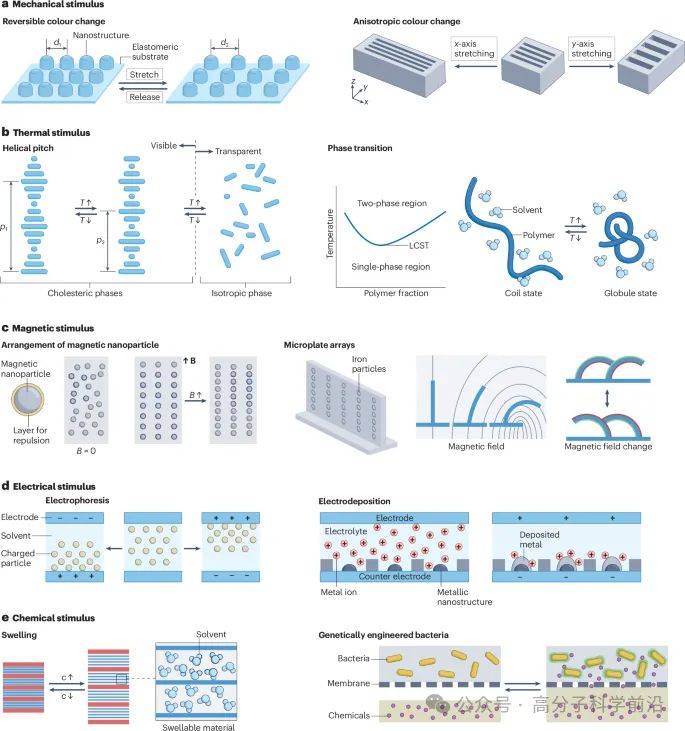
Figure 3: color changes in response to irritation
Apply
Reproduction of natural colours has been widely applied in such areas as biomedical equipment, display technology, sensors, safety systems, disguised materials and energy management。
In biomedical equipment, imitation can be used to monitor certain physical events in real time. For example, bioluminescence imaging can achieve real-time deep tissue imaging by expressing fluorescent enzymes, monitor the location and growth of tumours and can be used for high resolution visualization of neuroactivity (figure 4a). In addition, photocrystals can be used to monitor cell attachments and interactions with the surface without labels and can also be applied to cytology studies。
In the display technology, the imitation structure colour does not depend on chemical pigments or dyes and is therefore widely used in intelligent textiles and display screens, providing high resolution and dynamic displays (figure 4b). High pixelization displays can be achieved through precision control of nanostructures, and rewriteable and rewritten screens are designed. In addition, the structural colour can respond to external incentives (e. G. Electric field, mechanical stress or environmental change) and be used as a dynamic display。
In the field of sensors, biodynamic colours can be used to design sensors that provide real-time feedback on mechanical, temperature or chemical irritation (figure 4c). For example, sensors based on photocrystal structure can sense pressure changes and provide high-resolution response mapping through colour changes. Such sensors can be used for complex body kinetic decodering, as well as for temperature monitoring, which facilitates the production of soft and wearable temperature sensors。
In the field of security, biomimicated colours can be used for covert and anti-false techniques (figure 4d). Through specific structural mode coding information, this information can only be decrypted with specific irritation, such as temperature change or the auroraization of light. This method could be applied to wearable equipment, identification and forgery prevention。
In the area of disguise, passive disguise can be achieved by simulated micro- and nanostructures of the skin of insects, helping objects to hide in the environment (figure 4e). At the same time, in combination with changes in environmental sensory and pixel-level colours, dynamic disguise can be achieved and applied in areas such as military clothing. In addition, thermal disguise can be achieved by regulating infrared reflection or absorption。
In the area of energy management, the structural colour can regulate temperature by reflection, absorption and radiation light. For example, the development of radiation cooling film for high-efficiency heat dissipation can be achieved by imitating the triangulation of tropical beetles with triangular fur structures (figure 4f). In addition, light management mechanisms in nature can improve the performance of photovoltaic cells, imitate the microstructure of the wings of black butterflies, and enhance the light absorption capacity and efficiency of solar cells。
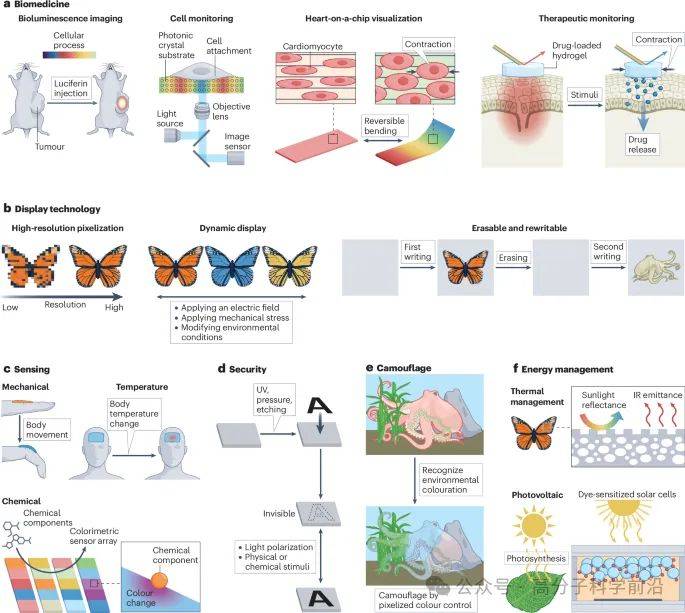
Figure 4: application of biologically inspired dynamic colour changes
Outlook
The re-emergence of natural colours, especially dynamic colour changes, requires an in-depth understanding of the mechanisms behind them. Structural colours depend on nanoscale precision and therefore involve high-cost manufacturing technologies, which are currently mostly limited to laboratory applications. For large-scale applications, low-cost, scalable manufacturing processes need to be addressed. Despite the potential of 3d printing and laser technology, improvements are needed in colour control, resolution and stability. In addition, the precise spatial and temporal control of dynamic colour systems is challenged, particularly due to the complexity of the material and the reduced technical difficulties of the implementer. At the same time, slow reactions and energy inefficiency in stimulating response materials have limited their widespread application. The development of more accurate, fast and sustainable control systems is therefore key to achieving large-scale applications。