


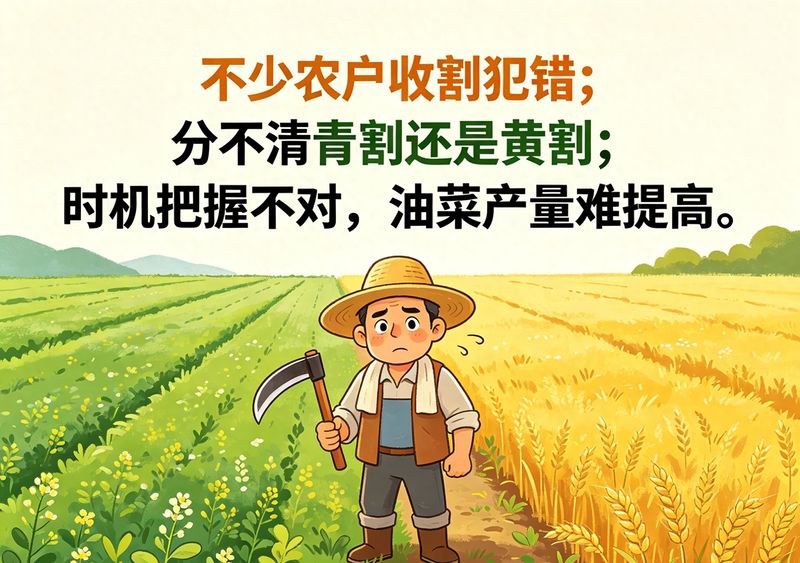
At present, the main oil-producing areas of the country are entering a critical period of maturity, from the south to the north, with winter and spring-creas harvesting windows. For a large number of growers, the last step of harvest will eventually be to deliver the harvest, from planting in autumn and winter, management in spring fields, to the pursuit of fertilizers, pest control and drought and flooding. Many farmers are well-managed in the field, with abundant water and timely pest and disease control, and oil and vegetable production looks great, but the final recovery of the family's vegetable seeds is always not optimal, and the rate of oil production is low, and the income is not going up for the whole year. Most of the reasons for this are not species problems or insufficient soil fertility, but harvest timings are not right, and repeated errors in the matter of ceding or yellow cutting directly result in reduced yields。
In rural areas, the vast majority of farmers judge the maturity of oilseeds by the colour of their eyes and by their old experience. Seeing most of the oil in the field turned green and yellow, they were rushing to collect it; or they kept waiting until the whole field was completely green and green. In fact, there are obvious disadvantages in both ways, either the harvest is too early and the seed granules are inadequate, or the harvest is too late and the pellets are blown off. Many people continue to harvest in accordance with old habits, but the root causes are not found in the pits. Today, in the light of the most recent guidelines for the multi-land agro-technology sector, feedback from farmers on real cultivation, and using the language of the earth, the advantages and disadvantages of cutling, the best harvest standards, and the techniques of different types of harvesting are presented once and for all。
First of all, we need to be clear about what is a cutting and what is a strung。
Cutting refers to the fact that the vegetable is six or seven years old, that the whole field plant is green, that only a small part of it is yellow, and that farmers are concerned about later weather variability, the fall of oil and seed grains and early harvesting。
Cutting is done when the vegetable is fully mature and the leaves of the whole field are yellow and the corneas are hard to grow, and then the harvest is concentrated until it reaches its full maturity。
The two methods of harvesting, which correspond to different planting environments, harvesting tools and weather conditions, are not absolutely good or bad, but blind choice is bound to result in a reduction in production。
First, the core hazard of premature cutting。
The oilseed has a very critical nutritional backsliding slurry period at an advanced stage of growth. Even if the leaves have become yellow, the nutrients within the tubing, branching and corneas continue to be delivered to oilseeds, which is the final stage in determining the abundance of seed grains, the weight of thousands and the rate of oil production. In order to avoid the late wind and the rainy weather, many farmers watched the vegetable harvest early as it started yellowing, which was tantamount to a direct interruption of the last slurry process。
Based on empirical data from local agrotechnic stations, the proportion of premature cut oilseeds is generally small, with a large number of dry granules and a high proportion of semi-prefined seeds. A direct drop of 1,000 grains would result in overall production being 10-18 per cent lower than timely harvesting. Not only has production declined, but the rate of oil production has had a greater impact. High internal moisture content of seed grains, low accumulation of grease, low production of oil after drying up, low-temperature and general quality of harvested vegetable seeds, whether left for consumption or sold, do not prevail. In particular, the widespread use of live oilseeds, pre-cooked varieties, short-lived growth cycles and early maturity have made it easier for farmers to develop the idea of “early harvests and savings” and have resulted in the worst losses。
There are also some farmers who are afraid of falling late in the oilseeds, who are in a good early position, and who fall after a little wind and cut early. In fact, as long as the eight harvest nodes are controlled, they will neither fall over the grains nor keep the seeds full, there is no need to rush early。
Then look at the ills of the late harvest and the complete yellowing。
Many farmers believe that the more green the vegetables are, the more full the seed grains and the higher the oil output, the more they wait until the whole field is yellow and the horn hair breaks. Theoretically mature oilseeds are indeed the most full of seed grains, but the actual losses in the field are greater than expected。
At a later stage of maturity, the agglomeration of the corneas becomes less resilient and becomes dry, thin, exposed to high temperatures and afternoon winds, which will burst as a result of soft shaking and the seeds fall directly into the soil. Artificial harvests result in a large amount of fallout when the body bends, moves the shaking, and when the machine shakes during mechanical harvests. A large number of farmers have waited for the gold and yellow of the whole field to look at their growing size, but the actual recovery of their vegetable seeds has been severely compromised, with field losses and losses amounting to over 15 per cent and a season of direct waste。
At the same time, completely sophisticated oilseeds are dry and fragile, exposed to stormy weather conditions that are highly invertible, impervious, seed grains that are germinate, of immediate quality, and have significantly increased the difficulty of drying. The southern region is characterized by heavy rainfall and, once caught up with continuous rainfall, late harvests are prone to bad horns and gerries, which directly result in crop failure and are extremely risky。
So the most important concern for farmers is: when is the harvest the most appropriate? How do you trade off
In combination with the long-term field tests and large-scale farming experience of agricultural technicians, the best harvest period for oilseeds is eight years old and the standard is eight years old, commonly referred to by the industry as “eightie-young”。
It is common sense that about 80 per cent of the principals and branches in the whole field are green and yellow, a small fraction of the upper middle and lower is slightly split, and about 20 per cent of the upper is green, and a little bit of cyanide is kept in the straw, which is the golden window period。
Here we share the simplest and simplest way for a farmer to judge: to see the seed. If the seed is red and brown and the particles are full and hard, it can be harvested; if the seed is green, soft and white, it means that it is not fully slurryed and must wait another three to five days。
The timing of the different harvest methods is fine-tuned and cannot be generalized。
Artificial harvests can be used by farmers as early as seven to eight mature harvests. After being cut, lay-ups are laid in place for two to three days, using pre-planting to allow the rest of the nutrients in the tubing to continue to flow back to the seed grains, both to reduce the amount of mackerel fallout and to increase the level of saturation, with the latter being clean and less depleted。
In the case of farmers using a combined harvester, the harvest must be more than eight years old at a later time, and the amount of water contained in the field seed is reduced to the appropriate level for re-operation. Excessive water content is prone to seed fragmentation, machine congestion; too low water content can blow up particles, increase losses and make mechanical harvesting more mature。
In addition to finding the exact time of harvest, there are a few details that are easily overlooked, directly determining the final yield。
First, avoid high-temperature harvest. The sunlight is strong at noon, the agglomeration is rapidly evaporated, the shell is flat, the seeds are blown off and the losses in the field are multiplied. Select as much as possible to harvest in the morning and evening when the air is so wet that the horns are so resilient that they drop least。
Secondly, the harvest is followed by a timely drying. The freshly harvested oils contain a high volume of water, and they are stored in concentrations that are prone to heat, mold and sprouts. The harvest takes place on the day of the harvest with a tan, which is dry before they are taken off and ensures the quality of the seeds。
Thirdly, the harvest rhythm should be adapted flexibly to the weather. Early attention to weather forecasts, near maturity, can be expected to harvest one to two days well in advance if there is a continuous storm and a strong current of wind; and if the weather continues to clear and wait strictly until it is ripe, it will not be blind。
Fourth, make the field drain. The planting of water in the fields at the later stages of maturity can lead to decaying roots of oil and vegetables, premature plant failure, early yellowing and death, early wiring of ditches during harvesting, maintenance of drying in the fields and guaranteed normal subsequent slurries。
Many farmers continue to fail in their annual production, not as a result of poor planting techniques or inadequate fertilizer inputs, but as a result of falling into fixed harvest error zones. The young are too young, they are too late, they are carefully managed, and the last step is unchained, and the harvest is not enough for the season。
In fact, the only way to grow oil is to follow the path of the key nodes. The previous management decisions were strong and harvest timing determined the final yield. It is not blindly cut early, it does not wait until all yellow, it captures eight full harvests of gold, taking into account the full capacity of seed grains, the rate of oil production and the loss of grains in the fields, that will truly transform the field into a real harvest。
A growing number of farmers are now focusing on precision cultivation, and water fertilizers, insects and weeding are increasingly doing well. A steady increase in production and increased crop yields can be achieved as long as the final harvest is avoided and scientific maturity is controlled。
Does your family grow oil and vegetables by hand or by machine? Has the normal harvest experienced premature cutting of a large number of granules and the late recovery of the masonry reduced yields? Welcome to sharing your harvest experience and small skills。
Pay attention to me, continuously sharing ground-based oil-crop cultivation techniques, field management dry goods, practical experience in helping farmers to grow their scientific fields, and steady increases in yields。
The content of this paper is based on national multi-land farming practices, field measurements, real farming experiences of farmers, and is objective and realistic; the best harvest times for oil can be influenced by diversity, climate, planting patterns, and regional variations, which farmers can adapt to local realities in a flexible manner; it is only for technical farming, and does not involve any agricultural extension or marketing。



