Understanding and application of a chemical reaction equation
For chemical reactions xa+yb=mc+nd+qe (values x, y, m, n, q are integers greater than or equal to zero), the extrapolation analysis is as follows. When x = 0, q = 0, the reaction is decomposition, b is necessarily a compound and c and d are not necessarily monolithic. 1 if b is a liquid of the oxide, the reaction shall be decomposition under electrified conditions; if b is an oxide with a non-polar key, b must have peroxygen. 2 if c is oxygen and d is a potassium-containing compound, b may be potassium chlorate. If c is able to clarify... More
Chemical reaction equations, also known as chemical equations, are formulas that are chemically expressed as chemical reactions. The chemical reaction equation reflects objective facts. The writing of chemical reaction equations is therefore subject to two principles: first, it must be based on objective facts; the second is to comply with the constant laws of quality。
Meaning of the chemical reaction equation
It's called chemical equations. It is simpler than the textual expression of chemical reactions and is internationally available. For example, electrolytic water reaction (as shown in the table below) examines the significance of chemical equations at both macro and micro levels, each of which can be divided into qualitative and quantitative dimensions. In addition, chemical equations reveal specific external conditions for material changes。
The chemical reaction equation
1. First state the conditions for response
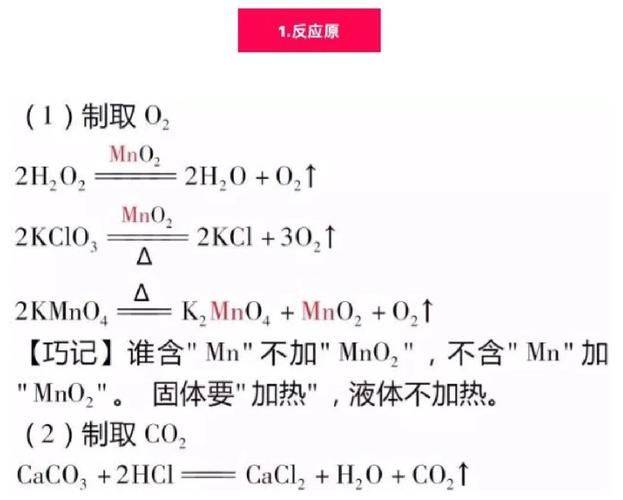
Some chemical reactions take place without any conditions, while others take place under certain external conditions. These conditions include:
(c) incineration: the ignition usually involves direct exposure of the flame to the flammable material and the local temperature of the flammable substance to the point of fire. When the flammable material is ignited, the heat generated by the combustion can keep it burning. Burning is a reaction phenomenon, not a condition for reaction。
Heating: the temperature does not exceed 500°c and alcohol lamps are commonly used。
High temperature: alcohol-jet lamps can be used as a source of high temperature heat generally at about 1000°c。
Heating and high temperatures are not only quantitative but also qualitative, and the two cannot be combined. If the heat is changed to heat, either the reaction cannot take place or the response is too slow。
Catalyst: the reaction occurring with the catalytic effect of the catalyst shall be named。
In addition, there are chemical conditions such as light, power, pressure or pressure reduction。
Note the difference between chemical equations and algebra equations
1 the chemical equations "+", "=" are similar to the mathematical formulation "+" and "=" but have different meanings. The “+” in the chemical equation is used to contact a variety of reactions or products. Instead of reading “plus”, read “and”, “with”, or “with”. The "=" in the chemical equation indicates the meaning of generation and also the meaning of constant mass, which should be read instead of "equal" and read "generated"。
2 chemical reaction forms cannot be rewritten and transposed。
Writing of chemical reaction equations
Principles for writing chemical equations
1 based on objective chemical reactions。
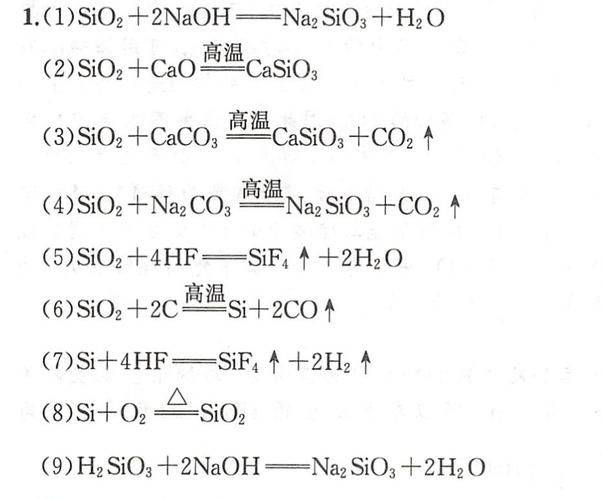
2 follow the constant law of quality (especially the micro-interpretation of that law, i. E. The equal number of atoms on both sides of the equation etc.)。
2. Writing chemical equations should indicate the conditions for reaction and the use of the ↑ and ↓ symbols
(1) response conditions include: ignition, heating, high temperature, catalyst, etc
(2) the ↑ means gaseous products
1 where a reaction is a solid or liquid substance, and after reaction produces one or more gaseous substances, the chemical form of the gaseous generator should be followed by the "polymerium"。
2 where a gaseous substance is present in the reaction, the generator is not labelled "polymerium" even if there is a gas。
3 whatever the state of the reaction, as long as there is only one of the products and it is in a gaseous state, it is not marked "polymerium"。
(3) the ↓ generation of insoluble solids objects
When the reaction takes place in a liquid (or gaseous) mixture, the sediment (or solid) in the generator shall be expressed as a “polymer”. If the reaction contains solids (solids that are insoluble in water), even the sedimentation in the generator is not labelled "polymerium"。
It follows that the "polymer" and "polymer" are the state symbols of the generator and can always only appear on the right side of the chemical equation。
3. Skills for formulas for graded chemistry
1 minimum common multiple method:
The first step was to identify elements that appeared once on each side of the reaction, to level them from different and different atoms, to remove the minimum common multiples from each of the two chemical formulas, the new one being the coefficient of the chemical formula。
In the second step, other prechemical coefficients are derived based on the chemical coefficient sought。
2 odd spouses:
The first step is to identify the most frequent occurrence of both sides of the reaction and the total number of atoms is an odd element, adding the smallest number of evens to the chemical formula with the odd number of atoms, and turning the number of atoms from odd to even。
In the second step, the chemical coefficient is calculated from the extrapolated coefficient。
3 observation:
The first step is to find a chemical formula that is more complex (a large number of atoms) on both sides of the reaction, with a coefficient of 1。
In the second step, the chemical formula coefficient (which may be a fraction) is determined by the constant law of quality and is then multiplied by a number on both sides of the reaction, making the coefficients the simplest integer。
Chemical reaction equation tactical
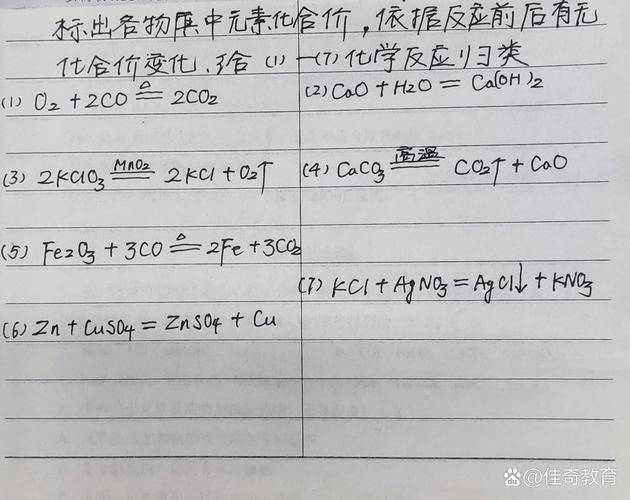
1. Cross-cutting of oxidation
An increase in oxidation and the reduction of cross-measurement coefficients of gross value are referred to as the rise in oxidizers and oxidizers or oxidizers and reduction products in the form of a formula 1 (a molecular body)。
After cross-measurement coefficients with higher and lower oxidation values, the gain of higher oxidation or lower total value equals the product of higher oxidation and lower oxidation values, which must be a common multiple (sometimes not the smallest numeric factor) of both, which clearly fully corresponds to the pattern of higher oxidation and lower total value of the oxidation reaction equations. When the accumulation of the two is not the smallest common factor, the coefficients obtained may not be the simplest set, but at the end, it is easy to solve the problem by making it simple。
This method is simple, easy to understand and apply, and improves the speed and accuracy of matching. In practical teaching, the application of this method to the oxidation reduction response equation has worked very well。
The following is an example of a formula for chemical reactions to sulfur-burning iron ore。
Pair step 1: identify the reactor and the generator and write the reaction。
Fes2+o2↑→fe2o3+so2↑
Step 2: determines the oxidation and reduction values of the oxidation and reduction agents of the 1st type (a molecule as a whole) and then cross-references to the measurement coefficients, written in front of the relevant molecular formula。
Step 3: measurement coefficients for levelling other substances。
4fes2+11o2↑→2fe2o3+8so2↑
Step 4: verify that the equation is even. Reaction arrows (or short lines) should be recast as equals if they are evened. If the parity factor is not the most simplified one, it requires approximately a simplified set of coefficients。
4fes2+11o2↑ =2fe2o3+8so2↑
2. Pairing techniques for the oxidation of number rises and drops
In order to be flexible, it is necessary to have some skills to use the oxidation number rise-and-drop cross-cutting method for flattening response equations. Different strategies can be used depending on the type of response: normal oxidation response, with coefficients for the reaction or product with a change in the oxidation number; coefficients for the product with its own oxidation reaction; inverse self-oxidation reaction, coefficients such as a variable reaction of the flat oxidation number。
Application of chemical reaction equations
I. The metallic strength of elements compared through chemical reaction equations
Question 1: how can experiments prove that iron is metalier than copper?
Program: the iron tablets were removed after a period of time after reaction, and a red layer of material was found on the surface of the iron table, and the reaction was that fe+cuso4=feso4+cu iron was replaced by copper metal。
Ii. Non-metal properties of elements compared through chemical reaction equations
Question 2: how do experiments prove that chlorine is more metal than sulphur?
Program: in the solution of chlorine gaseous hs acid, the solution becomes fuzzy, with a reaction of cl2+h2s=2hcl+s↓, chlorine is replaced with sulphur, indicating that chlorine is non-metal stronger than sulphur。
Iii. Alkylity of substances compared through chemical reaction equations strong weak
Question 3: how can experimentally demonstrate that carbon acid is more acid than silicate?
Program: the solution in the sodium sodium silicate solution of the carbon dioxide gas entanglement has become sour and silicate has been produced with a reaction of co2+h2o+na2sio3=h2sio3↓na2co3. Stronger acids produce weaker acids, so carbonate is more acid than silicate。
Iv. High and low melting points for comparison of substances through chemical reaction equations
Question 4: how do laboratories prepare hydrogen chloride gases? Why?
Program: heated a mixture of solid salt and sulphate with a reaction of naci+h2so4 = nshasso4+hcl↑, with a high boiling point and a volatile sulphate to prepare low boiling point, volatile hydrogen chloride。
V. Comparison of substance stability through chemical reaction equations
Question 5: what facts can demonstrate that sodium carbonate is more stable than sodium carbonate?
Programme: sodium carbonate is heated, with a chemical reaction of 2nshco3 = na2co3+h2o+co2 ↑. Under heating conditions, the chemical reaction is always directed towards the generation of more stable substances, so so sodium carbonate is more stable than sodium carbonate。
Vi. Improved solubility of substances compared through chemical reaction equations
Question 6: what is the fact that sodium carbonate is more soluble than sodium carbonate under the same conditions?
Program: co2 gas is integrated into saturated sodium carbonate solution, the solution becomes sour and the chemical reaction is na2co3 (saturation) + co2+h2o = 2nshaco3↓. Under the same conditions, the chemical reaction is always directed towards the generation of more insoluble substances, so the sodium carbonate is more soluble than sodium carbonate。
Question 7: what is the fact that silver iodization is more insoluble than silver chloride?
Program: the chemical reaction is agci+i-=agi+cl-, which is always directed towards the generation of more insoluble substances, so that silver iodization is more insoluble than silver chloride。
Chemical reactions
The chinese instrument network provides you with the concept of the chemical reaction equation, as well as the writing of the chemical reaction equation, the techniques of the chemical reaction equation and the application of the chemical reaction equation, as well as articles on the chemical reaction equation and news recommendations。
Hot article
Edit recommendations