What's going on
The experience of a brigade of the 76th army working hard on its work
Lee seon-sing, ko jintao, the pla correspondent, zhou ying
In the summer, a company of the 76th army brigade was preparing for the driving test. Looking at everyone's energy, the re-election of a company commander is frowned upon — the company lacks training aids, such as caps, which are replaced by home-made equipment, which makes training less effective. Prior to that, they had requested new equipment from the agency, but after a few days the equipment was still not in place。
Sergeant wang qi at the second rank, who saw the troubles of the commander-in-chief, proposed, “shall we ask the authorities?” the chief said, “it's not a question to ask.”
For a while, the commander called for questioning. At the end of the phone, the authorities asked him to give his reply in a moment: “it has been coordinated and is expected to be in place within a week”. It is not uncommon to leave the telephone and look at wang qi with a few surprises in his eyes — to have such a clear answer before。
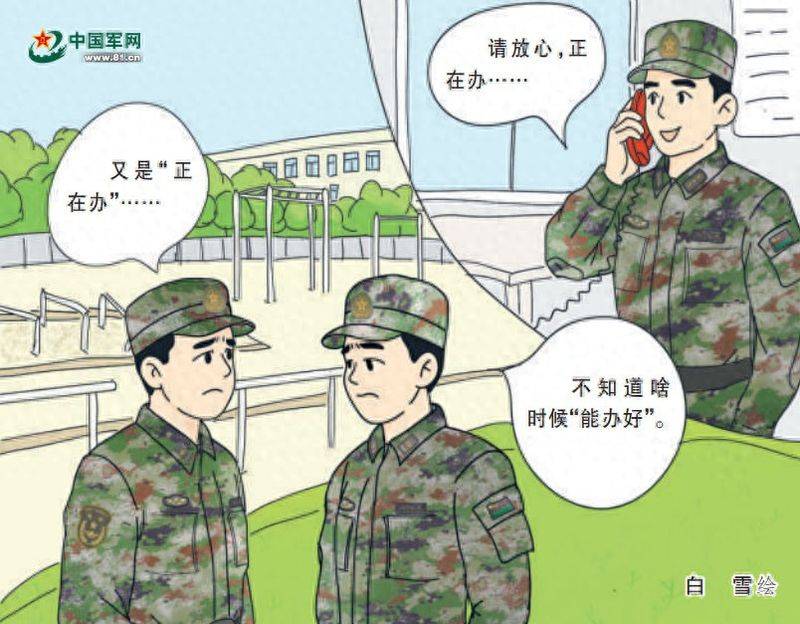
Just a few months ago, the same training equipment was requested, and the company's officers questioned the authorities several times and received almost identical answers: “please be assured that it is being done”. This seemingly polite and well-meaning statement makes it difficult to put aside the lingering hearts of the rank and file. “we are not pushing the authorities, but training is not waiting for people.” the captain said, “know when the equipment is in place before we can rationalize the training programme. But the organ says, "we're doing it," and we just have to wait."
Previously, something like this was not uncommon in the brigade, so that it became a popular euphemism “without fear that things would be difficult to do and that the authorities were doing it”. The brigade's leadership has found that this phrase simply reflects some noteworthy phenomena - • the equipment failure report, which is “in the process of coordination”; the progress of the leave clearance inquiry, which is “in the process of being approved”; and the travel reimbursement for study and training, which is “in the process of being processed” ... Which appears to have a response, but which is not。
Why do you always like to reply "in the process"? “sometimes it's too busy to say so first.” another official added: “or is the work in progress, but we have a division of labour that cannot be kept abreast of everything. We can't say "i don't know" to the grass-roots, but we can only tell them "is doing it" and then ask the person in charge." in addition to this, there are some comrades who believe that there are fewer agencies and that they need to make sure that things are “work-in-progress” before informing the grass-roots level in a timely manner, and that there is no need to “call and answer” the grass-roots level。
“there is nothing small at the grass-roots level, and the response of the agency personnel is directly related to the preparation of fighters and to their working life. The phrase `work in progress' reflects the fact that some comrades have not firmly established the idea of `grass-up, soldier first'.” in the ensuing thematic analysis session, the commission's words were bloodied, “we always speak of service to soldiers, but if not a clear answer, how can follow-up be done?”
Subsequently, in response to the questions of the organ “unsure responses, unclear progress and delayed feedback”, the brigade soon introduced 18 measures of service for military personnel, requiring that operational sections, when confronted with the rank and file, firmly refrain from vague responses such as “under way” and “more so” and that they be clearly informed of the required material, processed progress and “questioned and responded to”。
In addition, there is a clear requirement for “on-the-spot and time-bound closure” on matters that are procedurally and complying with the requirements; for complex matters requiring the coordination of various departments, there should be a linkage mechanism whereby regular progress is publicized and where it is to be reached; and for operations that do not meet the requirements of the procedure, there should be a patient explanation to put an end to the “denial” of the cold “repeat”. On this basis, the brigade has also established a mechanism for disaster relief visits to follow up on the quality of matters, to understand the attitude of the authorities and to gather advice from the ranks. The slowness of the process and the perfunctory of the responses were detected, the criticism was reported on the spot, accountability was modified by the deadline, and institutional cadres were forced to change their behaviour and effectiveness。
Today, at the brigade, “respondence, availability and feedback” have become the norm for institutional services at the grass-roots level. A few days earlier, a battalion had submitted a request for engine maintenance to the equipment maintenance section, and the chief of section, after detailed questioning of the failure, had clearly informed that arrangements would be made for repair technicians to come to the door the following morning. "a clear answer will work better than a hundred words. Staff sergeant gauhua jian of the battalion, who submitted the application, stated that “it is now timeless and frequent to ask questions about the matter. No one's ever said that again."
Short assessments
Services need to be both “smuggling” and more “effectiveness”
Zhang xing
The phrase “please be assured that it is being done” appears to be polite and gentle, whereas it is a vague phrase that “will remain unchanged”. This practice of “hearing the stairs and not seeing people down”, which “smuggles without doing anything”, not only makes the original warm speech unheated, but also cools the hearts of the rank and filers because of the pretentious attitude of some officials。
The rank-and-file asked about the operational progress, and what was expected was not empty comfort, but clear progress and clear time frames. Thus, the good attitude of the authorities towards the grass-roots level, with only a “smoke service”, is far from sufficient. Only polite and thoughtful answers are difficult to achieve, and rhetoric and enthusiasm are “probative”。
At the grass-roots level, it is difficult to wait, slow, and some things seem small, but they are directly related to combat capacity-building. The organs can only give real reassurance to the officers if they listen to them proactively, respond precisely to their needs and translate good attitudes into practical action。