#too much internet lending, what about the mail? # at 2:00 a. M., kobayashi slipped on the starter after the live news of the shopping, and finally ordered the “no interest-free” button. It shows on the screen that the latest cell phone needs less than $300 a month to get a cup of milk and tea in advance. Young people like kobayashi are not a few, and now they have mobile phones, and internet lending portals are visible: the periodic buttons for shopping software, social platform lending advertisements, “task money” recommendations in short videos, and lending has infiltrated young people's lives like air — why are more and more young people falling into the web lending trap
It's a low-threshold road
Unlike loans from traditional banks, which require belowline submission and level-checking, the internet loan has since its birth been a “comfort point” for young people: it is almost impossible for young people who are used to online life to refuse the ease of doing so when they complete their cell phone operation, 10 minutes to fill in the information and release the money as soon as possible. More critically, the threshold of access to internet lending is alarmingly low: no collateral, no proof of work, just an identity card, a mobile phone number, even for college students who do not have an income, can easily borrow thousands of dollars。
The crazy expansion of capital, and even more so the touch of internet lending, is so great that you can play short video, you can get a loan, you can talk about social software, you can get a loan, you can even order a drop, you can get a “pay first” option, and young people, if they don’t want to touch it, are pushed to the front. The low threshold, coupled with high conveniences, allowed young people who were already distant from borrowing to take the first step。
The desire to be fed by consumerism is not keeping up with ambition
When the internet places the template of “exact life” in front of every young person, the gates of desire are opened: twenty-year-olds are wearing big clothes at work, they're going to go to a red spot for holidays, they're full of other people's "sweet lives," and if you don't, you can't help it. In order to maintain this “dignity”, many young people choose to use their loans to bridge the gap between desire and income。
Even more subtle is the misinformation of the split campaign: a $5,000 mobile phone, not to say the total price, simply says “one cup of milk and tea a day, take home easily”, tears the bulk of the consumption into an indescribable small monthly supply, and makes young people less vigilant. Today's periodic purchase of a mobile phone, tomorrow's partial purchase of cosmetics, and the day after tomorrow, when every one of them looks small, add up to the fact that every month's wages are paid back to the various platforms, and when they fall short, they're forced to pay back their old rolling debts。
It's not just desire, it's pressure
In addition to active overdrafts, many young people have access to internet loans, driven by real and rigid pressures: having just graduated in the big cities, rents are paid for half a quarter of their wages, and they have to wait until they get paid for their jobs; marriage is contracted in less than a few years, the bride price and the down payment are incomplete, and the gap can only be covered by net loans; if a family member is sick and unemployed, there are not many young people who would have saved their lives。
Even university students who are supposed to be free of social pressure cannot escape the shadow of online lending: school fees, living expenses, wanting to buy learning materials, booking courses, being reluctant to reach out to their families, are attracted to so-called “low-interest school loans” until they graduate, and they find that debt has reached the point where they cannot afford to pay, and that they can only enter the community with their debts and continue to rely on net lending。
There's a hole in the cognitive deviation. A lot of people don't see the risks
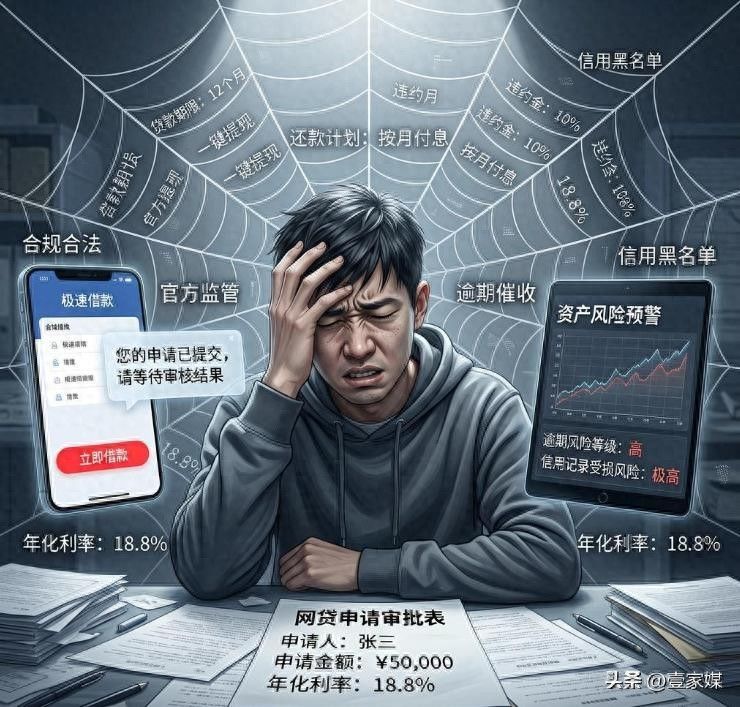
Many young people still lack a sense of risk because they can easily touch the internet lending: the platform promotes “fifteenths a day”, which sounds like five dollars a day, and many people can't, but the rate of annualized loans has exceeded 18 per cent, far above traditional bank loans; many others feel that it is just a few days late. To take several calls, there is no knowledge that a letter will be sent at the late-recording meeting, that future mortgages and credit cards will be compromised and that even the search for a job will be blocked。
Moreover, many young people, in a “slow-paying” mentality, do not plan to repay their debts at all, but do not look at how much they can pay each month, and when the repayments arrive, they find themselves simply unable to bear the burden, tearing down the east wall and eventually getting more and more debt。
Conclusion: borrowing is a tool, not a cure for life
It cannot be denied that a reasonable loan does help young people to overcome their difficulties and meet their legitimate needs in advance, but when borrowing becomes a tool to satisfy their desires, when overdrafts become the norm of life and, ultimately, only be kidnapped by debt. For today's young people, it is more important to see the truth about borrowing than to enjoy it earlier and to find a balance between desire and ability — after all, the true dignity, which is never financed by borrowing, is what young people give themselves。