This article was written in the context of a request i made two days ago to our time-management creator: help her answer the question about how to build a personal knowledge system。
Look carefully at this:
01
What does knowledge mean
Before you know how to build a knowledge system, you need to understand what it really is. So i did a little relearning online. What's knowledge? What do you mean, "system"
“knowledge” is defined as knowledge and experience acquired in practice。
The word to focus here is “in practice”。
“systems” are defined as the whole, within a given range, of different things or similar things in combination with a certain order and internal connection, which is the whole system of different systems。
The word to focus here is “composed of different systems”。
So, according to the phrase i often teach you, “knowledge system” is defined as a whole of different knowledge, or similar knowledge, based on a certain order and internal connection, that is a complete system of different systems。
I often say the same thing, and it's also the old chinese saying, “girls are different”。
The construction of a person's knowledge system is, in fact, a combination of knowledge from a variety of sources, all of which are different and have different characteristics, namely “different”
All knowledge can be brought together, like 10,000 “different” leaves, forming a large tree, the “and”。
And you're trying to constantly promote your “governance”, which is the notion of “governance and difference”。
I don't know if i can explain it, imagine the relationship between a tree and a pile of leaves, and constantly imagine the process, and i think you remember it。
02
What is the meaning of building knowledge systems
What is the meaning of building knowledge systems? Why build knowledge systems? Personally, i think there are two roles in building knowledge systems:
First, to reduce the chances of oblivion and improve memory。
When we go to school, there must be one class in which every lesson is very hard to take notes, but the grades are those of those who are unable to go to school, and one that appears to be very dissatisfied, but has always been good。
The construction of an individual knowledge system is clearly a “strategic dimension” of individual growth。
The former deserve recognition and respect, but such a learning approach is not worthy of publicity, as the student is very wary of tactics, such as how to get more and more useful notes during limited school hours, and how to use more time for the memory of knowledge points。
This led to a “hard-headed” situation。
We do not judge the extent of the latter's efforts, because he may be working very hard in private, and we can't see it at all, but his performance must have been “the essence through the phenomenon”, that is to say, he can classify the knowledge points, run the brain as fast as possible at a limited time and understand the link between the knowledge points and the knowledge points。
If he can tie it together, he can make it into a system, and if he really can't, he'll die on his back。
So two people have completely different ways of thinking back。
I was first in the history of the school in my student years, and i must have been the fastest person in the exam and never under 95, even teachers asked me how。
I have observed that many of my classmates remember the point of knowledge of history, but simply a single point of knowledge, such as the founding of the people's republic of china on 1 october 1949, but my approach is to take out a piece of paper and make a fish bone map on it, which i later knew was called the fish bone map, and to rank the events of the year in chronological order。
A lot of people answer the questions in the brain, "turn over the sea," but i answer the questions with a fish bone map that was done in a previous review, so it's completely different。
I didn't know anything about fish bone maps or knowledge systems, but i knew it wasn't too far to remember. So i thought about it。
There's a curve called the "albinhos forgotten curve" which you can look online, which is too long to explain, but which he has tested:
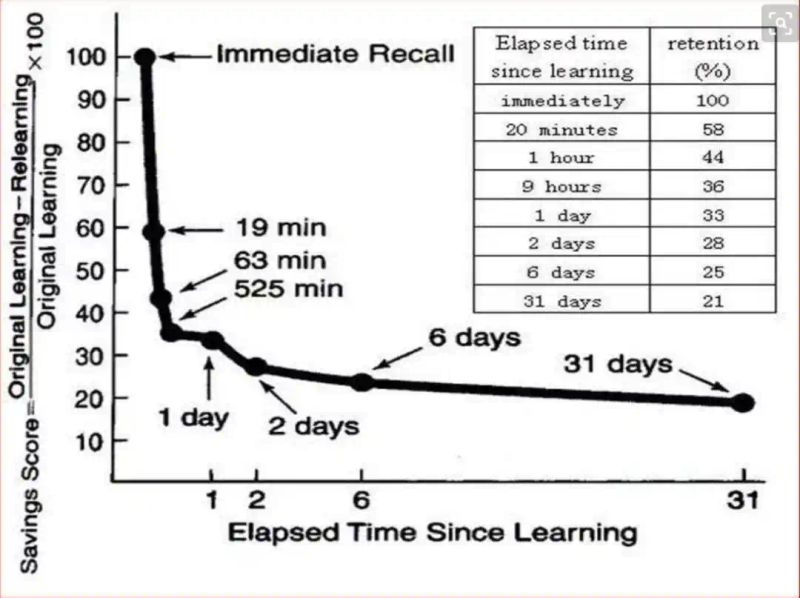
There is a “overlearning” in learning, in which learning continues after a perfect recitation of a material. Appropriate over-learning allows for better retention of learning materials。
When you remember one thing, repeat it in five minutes, repeat it in 20 minutes, after one hour, after nine hours, after one day, after two days, after five days, after eight days, after 14 days, you do the same。
So don't use tactical diligence to mask strategic laziness。
Second, make all knowledge coherent
What do you mean, organized? It is “conformity” that can bring together ideas。
When we have a knowledge system, one thing we can do is think of a knowledge point that you can relate to, by the way。
For example, when you look at my new book, you look at my personal experiences, you think about your own experiences, you think about the experiences of others, and you think of someone who has the same experience as hae。
Those who do not have a knowledge system are focused on a single level, but those who build it tend to go against each other, as i have just shown, and some who have read my book and really just read it, and some who have done so have been able to find out the life experiences of many people in their own knowledge systems and compare them, thus drawing a useful set of lessons, and finally incorporating them into this knowledge system in their own language and expression, thus building a “version 2. 0” knowledge system。
Let me take one more example of how i've often been live in tremors, and when talking about a particular point of knowledge, i've always been able to draw a lot of stories and cases about one point of knowledge。
For example, when it comes to the difference between the thinking of the poor and that of the rich, first i will explain what the difference is based on my own personal experience; secondly, i will address the gap based on the fairy tales; and thirdly, i will address the gap from the perspective of a common phenomenon in this society。
You see, this is the charm of the knowledge system, and when you see a story online, you have to know which branch of the knowledge system it should be。
For example, a tree represents a knowledge system, branches represent a knowledge framework and leaves represent a specific point of knowledge. So when you look at the story of the poor and the rich, you should find the branch of the tree that says “the poor and the rich”, so that the story can be turned into a leaf and hung beneath the branch。
The human knowledge system must have been continuously updated, passing over version 1. 0, version 2. 0 ... Unfortunately, many people do not even have version 1. 0, so you became the "eight" of the "eight laws"。
03
How to build their own knowledge systems
I divided the process of building knowledge systems into three steps: input, internalization, output。
It's like you drink water, and when you're thirsty, you need to "input" water, and then the body absorbs it, or internalizes it, and then you end up "output" with sweat and urine。
Here, i would like to answer the question about “a lot of reason, but still not a good life”。
In fact, the knowledge you have acquired is largely not of two types: debris knowledge and system knowledge. Because i'm a time management specialist, and for years i've studied time management, i have divided time into two types: debris time and whole time。
In the vast majority of cases, access to debris knowledge is done in debris time, and access to system knowledge is done in whole time。
And many things you know are just a lot of debris. Today, for example, a short video is written, a word is shown in the circle of friends tomorrow, and it's all stored in a cell phone memo, and it's never been systematized。
It's because you know so much about debris that you've had a hard life。
The structure of the knowledge system is described below:
I. Input
Thematic learning 01
In may 2020, for example, it was devoted to finance, in june to personal growth and in july to speaking。
02 classification of past knowledge
There must be a variety of articles, audio and video in your friend's ring collection, so it's sorted according to the type of knowledge。
It's like you're sorting out the house, putting three lockers in front of you, taking all the clothes out of the closet and putting the clothes that you're wearing during the different seasons into different lockers according to the type of clothes you wear in the summer, in the winter, in the spring, in the autumn。
03 secondary schools, secondary schools, secondary schools
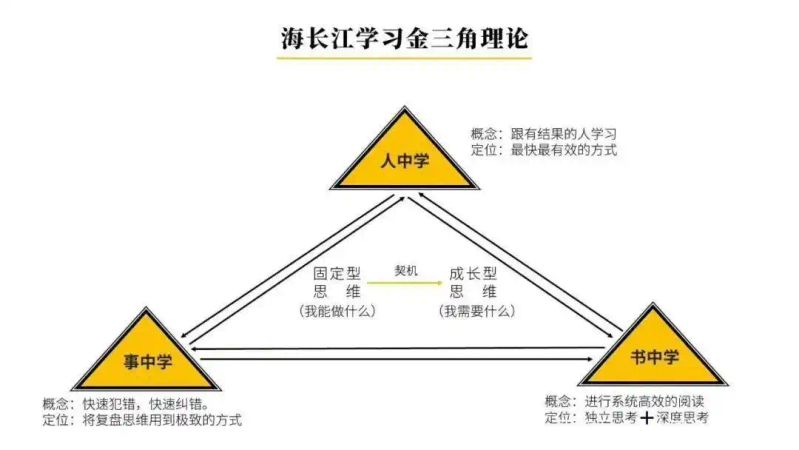
This is my original, and i highly recommend one of these。
Ii. Internalization
I'm just trying to figure it out
When you read, you have to take notes, but when you write notes, you must not write down all the knowledge that you think is useful in this book, which is no different from what i said above: "remember hard back," but sort out the key words。
You see, for example, in my autobiography power: self-regulating to the extreme, enjoying loneliness, a keyword, "365 days of the early sound exercise" and, under this big keyword, small keywords, such as "earth up early," "five o'clock exercise" and "hire house."。
This is the core of a thought map, and the software computer that produces the thought map recommends "xmind" and the mobile phone suggests "thinking" 。
I don't know
First of all, you can understand that, in the process of acquiring knowledge through reading, a book is temporarily called 100 per cent, which is usually not really digested after you have studied it。
I refer to this as “internalized efficiency”, i. E., the amount of internalized knowledge/the amount of knowledge learned。
What do you say
The first is to ask yourself, i. E. To develop the capacity to think independently, and the second is to ask those who have achieved results in this field, i. E. To develop the capacity to think in depth and to listen to the views and opinions of those who are more powerful than you。
This order must not be confused, but ask yourself first, then others, if they can find an answer without sufficient time and energy, and if they don't find an answer, then the key person must be found to help you answer the question。
And these key figures often don't have the time to answer to someone they don't want to do, so it's fair that you can choose to pay to learn and buy the time and knowledge of others。
Iii. Output
01 building the prototype of a knowledge system
The process of building the knowledge system is like you're painting it, first you draw out the trunk, which says "the knowledge system of the river" and then gradually improves the branches and leaves in line with the first "input" and the second "internalization" that i'm taking。
For example, i'm going to draw the trunks, and then i'm going to learn about the speech today, and i need to “input” and “internalize”, and then i should write the words on the first branch of the trunk, but you have to note that the speeches are also divided into “prompt speeches”, “public talks”, “reading speeches”, etc., so these are the little branches under the big branches, and the points of knowledge about each type of speech are the leaves under the little branches。
Do you understand? I don't think it's that hard, because you're the first to talk. I'm gonna brag. Just ignore it
The 02 is the best
Every true master should always have an apprentice's heart。
When we were in school, for example, the teacher gave you a math question that you could use for one night, so if one of the classmates made it, the other classmates would ask him, “what does it do?” so the fellow students will keep telling the subject to others, and the more they understand it, the more they remember it。
In the course of teaching, you may find a lot of problems that were not discovered before, which will make you more mature and comprehensive。
There's a lot of fans who say, "hai, i don't have any skills
I'd like to tell you that teaching is actually a good way to learn. For example, i didn't know anything about time management, but in order to exercise my time management skills, i told my fans, "i'm going to share a time management theme talk on the 10th of this month" and i want to grow up with a partner to learn with me。
And then you learn from the first, and you learn about time management over a 10-day period, and by the time you start with the tenth, you already have a lot of knowledge about this, which greatly increases learning efficiency。
And that's the real thing about teaching。
In conclusion, i would like to say to you:
I have experienced many difficult situations since i started a business in 2015。
As i set out on the path of time-management knowledge payments, many people are waiting to see my jokes, and they want to see what a furry boy can do, give up his career of stability, start from scratch, and march into an entirely strange territory。
But in 2019, under conditions such as blindness in the left eye, white wind, endocrinological disorders and the prominence of the interplex, i fought a beautiful battle to create my own brand matrix, and to flourish in multiple dimensions, such as writing, audio, short video, personal brands, not by luck, but by strict self-regulation。
Self-regulation is a capacity that, since it is, requires learning and refining。
Because of the many things to do during the day, and because of the conscious need to protect the right eye in case of blindness, it is impossible to make the day worse, but today's article, which i believe is of value to many people, biting on their teeth。