(read time: 4 minutes and 30 seconds)
"teacher, the voltage watch, the current watch, the slide transformer, i can never tell whether to use limit flow or split pressure!"
"i was right about the u-i image, but how did i end up with a symbol
“more power meters, om, voltage, current, zero, reading, block, i'm in the middle of more steps, i lose points every time i pass...”
And if you're in front of a physical experiment, you feel like you're new to an electrical workshop, full of table instruments, a bunch of wires, and you don't know which one to put -- you're not a person。
The position of the electron experiment in high school is not an exaggeration. It does not score much, but it has to pass year by year; it is not difficult, but it has a very high rate of error. Why? Because the first reaction of many of the students to the subject was to start with circuits, not animated drawings。
Today, we don't recite those textbook-style experimental steps. Let's break down the three core points of contention in the electron experiment, which are the best for students -- the selection of the internal and external connections, the determination of the flow limit, and the reading of more meters -- into the story of an electrical forensic team. All you have to do is remember who's in charge of these three characters, all the experiments, and you can see who's in charge。
It's..
I. Why do you always use the subject of the experiment
Don't rush into the lab manual. Let's do an intellectual experiment -- you're standing in front of a lab with a section of batteries, a voltometer, a current watch, a slide transformer, a bunch of lines. The mission is to measure the battery's electric motion e and internal resistance r。
Okay, tell me, what's the first step
Many of the students said, "close the circuits first!"
Wrong. Before you even get to the circuit, you have to solve two problems:
Whether the current meter is “in” or “out” on the voltage table? (inline or outside?)
Whether the slide transformer is followed by "restriction" or "discretion"
These two problems are not solved, and the circuits that you're connecting are either not read or you can't get the data you want。
The reason you've made the choice is because you've never seen the “real identity” of these three components. The voltage table is not a mere “voltage measure”, nor is the current meter a simple “flow measure” — they are all “private”。
Here's the organizational chart of the electro-intelligence brigade
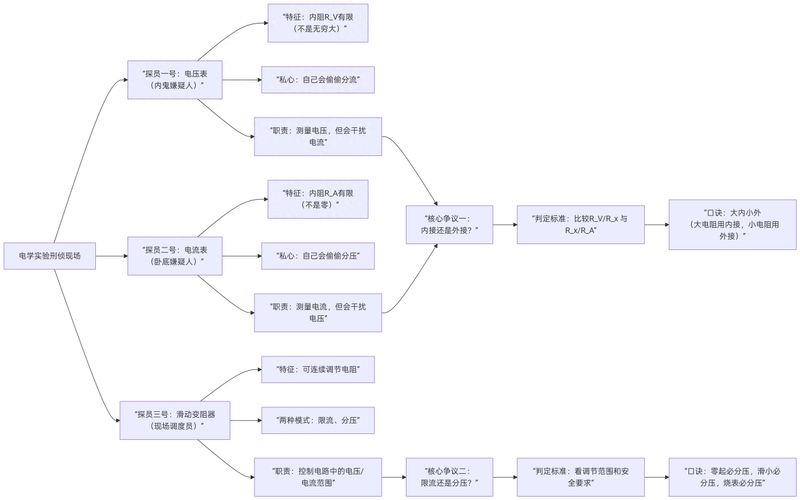
Remember the rules of this squad:
• the voltage and current tables are agents with “inner properties”. When they read, they also “eat” a portion of the current or voltage. All you have to do is decide which agent's "self" has less impact on the outcome。
• slide transformer is the field dispatcher. It says, "how far can you see the data?" the conclusions were biased when the scope was inadequate。
It's..
Core dispute i: internal or external? (specializing in “no reading”)
Scene: give you an electric resistance rx to be measured, a voltage watch (internal resistance r v is known or very large) and a current watch (internal resistance r a is known or very small). You have to measure rx's resistance。
"the reaction of ordinary students."
“the teacher said that the main electrical blockages were internal and the small blockages were external. How do i know if rx is big or small?"
"inquisition reasoning."
Step 1: clarify the “self” of the two agents
• inner method (the current meter is inside the voltage table): the current gauge is indeed a current that runs past rx, but the voltage gauge is the total voltage (the current table + rx). Source of error: current gauge pressure。
• extrapolation (the current table is “outside” of the voltage table): the voltage gauge is indeed the voltage of both ends of rx, but the current is the total current (the voltage table + rx). Source of error: voltage gauge diversion。
Step 2: compare "who is worse"
• if rx is large (e. G., thousands of euros) and the current gauge is very small (e. G., zero-point-plus) — the current gauge is almost negligible, so use the internal connection。
• if rx is small (e. G., several europes) and the voltage table is very large (e. G., tens of thousands of euros) — the voltage table is almost negligible, so it is attached。
Step 3: the upper judgement formula
Mathically, the line between "big" and "small" is:
• when rx > √ (r v x r a), rx counts as "large" and uses an in-house connection。
• da rx
:: in the case of equivalence, there is a similar error between the two methods。
(c) operational communications: large and small outer space (large electrical outlet, small outlet)。
It's..
Core dispute ii: limiting or separating? "i can't get it out."
Scene: give you a slide transformer to control the power of a section of the circuit from zero to zero, or to keep the circuit safe。
"the reaction of ordinary students."
"limitation is a series of transformers, with a split pressure and a transformer... Then i can even, anyway."
"inquisition reasoning."
Step 1: looking at mission requirements — should we “start from zero”
• if the title says “to cause the voltage to change continuously from zero” — a fractional pressure must be applied. The minimum flow-restricted voltage can only reach exrx/(r+rx) and never reach zero。
• if the title says “measuring multigroup u, i values, drawing u-i images”, it is suggested to use a fractional pressure because the data range is large and the images are more accurate。
Step 2: look at the transformer specifications - slipping fractional pressure
• if the total resistance value of the sliding transformer is much smaller than that of the pending resistance rx (e. G. R)
• if r is much greater than rx (e. G. R > 10rx) - the limit and the split pressure are available, but the limit is less electrical。
Step three: look at safety requirements -- burn the watch
• if the flow is restricted, the current may exceed the current gauge scale or the burning component when the transformer is moved to the minimum — the fraction pressure must be used because it can be slowly adjusted upwards from 0 to be controlled。
(b) operational tactics: zero splits, slids split, and meters burned; the rest is limited and power saved。
It's..
Additional meters: “toggle password” for three slots
A lot of students are using electric meters to pick up their heads, not because they can't read them, but because of a disorderly sequence。
Scene: an om set with multiple meters to measure a resistance。
Operation of ordinary students
Pick up the markers, plow them directly to the end of the barrier, look at the pointers, read them, turn them over. Deduct points。
Criminal standard operating procedures
Step 1: mechanical zero (first use only)
The head pointer is not at the left end? Scrambling it with a little screwdriver and pointing it at the "poll."。
Step 2: selection of slots
It is estimated how much resistance is to be measured, and a pointer is selected to drop at a level near the median (the most accurate in the vicinity)。
Step three: om zero
Key actions: two phrases short, adjust the om zero button, and point the pointer at the right-hand "0 times". Why? The battery voltage will change because of the batteries inside the om set, and it will be calibrated every time they change。
Step 4: measuring readings
Red and black pencils for electrical resistance at both ends, pointers, reading x multipliers。
Step five: reprofiling
If the pointer is too small or too big, it has to be replaced with the om 0
Step 6: close
To prevent miscalculation by dialling to the off slot or to the exchange voltage ceiling。
(c) operational tactics: a mechanical transfer of the first step, followed by the selection of the omdjo; readings multiplied by the number of times they are forgotten, and the highest points are returned。
It's..
V. "experience three no" for our headline readers
First, do not: do not “hands faster than eyes”。
When the subject is taken, the circuit chart is drawn on the draft paper, indicating clearly whether the interlink is in or out, restricted flow or split pressure. It's the right one, the wrong one, and the wrong one is zero。
Second, do not: do not superstition a formula。
The power source dynamic and internal resistance are measured. But when the image method handles data, the vertical distance of the line is e and the absolute value of the slope is r-- a lot of students here turn negative and positive because only formulas don't mean images。
Thirdly, do not: do not “mix multiple meter slots”。
When the voltage is measured, the pen is linked; when the current is measured, the pen is linked; when the resistance is measured, the circuit cannot be charged! These three, if one of them is guilty, the light shall not be read, and the heavy thereof shall burn the watch。
It's..
Vi. "empirical disorder three"
From today on, get any electron test questions, and ask yourself three questions:
Question one: retardation or power
• measurement of electrical resistance: the core is pick-up (internal/output)。
• measurement of power sources: the core is image processing (intersection and slope of the u-i line)。
Second question: is voltage from zero
It's a split pressure。
No, look at the slide transformer resize。
Question number three: what's the extra meter
• om: zero, then measurement, and then zero。
• voltage/flow slots: reading scale, estimation reading, protection against excess range。
It's..
To be honest, electron experiments are part of the “strategic abandonment” of many people in high school. Because they think, "the subject of the experiment is very variable, and it's not necessarily possible to get points."。
On the contrary. The subject of the experiment is the most "set-by-show" in all the types. Internal or external, with clear findings; restricted flow or fractional pressure, with fixed standards; multiple use of meters, with standard processes. All you have to do is get these "optional questions" right, and the rest is elementary math -- minus and minus and look at the coordinates。
Those kids who lost their jobs on the subject, they're not really clumsy。
You're just missing a clear chain of command with three agents。
Today's article is your dispatch manual。