The real challenge of the knowledge mapping project is much more than building a complex network. When faced with hundreds of thousands of scattered documents, the core issues shifted to how knowledge was structured into the system and how it was structured to govern and reuse. The paper deepens the six key elements of the operator's knowledge mapping practice, from access judgement to ai extracting boundaries, and brings rules to the chain of evidence to verify how to transform a knowledge of disarray into a serviceable business asset。

More recently, we've been doing a knowledge mapping project for the operator, and the more we're doing it, the more we think that a lot of people are actually looking at it in the wrong place。
When you listen to the “knowledge map”, you can easily see a cool web in your head: there's a lot of nodes, a lot of connections, a little bit of a product, next to a set of foods, entitlements, activities, rules。
But if you really do it, you'll find it's not at all a question of whether the web is sufficiently complicated。
The real difficulty of mapping knowledge is not to connect it, but to bring it into the system in an orderly manner。
If you simply throw the document to a large model, slice, quantify, question and answer, you can run in the short term. The user asks a question, the system finds a relevant document and generates an answer. The demo stage is usually kind of like that。
But when there are hundreds of thousands of documents in the knowledge base, the sources are scattered across systems, provinces, business lines, things change。
At this point, the question is not "can you answer this time," but:
What kind of knowledge is this? Which product is it related to? Is it still working? Is there any conflict with existing rules? Can we get a customer service, agent, rag system stable
That's the real reason we're doing this。
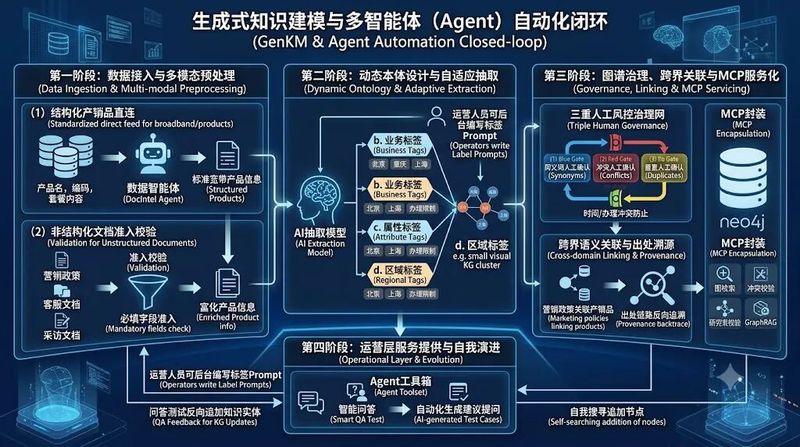
First, the first step is not to build a map, but to judge what comes in
The knowledge we now have is broadly divided into two categories。
The first is knowledge of products and products, such as broadband, food packages, terminals and equity packages. This type of data is usually derived from system access and has itself a comparative standard field: product name, product code, package content, cost description, processing rules, up and down。
Such knowledge is naturally more appropriate for the generation of maps. Because it already has a skeleton, it's more about filling it up。
The real trouble is another type: document-type knowledge。
Marketing policy, client service files, interviews, programme of activities, training materials these are scattered across systems, not in uniform formats, and not in a uniform particle size. Some documents refer to only one product, others to one activity, others to multiple products, rules, time limits。
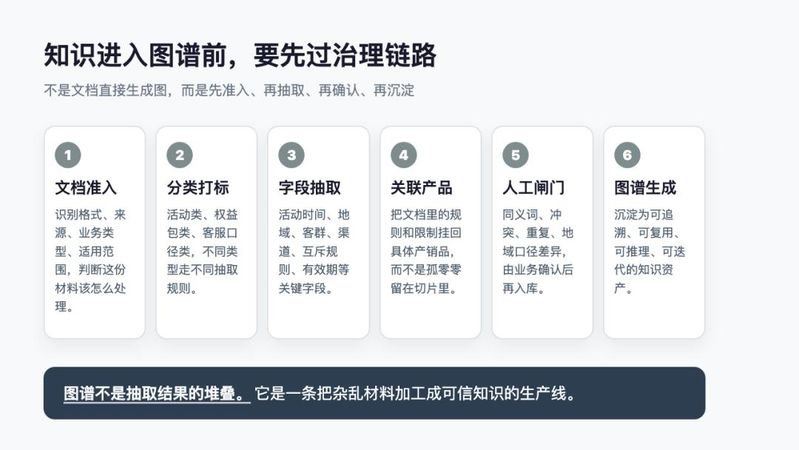
This type of document is not directly " forward map " . It must go ahead and get access。
Access is not about judging whether the document is valuable, but about how it should be governed。
A marketing campaign document, for example, cannot simply draw a name for the activity. At a minimum, it depends on the time of the activity, the geographical area to be applied, the client base to be applied, the product to be applied, the channel of processing, the rules of activity, the content of the interest, the rules of cross-reception。
Without these, the picture appears to have nodes, but it is still missing when it comes to real questions and answers and business judgements。
Two, ai can find a clue, but the rules cannot be left to it
At the extraction stage, ai was useful。
It can find entities, relationships, rules and conditions from unstructured documents. It can be seen, for example, as an active document containing activity time, geographical application, trophies and conditions for mutual rebuke。
But there's a point that's particularly important here: ai can find out freely, not always。
Our approach now is to combine ai's discovery capabilities and operational labelling systems. The system maintains business labels, attribute labels, area labels with corresponding extract instructions and p at the end of each labelRumpt。
But the label is not the end, the label is the entrance。
The system judges a document as an " active category " , which is only the first step. What really matters is: what exactly should active documents draw? The name of the activity, the duration of the activity, the application of the client, the geographical area, the channel of processing, the rules of participation, the rules of cross-crowding, the prize, the duration of the period, are the following manageable fields。
The same is true for package-type documents. It is not intended to draw a general “equity package”, but rather the content of the interest, the cost, the duration of the period, the manner of receipt, the rules of entry into force, the rules of change, the rules of withdrawal。
Ai is responsible for discovering and setting rules。
Let ai see what smokes and eventually get a bunch of pretty, uncontrollable fields. All types are written in advance and cannot keep up with business changes. The more practical way to do this is to get ai to help you discover the high frequency mode, then to sink the key fields on the side of the operation into standard extraction rules。
Iii. The most critical step in document mapping is to hang the rules back on the product
Our system produces two lines。
The product map is relatively straightforward. Product master data themselves are more structured and can be generated from product data。
More difficult and valuable is the document drawing. Because many business rules are not contained in product master data, they are hidden in various marketing policies, client calibres and programmes of activities。
For example, a product itself is a package. However, a marketing campaign document may contain a description of which users are able to participate, which packages correspond to which contracts, when the activities begin to end, which contracts are mutually exclusive, how long the awards are valid and where are the channels for processing。
This information can be answered occasionally during questions and answers, if only in document slices。
It is, however, difficult to relate steadily to specific products, to conflict detection, to duplicate identification and to rule-based governance。
The document chart is not intended to draw a single picture of the document, but to hang the rules back to the business object。
Activities, rules, restrictions, entitlements, channels, time, end up returning to specific products, specific clients, specific geographical areas, specific life periods。
In this step, manual confirmation is not inefficient but a necessary operational gate。
Multiple marketing documents overlap, product processing restrictions are inconsistent, rules of activity cover each other, and the same product differs from one market to another — problems that cannot be entered directly by the phrase “ai has been extracted”。
Iv. Question and answer test depends on the answer, more on the chain of evidence
We'll do a question-and-answer test when we're done. The system allows ai to generate questions about recommendations that can be used to quickly verify whether the mapping supports real questions and answers。
But what really depends here is not just the answer, right。
More importantly: what are the nodes of this answer? What relationships? What documents are the evidence from? Are there any key conditions missing? Was there a mistake in the rules of different documents? Are expired activities considered effective
For example, the user asks: can a hangzhou user participate in a lucky drive
A good system cannot simply answer "yes" or "no". It should be able to spread the judgement chain: whether the time of the event is effective, whether it matches the geographic location, whether the user is a suitable guest group, whether the set is compatible, whether there is a mutual rebuffing activity and whether the opportunity to draw is still valid。
The value of graph questions and answers is not to produce an answer, but to clarify the process of judgement behind the answer。
V. Quality of the map, not just nodes and relationships
Many spectrograph projects prefer the number of nodes and relationships. This indicator is of course visible, but it can easily be misleading。
The number of nodes is not necessarily good, nor is there a certain degree of relationship。
The real assessment is whether the entity is integrated, whether the field is complete, whether the relationship is tied up, whether there is evidence of the rule, whether the conflict has been identified, whether the repetition has been merged, whether the answer can be traced, and whether the mapping can evolve over time as the business changes。
In particular, document-type knowledge cannot be completed at once. Business will be updated, activities will expire, packages will fall off and policy will change。
If it doesn't evolve, it will soon become a beautiful, but outdated, map。
So we're also doing a self-evolved mapping: when we find a physical node inadequate during the question-and-answer process, the system can go back to the knowledge base and re-search, supplement and then go into the vetting process。
Attention, this is not to let ai quietly change the pattern。
Ai is responsible for identifying gaps, and the process of governance remains。
Vi. The mapping should end up being an accessible capability
After the drawing, there's a crucial step: mcp seal。
If the chart search, conflict verification, cross-node reasoning capabilities are sealed into mcp services, it can be called directly by the passenger service system, smart agent, rag applications, and operational tools。
At that point, the mapping was not a “show for presentation”, but a part of the enterprise's intellectual capacity。
It can answer questions, it can make qualification judgements, it can examine conflict of rules, it can recommend supporting products, it can support the quality of the service, and it can allow different agent to call on the same credible body of knowledge。
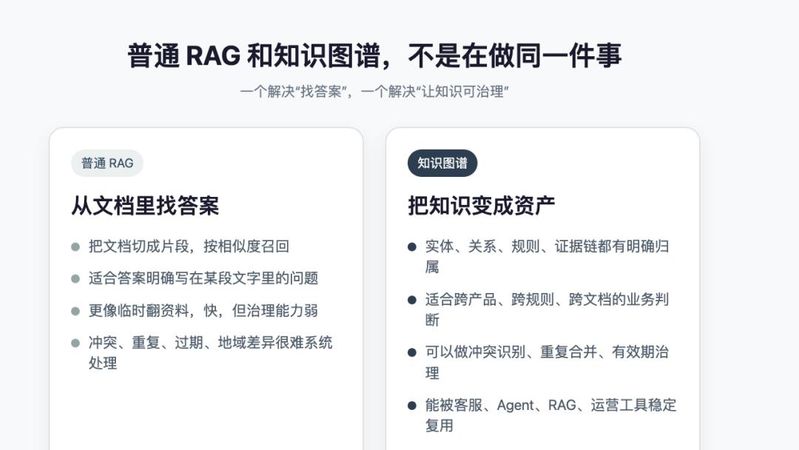
That's why we're not satisfied with ordinary rag。
Normal rag solves by finding answers from documents. Knowledge mapping addresses “structured governance, continuous reuse and stable reasoning”。
The former is more like an operational system。
So what this process really wants to do is not create a complex web of hundreds of thousands of documents。
It wants to solve another thing:
Let every important knowledge know who it is, where it comes from, who it relates to, when it works, whether it can be trusted and who it can be called。
The end of the knowledge map, not the map。
It is the transformation of knowledge from messy material to business assets that can be organized, validated and transferred。