


Professor, department of social and ecological civilization, central party of the chinese communist party (national school of administration)
In 2026, the communist party of china celebrated its 105th anniversary. From 1921, when the red ship of casingnan lake sailed, to today's tianxi river and vientiane, the communist party of china united the chinese people out of a vast path of recovery. This road is one in which the vast majority of rural communities have become particularly ferocious — the poor villages that once “feed by the sky” — and are now beautiful homes where industry flourishes, where it is ecologically liveable, where it is civilized, where it is governed effectively and where it is rich。
For more than 100 years, the communist party of china has placed the issue of the sannos at the forefront of governance. During the neo-democratic revolution, the party led the peasants in the fight for land and fields, and “farmers have their fields”; after the reform and opening up of the system, the co-contracting responsibility of the family released rural productivity; and into a new era, the party centre, with comrade xi at its core, made the fight against poverty the bottom line of the full-scale construction of a healthy society, organized the battle against poverty, which was the largest and strongest in human history and which benefited the largest number of people, and the historic eradication of absolute poverty in 2020. As one of the largest poverty-reduction initiatives in the world, the scale, speed and success of poverty reduction in china is an unprecedented milestone in human history, creating a “china miracle” in the history of poverty reduction in the world。
At present, our country's consolidation and expansion of the fight against poverty is effectively linked to the revitalization of the countryside, with a five-year transition period that has been successfully completed and firmly anchored in a threshold of no return to poverty on a scale. Over the past five years, 832 poverty-free counties have experienced an average annual increase in disposable income of 8. 2 per cent per year, which is 0. 8 percentage points higher than the national rate of increase in farmers ' incomes and has helped to stabilize the risk of 7 million people who have been monitored to prevent their return to poverty. Experience has shown that the success of china's anti-poverty campaign and its consolidation have been tested by history and the people. This profound rural change is not just a change of venue at the material level, but a comprehensive leap forward in the concepts of institutions, mechanisms and development. It has profoundly interpreted the people-centred development philosophy of the communist party of china and has demonstrated the great superiority of the socialist system that characterizes china。
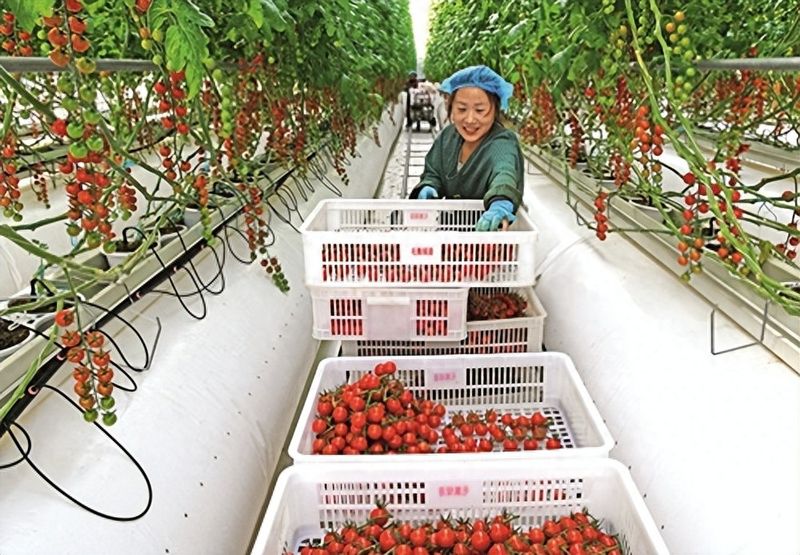
Wisdom agriculture has contributed to the revitalization of rural industries, with the aim of picking tomatoes for staff members at the mau jiaan agricultural science and technology industrial park in anhui province. (photo by chen bin/people)
From poverty alleviation to rural renewal: two hundred years of struggle, renewal and renewal
The fight against poverty and the revitalization of the country corresponded to china's “two hundred-year” goals in the modernization process, which, in terms of strategic objectives, specific content and working mechanisms, represented both a continuum and an improvement。
In terms of strategic objectives, the two represent a gradual and progressive convergence. The fight against poverty, which has focused on tackling the absolute poverty that has beset the chinese nation for thousands of years, is a landmark project for achieving the first centennial goal. Rural renewal, on the other hand, has been anchored in the second centenary of the struggle for the basic modernization of rural agriculture by 2035 and full agricultural, rural and rural prosperity by mid-century. From `all-round smallness' to `common wealth', from `deprivation of poverty' to `all-round rural renewal', the national strategy is moving forward with clear objectives。
In concrete terms, the fight against poverty provides a solid foundation for rural renewal. The “five groups” project, carried out during the poverty-eradication period, responds to and underpins the five major demands for the revitalization of the countryside: “industrial boom, eco-friendly, rural civilization, effective governance and well-being”. During the poverty-eradication period, about 70 per cent of the country's poverty-reducing funds were allocated to the alleviation of poverty in industry, the creation of jobs for ecological protection of public goods, large-scale investments in infrastructure such as transport, water, electricity grids, education and health care, which significantly improved the level of basic public services in rural areas。
In terms of working mechanisms, the fight against poverty has accumulated valuable experience. There is a leadership role for the “five-level secretary to fight poverty” and “four forces” that continue to play an important role, such as village-based support, east-west collaboration, stationary and social support. Since 2015, a total of 518,000 village secretaries have been selected, together with more than 3 million village cadres, to join nearly 2 million village and village cadres in the struggle against poverty and poverty. Not only have they brought with them projects and resources, but they have also reshaped party affiliations and developed a cadre of grass-roots cadres who “know agriculture, love rural, love farmers”。
Rural revitalization is by no means a simple continuation of the fight against poverty. Rural revitalization reflects the renewal and upgrading of the “two hundred years” goals in terms of strategic focus, promotion strategies and implementation of the main themes. The fight against poverty is firmly “precision”, in keeping with the solemn commitment made to the nation by the center of the party, centred on comrade xi jinping, that “there is no less on the path of full well-being” and that it is clear, time-bound and focused; and that rural revitalization is focused on “comprehensive”, and that the modernization of agriculture, which is strong, rural-american and peasant-rich, is a long-term and systematic project that emphasizes the priority of agricultural and rural development, takes into account the principles of sub-regional classification, and actively promotes the rights of farmers, equity of opportunity and fairness of rules, the reduction of rural-urban development gaps and the acceleration of the construction of a strong agricultural state。
From “breed transfusion” to “breeding”: the road to the transformation of rural industries
If the fight against poverty is a “strength battle”, then rural revitalization is a “protracted war”, the core of which is the construction of an internal dynamic mechanism for sustainable development and a shift from external “breeding” to self-breeding。
In 832 anti-poor districts of the country, this transformation is taking place vividly. The town of jaihan in paixah, gansu province, was a traditional agricultural area inhabited by ethnic minorities, with a single industrial structure and difficulties for farmers. In recent years, local efforts to restructure the agricultural sector have been based on a wealth of cultural resources and geographical advantages. Development of efficient cash crop cultivation through land-flowing, such as pyrotechnics, raspberry and cherries, and the creation of special flower seedlings. At the same time, a number of farming and deep processing enterprises, such as junyon meat products and the good shepherd industry, are being cultivated to extend the industrial chain. In-depth exploration of local history and culture, construction of village history, preparation of the cultural museum of the wangwon site, promotion of the integrated development of cultural tourism and revitalization of the sleeping cultural heritage。
With the help of a pair of local power companies, the town of ordos gygilantu, an inner mongolia, has been called upon to explore new models of “the three-chain integration of state enterprises, green electric farmers”. The development of an integrated roof-spread photovoltaic and smart light storage shed project directly increases the collective economic income of villages. At the same time, using a stable green power supply, traditional industries such as potatoes, vegetable vegetables, meat cattle, goats and even white-to-cray shrimp farming have been upgraded to create the country's first carbon-free food-processing production line, with a deep integration of one or two industries. This combination of “photo+agriculture+tourism” not only reduces production costs, increases product value addition and moves beyond a new path of ecological priority and green development。
In the kicheang commune of yunnan loping county, the number of animal wild monkeys protected at the second level of the state has increased with the continued improvement of the ecological environment, and the conflict between monkeys and monkeys has increased. Local governments have been able to mitigate “human and animal conflict” effectively by introducing a regular feeding mechanism for “monkey nannies”. What is even more clever is that they follow the path of making the monkeys a special tourism project, attracting tourists to see monkeys, photography, study and other related industries, such as residential accommodation and catering. At the same time, the cultural resources of the nation have been explored, the ecological brand of “that color” has been developed, the agricultural products of rice, pepper paste and vegetable oil have been developed, and the underground tunnel farmers have been transformed into “new farmers” through electric power companies。
The new era of rural industrial revival is no longer limited to traditional farming, but is moving towards greening, intellectualization and integration. In the past, agricultural efficiency gains were largely driven by increased product depth, variety and production, with an “additional effect”. Today, however, after the integrated development of the rural sector, the multifunctional nature of agriculture in terms of ecology and culture has been realized, with a direct rewriting of the production function and a “multiplier effect”. Whether it is light-voltage modern agriculture, cultural activating rural tourism, or ecological conservation that gives rise to new business patterns, it reflects a shift from “whether or not” to “good” rural industries。
From “empty villages” to “new homes”: rural governance and the return of talent
The rural stage is big, and of course young people are willing to return. The challenge of “brainpower” must be solved by insisting on “people-centred”, both to retain and to attract. The human person is fundamental to all development. If the village was an “empty village”, it would be difficult to revitalize itself if it was unbridled and invested more money。
Today, agriculture is deeply integrated with tourism, education, rehabilitation and telecom broadcasting, and by the end of 2024, the industrialization of agriculture had led to about 120 million households. The ministry of agriculture and rural development, in the 14th and 5th periods, has launched the “14th and 5th development plan for the development of the rural workforce in agriculture” to increase support for the development of “new farmers”. The “fifty five” programme outlines “incentives for all categories of skilled and rural services and job creation”。
For example, the zhejiang promoted a “1111” rural talent matrix, the development of a full-chain support mechanism for “retention of children”, the reshaping of the farmers' training system, the expansion of new spaces for entrepreneurship in counties and villages, and the introduction of “new farmers” credit products. At present, a total of 4,600 “head geese”, 89,000 farmers and 402,000 modern “new farmers” are being nurtured to revitalize rural industries. The specialty industries are set up from the “village super” “village” “ba” “village evening” to the village, village electric competition, village t-station, artist studios, village clubs where people are required to play cards..
Locals are actively exploring brain gain mechanisms. On the one hand, by optimizing the business environment, improving infrastructure and providing quality services, expatriate workers are attracted to start their own businesses. Many of them have fought in cities for many years and have accumulated financial, technological and market experience, known as the “cities of the city”. When the development environment in their home countries improves, they take on new ideas and new technologies to feed their children and become “lead geese” for rural development。
On the other hand, grass-roots organizations have been strengthened to select the “two-member” team for the best pair of villages. For example, through the implementation of the “two-way-for-one” model in the town of zchug, hanbin district, ankang province, cooperative leaders and resource-rich workers were trained as village reserve cadres, while veterans and university graduates were integrated into village cadres. Currently, each village in the town is equipped with at least one undergraduate and above full-time party organizational clerk, which greatly enhances grass-roots governance capacity and specialization。
At the same time, rural governance systems are constantly being innovative. Massive self-government organizations such as the red and white council and the morals council have been widely established to promote the change of customs and to curb stereotypes such as the price of the bride price and the burial of the deceased; governance systems such as the credit system and the list system have been introduced into the countryside to stimulate popular participation; and digital means have been applied to village management to improve service effectiveness. In the village of zhejiang province, in the town of kobashi, village of zhejiang province, villagers need only clear access to public information about the village and deal with various matters。
From “urban-rural integration” to “urban-rural integration”: fundamental changes in the concept of development
Behind the transformation of the countryside is a profound change in the concept of development. For a long time now, rural areas have been seen as a subsidiary of cities, with the main function being to provide food, raw materials and labour for industrialization and urbanization, with the “urbanization” becoming the mainstream thinking. The 16th congress of the party has put forward the concept of “integrated economic and social development in urban and rural areas” and the 18th congress of the party has clearly articulated the concept of “advancement of integration in urban and rural development”. The 19th party has further proposed “the establishment of a sound institutional mechanism for integrated urban-rural development”, which marks a move from “integrated” to “integrated” in order to enable the village to perform its specific functions。
The rural renewal promotion act, enacted in 2021, clearly defines three village-specific functions: safeguarding the supply of agricultural products and food security, protecting the ecological environment and transmitting the traditional culture of excellence of the developing chinese nation. These unique functions are not available in cities and are indispensable in the modernization process of the state. Today's integration between rural and urban areas is aimed at the beauty of both rural and urban areas。
The population is no longer a one-way migration to urban areas, and an increasing number of urban dwellers are beginning to live in fields; capital is no longer a mere urban migration to rural areas, and rural ecological products and cultural resources are becoming new flashpoints of investment; and elements such as land, technology, data and so on are accelerating flows between urban and rural areas, creating new patterns of complementarity and complementarity。
In the future, china may form a functional division of labour between cities, towns and villages: cities gather innovative resources and assume the burden of industrial upgrading; cities and towns act as “stretch stations” linking urban and rural areas to take over industrial transfers and provide integrated services; and rural areas carry cultural memory, ecological barriers and leisure and leisure functions and become spiritual homes for people。
In 105, the communist party of china (cpc) had its first heart and mission. From the eradication of absolute poverty to the comprehensive promotion of rural renewal, from the resolution of the question of whether there is a “no” to the pursuit of “goods”, the rural areas of china are undergoing a profound transformation that is unprecedented。
This is a change in the road, a change in industry, a change in governance, and a convergence of hearts. It has allowed hundreds of millions of farmers to live the good lives they have dreamed of for centuries, and it has given life to old villages. Looking to the future, under the strong leadership of the party, as the strategy of rural renewal moves forward, a beautiful picture of “the mountains, the waters, the homes and the countryside” is bound to unfold on chinese soil. In the future, china must be a country and a city with a modern tradition。
Published in the original language in issue no. 13 of 2026



