Current status and response to international intellectual property games
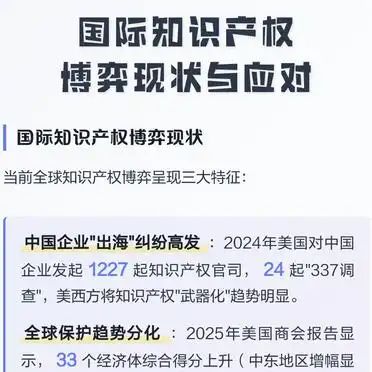
Status of international intellectual property games
There are three main features of the current global intellectual property game:
China's “off to sea” dispute was high: in 2024, the united states initiated 1,227 intellectual property lawsuits against chinese enterprises, and 24 “337 investigations”, with a clear trend towards “weaponization” of intellectual property in the united states and the west。
2. Distinction of global protection trends: the 2025 report of the united states chamber of commerce showed that 33 economies had increased their aggregate scores (with significant increases in the middle east region), but that us-european policy adjustments (such as the us drug price negotiations and the eu generic drug legislation) had weakened innovation incentives。
Cross-border electric operators are the worst affected areas: global trademark applications recovered in 2024 but decreased by 1. 5 per cent in china, owing to legal differences, abusive complaints about the “industrial chain”, internet borderless and territorial conflicts, and 60 per cent of cross-border electric power company platform vendors have complained and 30 per cent have been blocked。
Overseas protection challenges
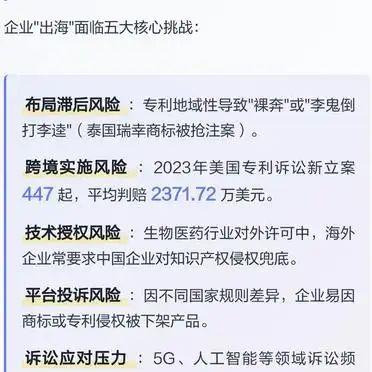
There are five core challenges facing the business “off to sea”:
Timing risks: the geographical nature of the patent leads to “naked run” (e. G., 26. 1 months of the united states patent review cycle) or “li gyu” (thai xian's trademark was betted)。
Cross-border enforcement risks: 447 new cases were opened in 2023 in the united states of america, with an average award of $2,371. 72 million, which is characterized by “one fast, two highs”。
3. Technology authorization risks: in the context of foreign licences for the biomedicine industry, overseas enterprises often require chinese enterprises to cover intellectual property rights abuses, and without fto analysis, they can easily incur high compensation。
Platform complaints risk: because of differences in rules between different countries (e. G., the european “regional exhaustion” principle), enterprises are vulnerable to being targeted for trademarks or patent infringement。
5. Responsiveness to litigation: 5g, artificial intelligence, etc., are frequent and require a combination of rapid downfall, evidence gathering, administrative/judicial defence strategies。
Corporate response
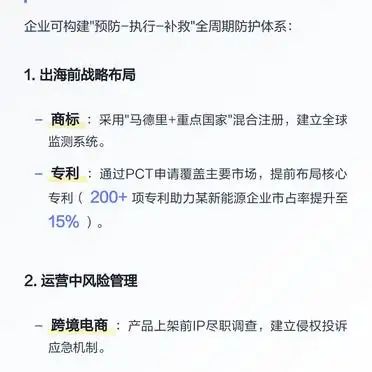
Enterprises can build a full-cycle system of protection from “preventive enforcement remedies”:
1. Pre-sea strategic layout:
Trademarks: a combination of “madrid+priority” registrations, core categories and defensive registrations, and a global monitoring system。
Patents: pct applications cover major markets (us, eu, japan, south korea) and pre-position core patents and build patent portfolios (200+ patent-assisted market share of a new energy enterprise increased to 15%)。
2. Operational risk management:
Cross-border electrician: pro-product ip due diligence, establishment of a mechanism for emergency response to abuse complaints, use of original photo/print。
Supply chain: secrecy agreements with suppliers, code/draw hierarchy management and block chain certificate technology。
3. Dispute response strategies:
(a) the scene of violations: the rapid removal of suspected products, the gathering of evidence prior to use and the defence of rights through administrative or judicial proceedings。
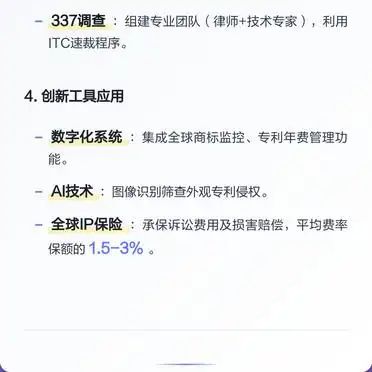
Investigation: forming professional teams (lawyers + technical experts) to use the itc expedited procedure in conjunction with conciliation and counter-claims。
4. Innovative tool applications:
Digital systems: integrated global trademark surveillance, annual patent fee management, tort warning function。
Ai technology: image recognition screening patent infringement, nlp monitoring trademark infringement。
Global ip insurance: costs of insurance litigation and damages, 1. 5-3 per cent of the average rate。