Walnut cultivation common pests and pest control strategies
Yang xing ming and others
1 ulcer disease
1. 1 characteristics of occurrence
Erosion is a common type of fungal disease in the cultivation of walnuts, which can cause greater harm to the trunks of walnut trees, twigs, fruit, etc., and, in serious cases, death of walnut trees, causing significant economic loss. In the affected area, there are circular signs, most of which are black and brown, which are then gradually extended to long stripes, water herring spots on the cortex, some mucous fluids flowing out of the ulcers, light yellow, and stains after exposure to air. When the branches are sick, they weaken, decay or die. When the fruit is sick, round brown spots appear, and the fruit trees gradually rot and fall. In april-may and august of each year, the pecan ulcer outbreak will increase the incidence of pecan ulcer disease if the tree grows under adverse environmental conditions such as drought, cold temperatures, wind, and a large number of branch wounds。
1. 2 measures
In order to prevent walnut ulcer disease, tree management should be made more aware, timely watering, scientific fattening, rational trimulation, tree tending, raising the resistance of walnut trees to disease; scientific choice of walnut tree varieties to ensure that the species selected are relatively resistant and reversible; close attention should be paid to the growth of walnut trees, which should first be removed from central burning if dead branches and dead trees are found, reducing the likelihood of disease transmission; emphasis should be placed on the dry whiteing of trees and the prevention of the production of lime, edible oil or vegetable oil, salt, bean-faced water, etc., should be mixed at an appropriate rate to ensure a good preventive effect; during the high incidence of ulcosis, it should be recommended that 50 per cent of the ethyl-trazine humid powder be administered 200 times the fluid, 80 per cent of the anti-bacterulose cream cream milk should be used to prevent the spread of the disease; and in the case of pecan trees, the disease should be reduced by a further 1 per cent of methylate, 50 per cent of 。
2 black spots
2. 1 characteristics of occurrence
Walnut pheasant is a bacterial disease, also known as black curvature, which poses a greater hazard to walnut blades, berries, twigs, etc. Following the injury of the branch, there were some long-shaped incubation signs, many of which were brown in colour and later branches dying of atrophy. After the blades were injured, there were signs of multi-angle disease in the veins, a dizziness on the outer edges of the tracts, water stains, post-leaf punctures, wrinkles, malformations. After the flower was injured, there were some black and brown spots. After the fruit had been cut, the top layer formed a brown spot, which continued to grow into a single piece of fruit and nucleus, and gradually decomposed. Black spots tend to occur between the walnuts and the flowering season, when they are exposed to high temperatures and humidity. The fruit is easily infested by walnuts and walnuts. In the case of walnut cultivation, excessive density and a lack of attention to trimming can lead to poor photo-ventilation, which can significantly increase the incidence of black spots. Weak trees and old trees tend to have worse symptoms after they develop (see figure 1)。
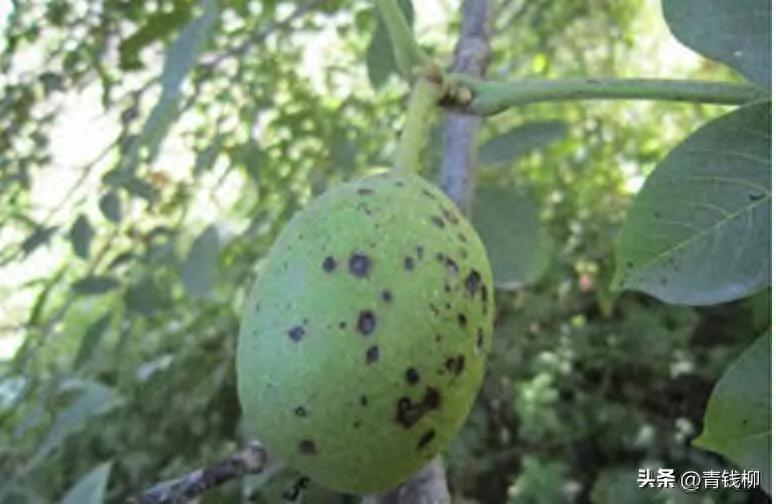
Figure 1
2. 2 interventions
In the prevention of walnut pheasant pheasants, care is taken to select species that are highly resistant and adaptable; flexible control of walnut tree planting density in combination with such factors as varieties, soils and so forth is not too high, avoiding the influence of lumbering to induce black spots; increased awareness of inter-forest management, with emphasis on triming and enhancing the position of the tree to ensure healthy growth; increased management of water fertilizer, based on the scientific pursuit of walnut tree and water, to avoid injury to the tree; better control of walnut fertiloma and reduction of haze wounds; increased awareness of gardening and early removal and central burning of deep burials in cases of disease, leaves, etc.; deep burial of cucumbers after walnut harvesting, to reduce the incidence of chlorobeticides; increased management of water fertilizers, based on the scientific pursuit of walnut tree lengths, and to meet the demand for walnut ferant growth, to reduce the incidence of hazes; increased use of microbicides in a timely manner and to avoid the occurrence of ticides of 。
3 anthrax
3. 1 characteristics of occurrence
Anthrax, which is more common in walnut cultivation, is a fungal disease and one of the three major diseases that endanger walnuts, which, if massive outbreaks occur, can significantly threaten the growth and outcome of walnut trees. Anthrax poses a greater risk to the buds, leaves and fruits of walnut trees. When the fruit is sick, there are circular spots on the sheet of fruit, most of which are black and brown, dimmed in the middle, small black dots, and small dots in a damp environment become pink. When the disease occurs, it does not disproportionately affect walnuts, but if it does, it can lead to their gradual blackening and decay and loss of edible value. The disease of the leaves produces irregular spots, with later leaves dying yellow and gradually falling. The sprouts, lumbers and twigs are gradually dying and the leaves are burning and falling. Anthrax of walnuts occurs from june to august of each year, when the rainfall is too humid, management is widespread, trees are weak, plant density is high and leaves are extremely dense。
3. 2 interventions
In order to reduce the incidence of walnut anthrax, priority should be given to the selection of strains that are resistant to disease, and, in normal cases, to late-literated varieties that are more resistant to disease than pre-pregnant varieties; emphasis should be placed on the cleaning of forests, the timely removal of strains, fruit, branches and leaves, the prevention of further infestation and the reduction of the incidence of next-year diseases; walnut tree cultivation should be followed by enhanced fertilization management, the promotion of fertilisation techniques for soil formulations, the scientific preparation of fertilizers, increased use of fertilized organic and phosphate fattening, the control of nitrogen fertilizer and the promotion of seedlings to increase the resistance of walnut trees to precipitation; work should be done in the summer, with a focus on cutting crowns and other long leaves, the creation of good luminous wind conditions to prevent the occurrence of an anthrax of anthrax1 and a dose of a dose of up to a factor of one thousand and a factor to one hundred and a half times a thousand times the dose of a dose of a 。
4 legion moths
4. 1 characteristics of occurrence
The moths are one of the major pests of walnuts, and the larvae of limb moths eat fruit, produce a large number of cavities and release some transparent secretions. When the nuts are affected by the pickled moths, the skins gradually become dry and black, the pecan skins of the worms form a stationary troupe, which accumulates large amounts of insect manure, pollutes the pecan as a whole, the fruits of the later period gradually fall out, some of the pecan colours that are affected by the moths of the limbs are blackened, the pecan skin is wrinkled, stunted, and the internal tissue is decaying, thereby affecting the production of the pecan and reducing the value of the goods. The occurrence of walnut pick-up moths, which are closely related to environmental factors, the walnut pick-up moths are significantly increasing the incidence of walnut pick-up moths due to excessive damp soil, excessive weeds and poor ventilation。
4. 2 interventions
In case of walnuts and walnuts, it is necessary to increase the awareness of orchard management, scientific walnut tree trims and timely trims of sick and dense branches and maintain normal light and ventilation; to strengthen garden drainage management to avoid excessive dampness of the soil; to recommend, before winter, that the soil be farmed over and over again and freeze to death in winter beaks in the soil; to remove the old bark from the orchard in the early spring; to remove it first time when there are weeds and dead leaves in the orchard; to harvest and bury the affected fruit in a timely manner, thereby reducing the number of insects and the harm caused by it; to give priority to the use of walnuts, to release a bee in the orchards, every 667 m2 in each of the orchards; to release 25 to 300,000 heads in the orchards, and thereby to kill the limbs and reduce the harm caused to the peaches; to reduce the number of insects and reduce the harm caused by the use of black light, and to use the 3 esters, to produce more than 1 % of the mt。
5 silver almond moth
5. 1 characteristics of occurrence
Silver almond moths are one of the major pests that endanger walnuts, which occur one generation a year, and the larvae accumulate to cause harm on the leaves of walnut trees. The larvae aged 1 to 3 years are mainly gnawed on green leaves, and the damaged leaves are incomplete. There is a marked increase in the vulnerability of larvae aged 4 to 5 years to leaves, and it takes about one day to eat all the leaves of a walnut tree, leading to a bald crown, limited growth and reduced harvest of walnuts. Silver almond moths are concentrated mainly in the backwind-to-earth old trees, the trunks in the cavity of the skin 2 m above the ground, where the larvae enter the tree for food an hour after they hatch. During the day, the pest is in danger, but when the light is strong at noon, the larvae gradually move to the lower to avoid high temperatures。
5. 2 interventions
During the control of walnut almond moths, an increased awareness of artificial control is needed to scrape the old skin of the walnut tree during the winter and then rubber the thiomers; in the spring, encircling the sticky bee around the trunk before the larvae has reached the tree, preventing the damage from the tree; in june, artificially killing the aged larvae to reduce the harm to the walnut tree; promoting light-trap techniques to lure and trap black lights into the walnuts before the fertilizers produce their eggs, thereby reducing the number of pests; and focusing on the application of the vermin technique, such as red-eye bees, to release the beeeye bees to the fertilants during their spawning, then plant them on the eggs, prevent their incubation and reduce the harm to the pecan trees. However, care should be taken to prohibit the application of chemical insecticides after the release of the red-eye bee and to avoid the accidental killing of the red-eye bee to influence the effects of post-pest control; to promote the use of insecticidal techniques, such as white fungus, sodium fungi, etc., which can have a good effect on walnut moths and ensure the healthy growth of walnut trees; and to monitor closely the growth of walnut trees and, in the event of the discovery of an excessive number of silver almond moths in walnut gardens, to recommend the application of a combination of 2. 5% of brominated pyrethrin, 90% of trichlorfon 2000 and 25% of insecticidal two 500 times, with a dose of 1 to 3 times a week。
6 worms
6. 1 circumstances
In recent years, exposure to climatic factors has increased the incidence and hazards of walnut shells. The walnut vermin is a virulent pest that mainly takes the juice from the walnut tree, thereby having an impact on the growth of the walnut tree, and sometimes even leading to the death of the walnut tree, causing considerable economic loss. There are a large number of species of walnuts, the main current hazards to walnut trees are blowing, lids, mackerel, etc. The above-mentioned pests have a very strong reproductive capacity, with an average of multiple generations occurring each year, with greater risks for leaves, leaves, fruits, etc. The walnut vermin is long-lived in the walnuts' leaves and fruit, the affected walnuts' leaves are yellowed, the branches are decaying, the tree position is significantly reduced or declining, the fruit is limited and the fallout is severe, seriously affecting the production of walnuts. Some of the walnut trees will dry and die when they are endangered. In addition, walnut trees, which are endangered by pheasant worms, are highly susceptible to diseases such as coal smoke. The larvae's surface is wrapped in larvae and therefore very resistant, which greatly increases the difficulty of combating it。
6. 2 interventions
In order to prevent the occurrence of pests such as walnuts, the cultivation of walnuts should pay close attention to the growth of walnut trees, and should they be found to contain endangered branches and leaves, it should be recommended that they should be removed and burned as soon as possible to mitigate the harm caused to walnut trees; that the application of physical control techniques should be actively promoted in areas where the walnuts have a high concentration of pelvis in their crowns, and that some pest-killing lamps or pilfer boards could be installed to induce and trap pests and to reduce the base number of pests in walnuts; that statistical work be done on the number of walnuts, e. G. Red verworms and diaphragms, should be carried out with 25% of the fentex, 2. 5% of the chemical insecticides and 3000 times of the pyrethrin on the main branch of the pecan tree and in the trunk to ensure that they are plastered or sprayed and to reduce the incidence of l000-000-000-000-0-000-000-000-000-。
7 concluding remarks
The area of walnut cultivation in hanchang city, ankang, is relatively extensive and plays an important role in boosting farmers ' incomes. In the context of the high incidence of walnut disease and pests, foresters are expected to increase their awareness of prevention and control, in accordance with the principle of tailor-made practices, and to develop scientific, sound and integrated preventive and control measures that take into account the types of common walnut disease and pests and their causes, effectively reducing the incidence of walnut disease and pests, ensuring that walnut trees are well grown and improving their yields and quality. In the case of sick trees, targeted treatment programmes should be developed on the basis of sound diagnosis, with a view to reducing the mortality and economic loss of walnut trees, promoting the high-quality development of the forestry industry and promoting ecological beauty, industrial prosperity and the prosperity of the people of the hambin region。