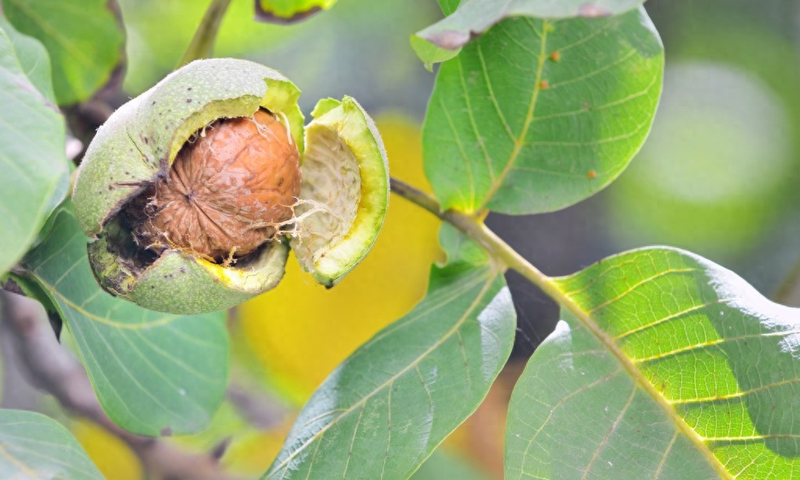
Walnut nursery key technology
Peaches, also known as walnut walnuts, are one of the world's famous four largest dried fruit, rich in proteins, fats and a variety of trace elements and minerals, such as calcium, phosphorus and iron, with high nutritional and economic value. In general, walnuts are radiant, cold-resistant and drought-resistant and are grown mainly in fertile, humid and sandy areas of the valleys, while the city of 100th city, in the north-west of guangxi, belongs to the subtropical humid climate zone, with annual precipitation of 1,100 to 1,500 mm and average temperatures of about 16. 3 °c, which are very suitable for the cultivation of walnuts. Moreover, according to recent cultivation statistics, in 2011-2018 the county completed a total of 2,492. 73 hm 2 walnut cultivation and 747 820 seed production, involving the town of homo, 439. 87 hm 2, the town of sands, 519. 33 hm 2, the town of ganda, 381. 60 hm 2, the town of flowers, 1 053. 27 hm 2, the town of ping, 1. 33 hm 2, and the village of xanxi. In general, the rapid increase in walnut cultivation is due to the availability of adequate seed security, and therefore the promotion of walnut breeding techniques can contribute to better walnut cultivation。
1 elements of walnut nursery technology
In carrying out walnut breeding, the following five aspects should be noted in order to guarantee the quality of walnut seedling: 1) walnut selection; 2) walnut seed processing; 3) proper nursery area selection; 4) ground preparation; and 5) walnut seeding。
1. 1 selection of species
Prepping for walnuts is done before walnut breeding takes place. 1) in terms of walnut selection, the species of walnuts are selected for cultivation; 2) in terms of walnut extraction, the species of walnuts are selected for harvesting as mother species with a growing age of more than 30 years and with a high yield and adaptability, in order to guarantee the quality of walnut cultivation; 3) in terms of walnut seed storage, the seeds of walnuts are placed in a ventilated place and then the seeds are placed in a specific container for sealed storage。
1. 2 seed treatment
Generally, seed treatment varies depending on the timing of seeding. Autumn seed planting does not require pre-plant processing and can be broadcast directly during planting; spring seed planting requires special treatment before seed planting can take place, while spring seeding can ensure that the new sprouts are not affected by the frost weather, but the sprouts take place slowly and are shorter than the fall planting for two to three months. Specifically, three treatment methods are used to sow seeds in the spring: 1) cold-water immersion, i. E. Immersion of seeds with cold water, about 7 d, until the seeds are split and sowed; 2) cold-drying, i. E. Cold-water immersion, which is then laid in the sun and collected for use; 3) warm-water immersion, where the seeds are placed in warm water, and when the seeds expand and become available。
1. 3 land selection
Before planting walnuts, growers are required to focus on the selection of walnut breeding grounds, including the following: 1) the selection of flat and well-drained areas as the main areas for walnut breeding, based on the practice of walnut cultivation; 2) the selection of transport-friendly areas for nursery work by growers in order to ensure the survival of tree plantations, both for nursery management and for safe transport; 3) the processing of permits for the production of tree seeds in nursery grounds。
1. 4 land as a whole
Following the selection of the planting grounds, the planters are also required to repair the breeding grounds, which are critical to the quality of walnut growth. 1) the soil of the planned planting area is to be fertilized in order to increase soil fertility and maintain soil permeability, with lime disinfection and sterilisation in the ground before the soil is to be used at around 100 kg per 667 m2 or the soil is to be disinfected with potassium permanganate. 2) start up. The width should be 1. 0 ~ 1. 2 m, 20 ~ 30 cm, and the direction of the piping should be in line with the drainage direction of the field to facilitate drainage and avoid accumulation. 3) sufficient farm fat should be fed before breeding, at 150 to 250 kg per 667 m 2, to ensure nutrients for walnut cultivation。
1. 5 seeding
In sowing walnuts, growers also focus on the following three aspects. 1) the growers should be careful about the planting time, and in general walnut seeding is best done in march-april of each year, although it is possible to sow in the autumn, but it is more vulnerable to the effects of rodents than in the spring. Thus, in order to guarantee the production of walnuts, it is usually chosen to sow in the spring. 2) when sowing, growers shall be careful of the manner in which the seeding is carried out, by placing the walnuts on one side to ensure that the growing trees are stronger and more straight. The planters also focus on sowing density, using on-demand transmission, at 20-30 cm range and around 15 cm range in a good seedbed。
2 field management of walnuts and nursery work
When seeds of walnuts are planted, they are generally fully seeded at around 30 d, and during this period, in order to improve the quality of the trees, growers are also required to manage the relevant fields. (1) cultivators are responsible for the fertilization of trees; (2) growers are responsible for the irrigation of trees; (3) growers are responsible for the regular removal of weeds; (4) growers are required to prepare for sunscreening of trees; (5) growers are required to carry out the transfer of trees。
2. 1 fertilisation
The planters are required to perform the relevant fertilization during the growth of the tree, in addition to the application of bottom fertilization prior to planting, and in accordance with the growth of the tree. The month of may-august, which is a critical period for the growth of plants, needs to be strengthened in the management of hydro-fertilizers, which are generally applied once in may-june and july-august, mainly on nitrogen and compound fertilizer, at 20-30 kg for each application, to promote the growth of trees。
2. 2 watering
Growing trees require sufficient moisture, so that growers also have to do irrigation work. Often, before the trees are fully integrated, the amount of irrigation is not too high and, if over-irrigated, it can lead to problems of soil sheeting in the areas where they are grown; and once the trees are fully integrated, the number and amount of irrigation will be increased to promote better growth。
2. 3 weeding
Weeds are regularly cleaned during walnut breeding. Overcrowding not only affects nutrient absorption but also causes pest problems。
2. 4 reduction of sun
In general, walnut trees are fragile and cannot be exposed to high temperatures for long periods of time, so in order to protect the trees from sunlight, a shade can be placed above the trees to reduce sunlight exposure and prevent evaporation。
2. 5 slender work
The walnuts are deep-rooted tree species, so the planters, in order to ensure the quality of the seedlings, are required to manage them. 1) carry out survey of seedlings. Ten per cent of the walnut seedlings in the nursery area are catalogued by means of geometry, height, root length, pest survey. 2) classification of trees according to national or local standards, according to the results of the survey of seedlings, dividing all trees in the nursery into qualified and unqualified seedlings, and separate management of eligible and unqualified trees in different areas. 3) qualified trees can be planted in the mountains, if they are not eligible, and when they are released, a “two certificate” is required, i. E., a certificate to test the tree, a sticker and a quarantine certificate. 4) in order to ensure the survival rate of seedlings, growers must raise seedlings within one working day and transport them to an afforestation site and complete the planting within one to two d. 5) there is also a need for slurries to be treated when walnuts are planted on the mountain。
3. Pest control of walnut trees
During walnut breeding, growers are required to perform walnut-related pest control. In general, black spots, anthrax, elephants, gold turtles, etc. Are common during walnut breeding, so planters are required to take appropriate precautions for different pest types. In the case of diseases such as black spots, anthrax, etc., the soil can be sterilized by growers before seeding, specifically by copper sulphate or lime, while insect pests such as nasal worms, gold turtles can be eliminated by trichlorfon, bromethrin cream, etc. During the period from april to june, roots were susceptible to fungi infection and required multibacterium control. In april-july, the plant was vulnerable to wood plating, and the pest was used mainly to extract leaves and, in severe cases, to eat photos and influence tree positions, using 25 per cent of the larvae suspension of 5,000 times asphyxiating。
4 concluding remarks
In general, in order to improve the production and quality of walnut cultivation, the relevant sectors are also expected to increase their awareness of walnut-breeding techniques so that more farmers can use scientific methods and methods to grow walnuts, thereby enabling local walnut cultivation to contribute effectively to the economic development of the region。