


Tulip-basket flowers, flower cultivation technology
As people's standard of living improves, it becomes fashion to enjoy the pelvis in the courtyard and at home. Today, while it has become possible for tulip-basin counter-season planting and anniversary supply, most growers do not have full mastery of planting techniques and the tulip-basin industry has not yet taken shape。
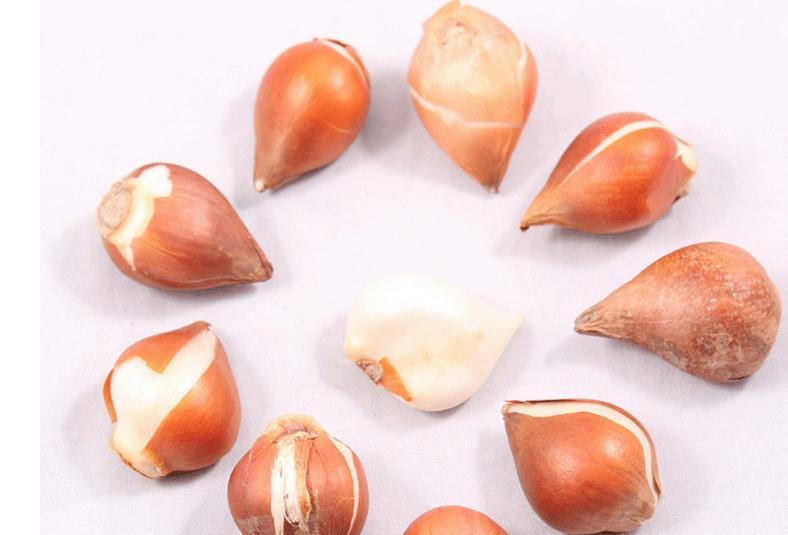
Level 3 tulip balls
The varieties used for tulip-baskets should be characterized by strong growth, low rates of blindness and moderate heights, with weak growth, blind flowers in the plant and too high a plant affecting the viewing effect. More suitable tulips are the ‘true love of the world’, ‘linmark’, ‘captain eskimo’, ‘afk’, ‘adire mother’, etc。
Sphere selection and treatment
The good or bad quality of the balls directly determines the success or failure of the production of the pelvis. When buying tulip balls, the choice is to have a full, smooth surface and a light skin, free of mechanical damage, disease, fungus or pests, and a class 1 ball with a diameter greater than 3. 5 cm。
Tulip balls purchased from the netherlands can be divided into natural balls, 9 degrees and 5 degrees. Natural balls are those that are not treated at any temperature from harvest to consumer. Such tulip balls must be treated at a low temperature for a certain period of time before they can flourish. In the northern part of the country, such as botanical gardens, world parks and others, most purchase natural balls, which were planted after cold winters in the fall, and leave in the early spring. 9 a degree ball means a 9°c cryogenic treatment after the harvest of a tulip fragrance, but the cooling amount does not meet the requirements of the species' optimal required cooling, and the consumer must purchase it with a temperature of around 9°c for a certain period of time in order for the species to exhibit its optimal properties. When tulips are produced, the choice is usually to purchase a 9-degree ball, plant the ball and plant it in a 9-°c tank and transfer it to a cooling tank, to seed the tulips and promote their rooting, while providing insufficient cooling. 5 a degree ball is a ball of tulips that, after harvest, is processed at a sufficient length of 5°c to fully satisfy the cooling requirements of the species and that can be grown directly after purchase by consumers. 5 balls are generally used to foster cultivation, such as the tulips that are on the market at christmas and spring festivals, which are selected for cultivation by 5 degrees. So pot flower production should choose five degrees. When the balls are purchased, they should be stored in a freezer at 5°c and planted in a timely manner. Before planting the ball, the skin of the tannery, which is part of the plate, is removed for the growth of the roots. Some of the tannery skins are extended to cover the growth point entirely, and the skins of such balls should be removed in full to prevent inhibition of the root system and the growth of the caps. Under normal circumstances, imported healthy seedlings need not be sterilized before growing. However, if visible fungus, pests or decomposition are detected, it must be sterilized before planting. Mettobutin 100 times liquid + kactan 200 times liquid + avimectin 200 times liquid, impregnated seed ball for 2 hours, dryed and planted。
Flowerpot selection
For the purpose of indulging in chemical production and transport, the tulip-planting basin should not be too large, and the above-mentioned mouth should be 18-20 cm in diameter. In order to reduce production costs, lower-cost recycled plastics can be used for production。
Nucleic selection
A base suitable for tulips is a base rich in organic, well-drained or sandy soil, with a rigidity and poor permeability. A tulip-basket plant-planting matrix is best used for tulip-species, without the need for disinfection and insecticidal treatment, directly for use in the basin at a cost of approximately $0. 8 per basin. It is also possible to deploy directly when it is not possible to purchase a base for tulips. Decorated soil = 1:1:1, or decomposed soil = 10:1, or peat pearl rock = 3:1。
In the case of formulation, disinfection is required before use. Fifty per cent of the polybacterial humid powder can be used 600 times the liquid, or 500 times the liquid methyl tobuzin, or kactan 800. Spraying side-by-side agent to balance the fluid with the matrix and then seal the matrix with a plastic membrane after 24 hours or more。
Plantation methods
First, the bacterial compound is fed into the flower basin, deep into two thirds of the flower basin, 5 cm from the edge of the flower basin. The tulip balls are then evenly placed and pressed downwards, so that they sit firmly in the matrix, with the edges of the ball being 2 cm from the edge of the flowerpot, and eventually fill the remaining matrix. The matrix is not less than 2 cm above the flower pot to facilitate the next watering. If a lighter matrix is used, the uppermost layer needs to cover 2 cm thick, clean river sand。
Based on a comparative test of the different density of the tulip (1-8 basins) with a diameter of 18 cm at the mouth of the flower basin, one or two plants per basin were found to be strong, but small and poorly viewed; five or eight plants per basin were found to be thinner, with decreasing growth as planting densities increased, and the height of the plant was significantly different; and six or eight plants were found to be dry and blind. Only three tulips per basin and four tulips per basin are strong and enjoyable. Taking into account the economic benefits, it is advisable to use density cultivation of 3 plants per basin for the production of tulip-scale flowers, such as in areas where the price of tulips is higher, or where the price of 4 plants per basin is significantly higher than that of 3 plants per basin, to consider production using density of 4 plants per basin。
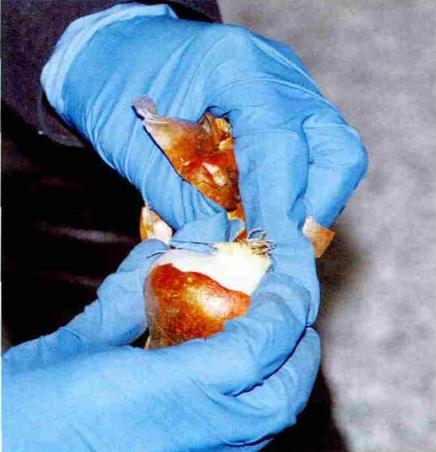
Take off the leather skin
Plantation management
Water fertilizer management the water should be in the range of 55% at the time of planting the base pots, and once the tulip ball planting is completed, the water should be poured out once. In the case of a low water content, the planting of a ball shall be followed by repeated watering to ensure that it is humid and in full contact with the seeding ball for the benefit of tulips. Thereafter, water can be poured every seven days to keep the basin dry and wet. The amount of water required to plant leaves is gradually increasing when they start to graze, usually by three to four days. During this period, the water is inadequate, the plants are slow to grow, the leaves are small and, when severe, the flowers can be dried up. They can be sold before or when they change。
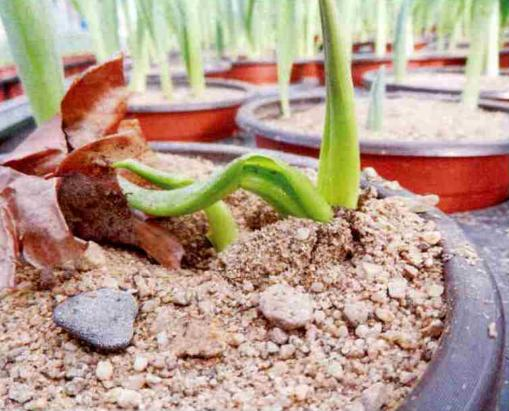
If the skin isn't stripped in time, it'll bend and grow
The tulips are not in high demand for fat, and they are applied to the bottom, so that they may not be followed up during their growth, or they can spray 1 dose of potassium dihydrophosphate 500 times the fluid in front of their current buds, or they can spend more than 1,000 times the balanced fat. Bottom fertilizers can be applied to 150-200g/m2 compound fertilizers with a ratio of n, p and k of 1 = 1, and to long-term long-acting fertilizers, around 20 per basin。
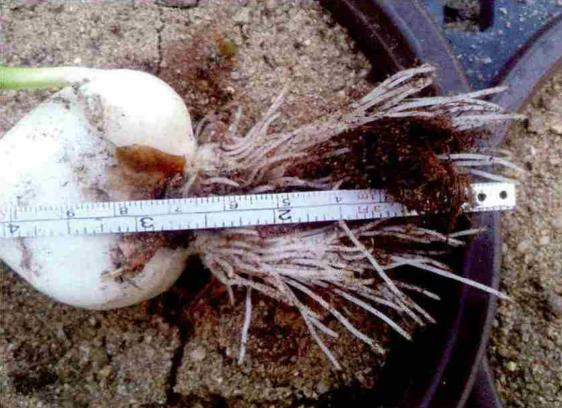
The ball is planted
Temperature management the tulips require lower temperatures during their growth. At 5°c ~ 8°c, the roots grow at a temperature of 9°c ~ 10°c. The tulips are therefore fixed with an indoor temperature of 9 °c ~ 10 °c and maintained for at least two weeks for root growth. The roots of the tulip grow fast, reaching 7 cm within a week. In two weeks, the temperature can be controlled at 13°c ~ 15°c for seeding and leafing. When the leaves are fully stretched, the manageable temperature is 15°c ~ 20°c, with the maximum temperature not exceeding 25°c. Excessive temperatures speed up the process of tulipification, which results in thinning, small flowers, unlighted flowers and shorter periods。
The tulips are not sensitive to the intensity of the light and can grow normally under conditions of full light or half shade. The main purpose of shade is to reduce the temperature, but excessive shade (over 70 per cent) is not conducive to the growth of the tulips and is prone to phenomena such as longitude and invertion。
The tulips grow faster, such as the disinfection of the planting matrix, with fewer pests. 3 to 4 times methyl tobuzin 800 times more liquid or 1,000 times more fungus during growth. The tulip pests are mainly aphids, which can be combated with 1,000 times more aluminum。
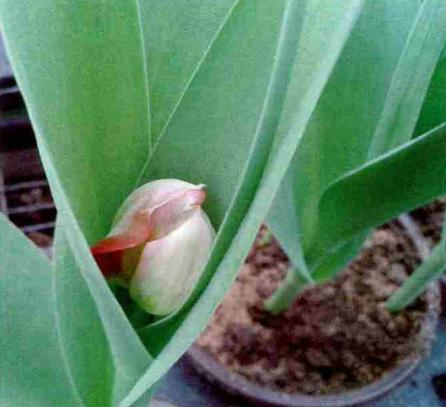
Flower bud dry



