


Cherry, this early and colourful fruit, is becoming increasingly popular because of its abundance of nutrition and considerable economic benefits. Today, the cultivation of large cherries has become a new attraction for many farmers. However, owing to the lack of scientific management techniques, many fruit-farmers face low yields and poor performance, which not only discourages them from growing large cherries but also affects their economic income. To help farmers upgrade management techniques and improve the production and quality of large cherries, thereby increasing economic returns, this paper will provide an in-depth analysis of key technologies for high-quality, high-yielding, high-yielding cherries。
011. Choice of the large cherry varieties
1. 1 [middle]
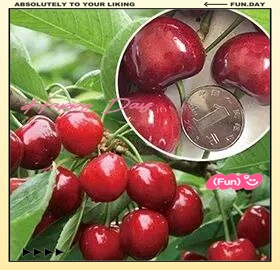
The united states of america has been a remarkable species since 1988 when the dalian city institute of agricultural science introduced it. The fruit is wide heart, equal in size and weighs about 12 grams on average, up to a maximum of 20 grams. The fruits show little red, matured into purple black, and very bright (see figure 1). The meat is hard, the fruit is short, it is extremely durable. The soluble solids content is maintained at around 18 per cent, with moderate aroma and high quality. However, in the process of terrestrial cultivation, fissures sometimes occur when water is not properly managed or affected by climate。
1. 2
Fukqinglong eye, a variety derived from fujian, occupies a place in the fruit world in its unique form and taste. The fruit is almost spherical, with an average of about 15 grams of single fruit and a maximum of 25 grams. The skin is smooth and brown, and the meat is white and fresh and juicy. However, the maturity of the fukuoka eye is relatively short, and the timing of extraction and sale is important。
1. 3 [fry morning]
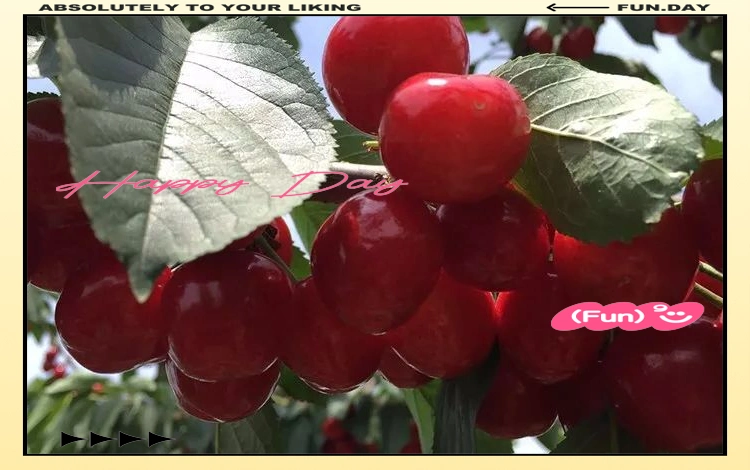
Fukuma, a well-developed early-cooked variety developed by the institute of fruit trees of the tantaa agricultural institute, successfully accepted by experts in june 2012 through the mixing of sami with red lights. The fruit is heart-shaped, larger in size, with an average of about 9. 7 grams of single fruit and a maximum of 11. 7 grams. The skin is red, the meat is light red, it has a very attractive appearance and is luminous (see figure 3). And the flesh of the good morning is hard, and it is strong for storage and transport. In addition, solubility solids are as high as 18. 7 per cent, which ensures a high taste. This variety is not only premature and productive, but also has broad development prospects. It needs to be noted, however, that mismanagement can lead to premature decay。
1. 4 [frying]
Fukusung was created by a mixed selection by the institute of fruit trees of the yantai agricultural college through the samdech and spakli, and was validated by the shandong crop varieties validation commission in 2013. The fruit is heart-shaped and large, with an average of about 11. 8 grams of single fruit and a maximum of 14. 3 grams. The skin is red, the meat is red, the skin is very bright and radiant (see figure 4). And the flesh of fook is hard, and the fruit is short and thick, and is very durable for storage and transport. It is symmetrical and similar to early varieties, but it does better in terms of premature fruit and abundance。
1. 5 [russian 8]
Russian no. 8, also known as fragrance, has a wide heart, a large head, with an average of 12. 9 grams of single fruit. When the fruit matures, its colour gradually changes from red to black and purple, its skin is thick and strong, and its meat is thick and hard, its juice is abundant and its taste is excellent. In addition, soluble solids were as high as 18. 9 per cent and matured slightly earlier than early varieties. It is worth mentioning that russia's 8th is also excellent in its resistance to cold, can produce early flowers, early results and has the characteristics of early production。
Orchard planning and planting techniques
2. 1 [tree variety and nectar selection]
When planning orchards, we usually choose one or two main plant varieties and combine them with two or three pollination trees, which are configured at a ratio of 4 to 1. For example, varieties such as red ruby, pioneer and rabins are often used as pollination trees. It needs to be noted, however, that genetically identical varieties should not be pollinated with each other, such as red light and beauty, which could not be pollinated successfully. At the same time, consideration needs to be given to the sequencing of flowering periods to ensure that pollination varieties are consistent with or within one to two days of the flowering period of the main plant species, so that optimal pollination opportunities are not missed。
In addition, the choice of neptunium is crucial. In the past, when cherries were planted, people tended to focus only on the seedlings and neglected the wood. However, aluminum has proved to have a significant impact on production, quality and many other aspects. At present, the most common logs are the gisella series and the blue leaves. Gisela 5 and 6, although the effects of dwarfing are significant, have small foot problems; gisella 12, with a slightly poor but strong degree of affection and strength; and the blue leaf, with strong growth, kinship and strength, with attention to the disease resistance, late outcome and death tree after outcome. In addition, cottex wood may be used under certain conditions, subject to careful selection。
2. 2 [horizon and tree selection]
The average annual temperature should be selected at 10 ~12 °c, soil fertility, earth thickness (at least 60 cm or more active layer), ph values between 6. 5 ~ 7. 5, good drainage, non-salinization, no-late frost accumulation, low-intensity and drought-resistant hills or flatlands. In the case of plantations in the mountains, the sun slope or half-moderate shall be chosen. In addition, for the past five years, no plantations of nuclear fruit have been allowed to be built. The site is suitable for work in the autumn or early winter, with an application of 4,000 to 5,000 kg of decomposition organic fertilizer per acre. After that, the land was thrown deep above 40 centimetres and the earth was ragged. Starts at a line distance of 4-5 m, with a width of 2. 0 m and a height of 30 cm。
2. 3
The best planting time was in mid-march, at a distance of 3-4 metres, with 33-56 plants per acre. The depth of the plant needs to be established at an appropriate level, at the same level as the ground cover of the tree in the nursery area, which is then stepped on and watered, and the membrane is also covered. Triangular seedlings are usually used to ensure ventilation; at the same time, detoxification trees are recommended for root cancer prevention, and k84 is used for rooting before planting if normal trees are selected. After planting, two to three times during the period from april to may were pumped in accordance with the soil conditions. In the spring, big cherry seedlings will be ready to dry (or immediately after planting) at a determined height of 60 to 80 cm。
Integrative shearing and soil management
3. 1 [prosthetic and trim]
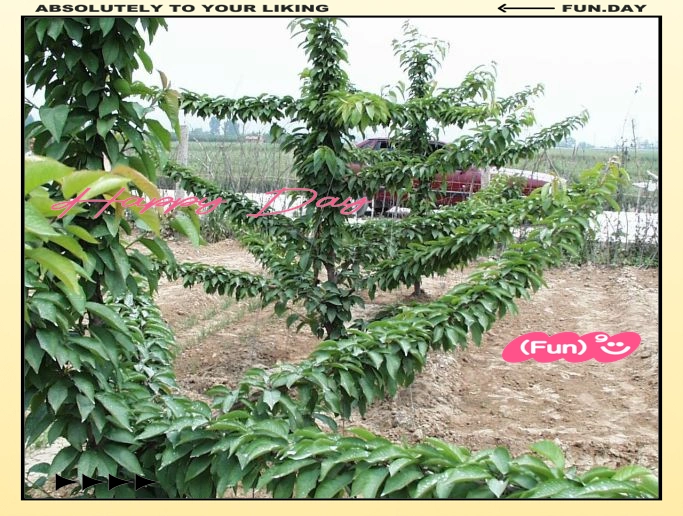
In order to optimize ventilation and reduce labour intensity, the fine long hammer shape is widely used (as shown in figure 6). The plasticization process is as follows: before the first year of growth, new branches are being stimulated by sprouts and plastering. During the growing season, when the length of the main branch reaches about 50 cm, pulls are carried out at an angle of 70 ~ 80 °, while the main branch below 60 cm is taken to an angle to promote thickening of the main branch. With the extension of the main branch, the pull position needs to be adjusted in due course. Early in the spring of the following year, the central dry extension branch was briefly cut, with approximately 50 centimetres retained and the main branch below 60 centimetres removed and the main branch with a diameter exceeding half the backbone. The other branches are briefly cut in a medium to severe manner, while the branches are sprouted or painted on the branches and other branches of the new primary stem to promote their growth。
3. 2 [soil management]
Soil management of the large cherries is particularly important because of the high respiratory strength of their roots and the high requirements for soil penetration. This relates mainly to the expansion of the soil and ground cover. For the uncultivated cherries, the first year of planting began in the autumn, with a continuous expansion of the den to enable the root system to spread smoothly. This process should be combined with the application of base fertilizers, so as to meet both the nutritional needs of the tree body and the growth of the root system. It is important to note that for the cherries, which have been born for more than four years, the entire garden should be avoided. In addition to the expansion of the dens and the conversion of the soil, there should be regular planting of the pine soil and soil estration, especially after the rainy season, in time to prevent the growth of the absorbent roots to the ground due to the poor permeability of the soil。
Fertilizer and water management
4. 1 [ fertilizer management]
The fertilization characteristics of the big cherry trees vary according to the age of the tree. In the case of young trees born below three years, the crowning period is dominated by fast-activated nitrogen fertilizer, while in the case of trees born between four and six years of life, organic and compound fertilizer is predominant, while the application of nitrogen fertilizer is controlled, increasing the supplementation of phosphorus potassium fertilizer. For trees with more than seven years of life, care needs to be taken to increase the application of nitrogen fertilizer, in addition to the application of fertilizers in autumn and before the flower。
4. 2 [water management]
Since the root systems of the large cherries are shallowly distributed and neither flood-resistant nor drought-resistant, the principle of numerous small amounts of irrigation should be followed. Maintaining the soil water content between 60 and 80 per cent of the maximum water holding in the field facilitates normal activity in the root system。
055. Flower fruit management and pest control
5. 1 [frucial fruit management]
The freezing of late frost is a major challenge to open-air cherry production in the purewater county, which could, in serious cases, lead to the closure of some orchards. In order to prevent this, suitable parks, such as backwinds to the sun, smooth terrain and high soil fertility, should be selected, avoiding cultivation at the bottom of valleys, basins and low-lying areas. In addition, measures such as good logs and varieties, water before flowering (or spraying) to delay flowering, orchard smoke, and enhanced soil water management can be effective in preventing the freezing of night frosts. If big cherries are frozen, timely remedial measures, such as the spraying of sugar cane, odium, etc., will be required to make full use of late flowers for supplementary pollination and timely re-cuting and pursuit of high-quality quick-effect fertilizers to promote tree recovery。
5. 2 [pest control]
Pre-sprung copper acetate 600 times the fluid for protection; fungicides such as stairns 1,000 times the fluid every 7 to 10 days to combat molluscs, as well as corrosive diseases; and pests such as caterpillars, corsets, etc. Vegetables continue to be sprayed with microbicides and insecticides to combat diseases such as early foliage, bacterial perforation and other pests such as shellworms and caterpillars。



