


Muir is a highly marketable edible fungus, rich in nutritional value, known as clouds, with extensive natural distribution and artificial cultivation. What part of the country is moo's home?
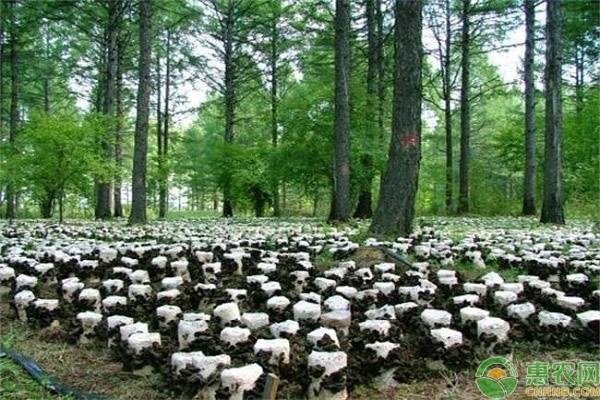
I. Where's the mooch?
China is a major producer of moo-il, mainly in jilin, heilongjiang, liaoning, inner mongolia, guangxi, yunnan, guizhou, sichuan, hubei, shaanxi and zhejiang, among which heilongjiang province, the town of hai lin, the district of toung ning, and the town of wong songtang, the province of jilin, are china's largest blackwood ear base。
Ii. Wood-earing techniques
1. Production season
The ears are medium-temperature, usually at 12 to 28°c. They are grown in january to february and in april to may of each year. They are high-temperature, usually at 15 to 32°c, in march to april and in may to june。
2. Nutrient formulations
Cultivation requires 65 per cent water content, with a ratio of 1. 25 to 1. 3 per cent, held in groups of hands, and with no drops. The usual nutrient formulations are: 30 per cent cotton seed shell, 30 per cent maize core, 30 per cent sawnopsis, 7 per cent plaster, 1 per cent plaster, 1 per cent compound fattening, 0. 5 per cent phosphorus, 0. 5 per cent lime; 30 per cent cotton seed shell, 60 per cent maize straw, 7 per cent plaster, 1 per cent compound fattening, 0. 5 per cent phosphorus fat and 0. 5 per cent lime; and 30 per cent cotton seed shell, 60 per cent maize core, 7 per cent plaster, 1 per cent plaster, 1 per cent compound fatty, 0. 5 per cent phosphorus and 0. 5 per cent lime. Each of the above formulations would require the addition of a further 0. 1 per cent for crovaling。
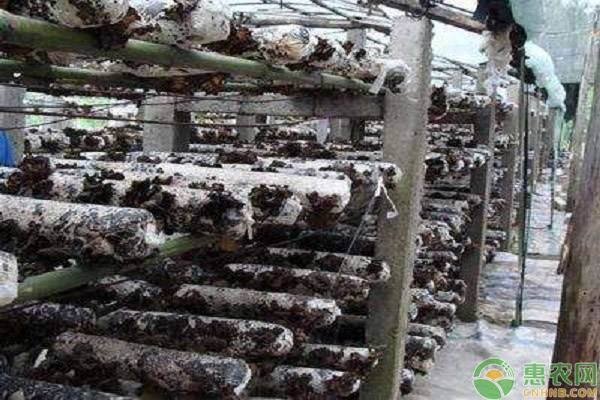
3. Packing with sterilisation
A 17cm x 38 cm x 0. 035 cm low-pressure polyethylene or polypropylene bag, each containing 0. 5 kg of dry material, is selected for the planting bag, and the bag is tight, with plastic ropes at both ends. The bags are then fed into the usual pressure-elimination pot for 10 to 12 hours under 100 °c and suffocation for another 12 hours; they can also be used for high pressure sterilization, with 1. 5 pressures remaining at 1. 5 to 2 hours。
4. Vaccination
Inoculations are carried out to cool herbicide bags up to 25°c and at temperatures around 10°c. When the temperature is high, it is advisable to arrange for vaccinations in the morning or at night; the vaccinations can be carried out in an inoculation box or in an inoculation room, and 30 minutes after the sterilization, the bag is unloaded into the fungus and then the bag is covered. The inoculation bag is placed in the culture room for fungi. Precipitous strains have a temperature of not less than 20°c and a gestation period of not more than 30°c, and avoid a high-light directness。
Into and out of the shed
Ears management can be done by moving fungus planting bags out of the ear hangars, either by using a bag or by using stereowalls. 1 hang bag ear method: 10-12 ear openings will be drawn from the fungus planting bag, which will be applied to the regular bag method. 2 stereo-wall ears: 6 to 8 “one” penthouses with a blade and a blade are circumcised at both ends of the fungus, with the criterion of non-connection of the blades, and the stoked planting bag is moved out of the auditorys and folded 7 to 8 floors. When an eardrum is formed and a juvenile ear grows, it starts to increase humidity and is managed normally, at normal temperatures, usually for 10 to 15 days. This eardoing, large, thick, small, good for sale。
6. Reminder
Generally, after mid-may, temperatures stabilized at more than 20°c. Daytime warming, wetting, night ventilation and cooling, high day and night temperature differentials, and ten days of wetting and temperature differential management can form the earring。
7. Ear management
To be formed, the baghead begins to increase the humidity of the air, spraying small amounts of water with small ears in the morning and at night, increase the humidity of the air and provide ventilation management; and to bring the air in the shed to more than 85 per cent humidity and fresh air to induce the pocket to grow into small ears。
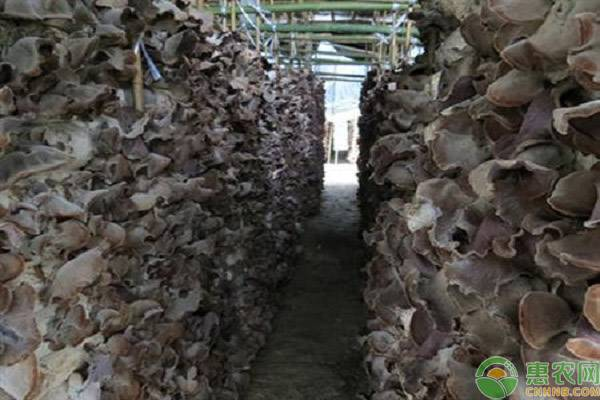
8. Long-term management of sub-entity
When small earpieces are formed, they become more humid and ventilated, preferably by mist, which increases ventilation in fog and rain, prompting their rapid spread. The management of dry and wet alternations in the birth of a sub-entity should take place over a long period of time, with the first two to three days of suspension, so that the fungus can rest, accumulate nutrients and then increase the humidity so that the earpiece is fully drained. High temperatures and humidity should be avoided throughout the narration period in order to avoid run-in or fungus infections. (b) the ear temperature of the ear shall be kept at 15-25°c and not exceeding 28°c; molybdenum ear temperature is controlled at 15 - 33°c and not exceeding 35°c. If the temperature is too high, the sub-entity accelerates cell division, the dry matter accumulates less, and the earpiece is thin; if the temperature continues to rise and exceeds the limit, the sub-entity will dissolve itself. In order to avoid the occurrence of malfeasance, the principle of “seven-and-three-dry, dry-wet alternation” should be observed in water management. In addition, the sub-entity growth phase needs to have sufficient dispersing light to facilitate the growth of thick, colourful and high-quality ears。
9. Collection
Until the earpiece is fully extended, wrinkled along, the ear root shrinks, and the spores are about to ejected and collected before ejection. The first day of the harvest was suspended, the sun was exposed directly to the planting bag and the wooden ear, which were taken to the point of drying up the earpiece, and the subsequent planting bag was cut to the point of 7 to 10 days, followed by the management of the first ear。
These are some of the descriptions of wood ear cultivation, which, in fact, is done in several ways and can be chosen according to your own circumstances。
You may be interested in and welcome the content of the following recommendations of the network for reading。



