Optimization analysis of planting techniques to increase apple tree production
Chen zhen
Since ancient times, apples have been regarded as a happy and safe fruit with the title “national fruit”. Apple tree cultivation is the main form of current rural economic development. According to the national statistics institute, the area under apple tree cultivation declined slightly to 1928. 46 hm2 in 2023, but the total production of apples increased to 49. 601 million t, with exports being the second largest of the country's exports of fruit. In this context, in order to promote the high-quality development of the country's apple-growing industry, it is necessary to continuously optimize high-yielding cultivation technologies, identify technical points, implement precision management, further improve apple production and quality and help farmers to reap higher economic benefits。
1 preplant work
1. 1 location of the park
Apple trees are mainly grown in temperate areas, with higher requirements for light, temperature and precipitation. In general, apple trees should be grown at an average annual temperature of 11. 5°c in a cold and dry environment, with a preference of 500-2000 m above sea level, deep earth cover, good drainage, and a backwind to the sun to ensure the healthy growth of apples. It is important to note that apple cultivation in industrial parks and contaminated land is avoided, that there are no other large trees surrounding the plantation area, and that transport is considered for later sale, and that transport-friendly plots are selected。
1. 2 campus planning
The identification of plantations requires scientific planning and rehabilitation of the plantations ahead of time, improvement of irrigation systems, drainage systems, vehicle roads and planting directions, etc., to ensure that apple trees grow in the dry season, during the rainy season and can be effectively replenished and drained, and to prevent excessive drought or prolonged water accumulation from affecting fruit tree cultivation. The apple tree is built in such a way as to increase the yield and quality of apples by choosing, to the extent possible, the north-south direction and ensuring a smooth ventilation and adequate light。
2 plantation techniques
2. 1 varieties selection
Apple tree varieties are closely related to apple production and quality and are cultivated in such a way as to make reasonable choices in relation to local climatic and soil conditions. To avoid exceptional circumstances, an orchard should select two to three main plant varieties。
When species are identified for purchase, preference should be given to species with a high purity (over 95 per cent), well-developed root systems, disease-free and saturated trees. The selection of pollination trees needs to be determined on the basis of the main apple tree species and, above all, to ensure that the pollination tree results are consistent with the primary apple tree species, on the basis of which pollination trees with high gestation rates, high pollination volumes and good pollination proxies and strength are selected to meet pollination requirements, in order to guarantee yields and quality. In the case of apple trees in the field marshal's department, the pollination effect requires the selection of crowns of gold, crowns of qin and fuji as pollination species; in the case of the fuji apple tree species, such varieties as gala, marshal and crowns may be selected as pollination trees. The amount of pollination tree cultivation should account for 15-30 per cent of the total number of orchards。
2. 2 cultivation density and methods
In order to ensure that apples are of high quality and yield, planting must be carried out with strict control of planting density and with appropriate planting methods to provide a sound environment for fruit tree growth. Low land-use rates, low yield per unit of fruit tree production, lack of access to high yields and low economic efficiency are the result of too low plant density, which results in insufficient light, low area of light co-operative leaves, competition for nutrients and moisture between stands, and unequal size of fruit. The density of apple tree planting is determined according to climatic conditions, soil conditions, and variety characteristics, with a reasonable layout range, usually 3 mx (4-5 m), i. E. 44 or 55 apple trees per 667 m2, as shown in figure 1. Apple tree planting can be done with triangles, squares, rectangulars, etc. Extensive research and practice has shown that rectangular planting is more effective and should therefore be chosen as much as possible。
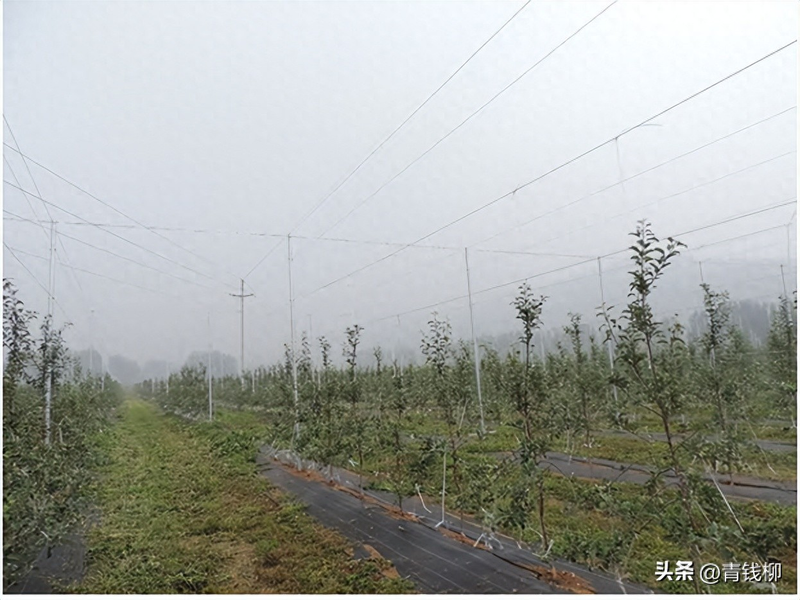
Figure 1
2. 3 time and method of planting
Spring and autumn are the best times for apple tree planting. The gradual recovery of spring temperatures, unfrozen soil, adequate light and high rainfall have contributed to the rooting of apple trees and to their growth and nutrient accumulation. The moderate, stable and low temperatures of the fall soil contribute to the development of root systems and the growth of seedlings, reduce the probability of disease and pests occurring and increase apple tree survival. However, it is necessary to pre-empt the cold and to avoid the freezing of the trees in winter, which affects their growth. It should be noted that in order to observe the growth of the tree in real time, planting should be completed before the tree moves and should not begin until the tree has sprouts, which would otherwise be detrimental to the growth of the apple tree。
Before planting, the tree shall be immersed in water of about 12h or in powder solution, thereby promoting its roots. During planting, 80 cm squared caves are to be dug to increase soil fertility by adding appropriate amounts of straw, fertilizers and 0. 5 kg of calcium per phosphate to the site. When the subsoil is refilled, the apple tree tree is vertically placed in the center of the fixed den, ensuring that the tree roots are stretched and then refilled and gently trampled. Upon planting, water is to be pumped to ensure that the soil is fully integrated with the root line at the rate of 40 kg/stow, followed by covering of the membranes, which reduces water evaporation。
3 integrative cuts
Upon the end of the planting, apple saplings are periodically trimmed to ensure balanced growth of tree shapes and avoid excessive growth in a single direction in order to achieve a reasonable supply of nutrients. The requirements and frequency of the plastic cutting of apple trees vary from time to time and are analysed on a case-by-case basis. However, integrative cuttings are carried out with respect for the natural growth patterns of apple trees, and do not easily alter the overall structure of fruit trees, balancing the light of the individual with the whole and avoiding uneven growth of fruit trees in the same park。
It is not appropriate to have too many osteoporosis in the early stages of growth and the outcome period, and it is sufficient to do so one to two times a year. Overcuted branches have adverse effects on the nutritional supply of fruit trees and negatively affect their growth. The hibernation period of the fruit tree (december to february of the following year) is the period during which the apple tree is nourished, with the emphasis on the removal of ill and weak branches, dead branches and cross branches, which should be heavy. The number of long-term (june-july) trims should be 2-3 times, at which point the main method of intracting is to pull branches, as shown in figure 2. In order to ensure the good growth of late apple trees and to prevent nutrient loss from pull, no one-time pull is put in place to make gradual adjustments. In general, the plastic cutting of apple trees is governed by the principle of “due to tree trim and branching”, with flexibility to adjust the method to the requirements of different tree ages, varieties and planting objectives。
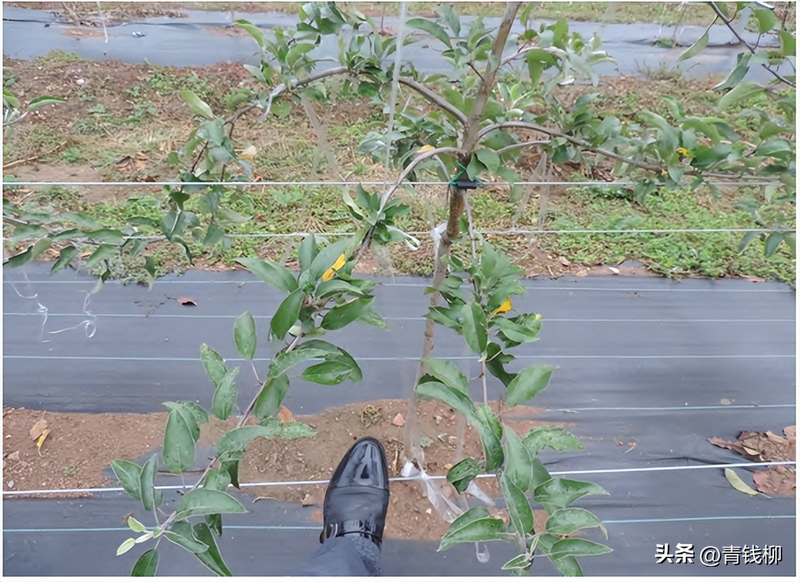
Figure 2
4 fruit tree fertilizer management
Fertilizer management is the key to high-yielding apple tree cultivation, and scientifically sound fertilization can help grow apple trees, thereby improving their yields and quality. In order to achieve the greatest impact of fertilization management, it would be counterproductive for the grower to apply fertilizers rationally according to soil fertility and apple tree growth patterns, at a given time, with a scientific mix of organic and chemical fertilizers to avoid blind fertilization. Fertilizers need to be supported by organic fertilizers (farmers, composting, green fertilizers), fertilizer (nitrogen, phosphorus, potassium fertilizers) and use of organic fertilizers to improve soil structure and quickly supplement nutrients, in which farmers ' fertilizers are to be fermented before they can be used, otherwise they will have an impact on the root systems of fruit trees and endanger their growth。
In fertilization management, the tree needs to be fertilized according to the different stages of its growth. After the fall apple harvest (late september to mid-october), fertilizer is required to supplement the nutrients consumed by the apple tree and to promote root system growth. A loop can be dug at 1. 2 to 1. 5 m from the trunk, organic fattening (deferred sheep dung, cow dung, etc.) can be applied to the bottom of the ditch, combined fattening of nitrogen phosphorus, etc., followed by co-fertilized soil, weeds (crushed straw, maize straw) and water. During apple tree growth, various types of fertilizer are required to be applied during the spring gestation period (in mid-march) to nitrogen fertilizer, to promote thawing, to apply potassium and phosphorus fertilizer and to supplement nutrition after flowering. Fertilizers are applied in such a way as to ensure a distance of 40 to 50 cm between the application pit and the apple tree main stem so as to avoid damage to the roots of the fruit tree during fertilization. In short, sound scientific fertilization not only meets the growth needs of apple trees but also provides good guarantees for their subsequent growth。
5 pest management
5. 1 methods of response
In recent years, green agriculture has become the main trend in agricultural development in our country, with the adoption of chemical pesticides for pest control being replaced by biological control, physical control and agricultural control. Biological control refers to the use of biological control methods, including, inter alia, insect treatment, bird treatment, etc. In the case of apple pest control, we can reduce the number of pests by feeding red spiders and aphids. Physical control means the prevention of the occurrence and spread of pests and diseases using a variety of non-polluting, non-hazardous physical means, such as the placement of insect-killing lamps in apple gardens and the enticing of insects. Agricultural control refers to effective control of apple garden pests and pests through advanced and efficient agricultural techniques, such as the prevention of pest attacks on apple fruit through packs, and the reduction of the probability of the occurrence of rota disease。
5. 2 disease control
The diseases common during apple tree cultivation include rota, cardiac disease, decomposition, etc., are subject to targeted, scientific measures based on the specific conditions。
Rotal diseases not only endanger the health of the branches but also lead to the decomposition of fruit, with a direct impact on the quality of fruit. At present, the disease has become the main cause of bad fruit, which can lead to the disease of 20-30 per cent of fruit trees in orchards, with serious consequences for apple production. In order to reduce the adverse effects of rotaline disease, 43 per cent of the equinol can be sprayed at the onset of the disease by 3,000 times。
Rogue heart disease is a fungal disease which, as shown in figure 3, mainly endangers apple fruit, which, after infection, deteriorates from the heart chamber to the outside and is extremely severe in the field marshal's apple species. In case of prevention, 25% ethyl ether ester should be sprayed with 2000 times fluid immediately after apple tree flowering。
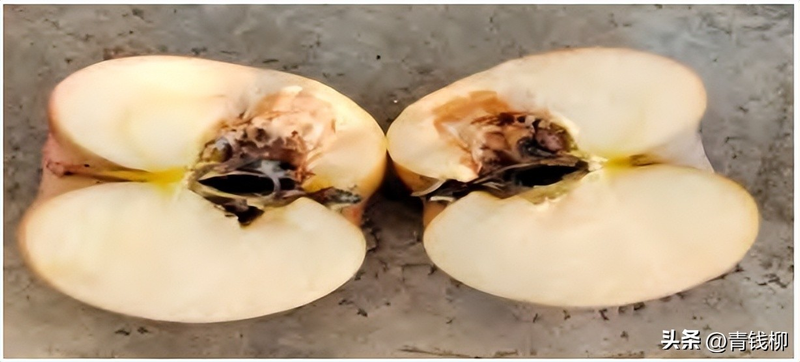
Figure 3
Decomposition mainly affects the branches of apples, and the branches of apples have ulcers after infection, which, as shown in figure 4, affect their growth and even cause death. During cultivation, organic fertilizers should be applied to improve the resilience of apple trees. If a decomposition disease has been infected, a 100 times more copper performation of 3 per cent of the acid should be used immediately to smear the disease。
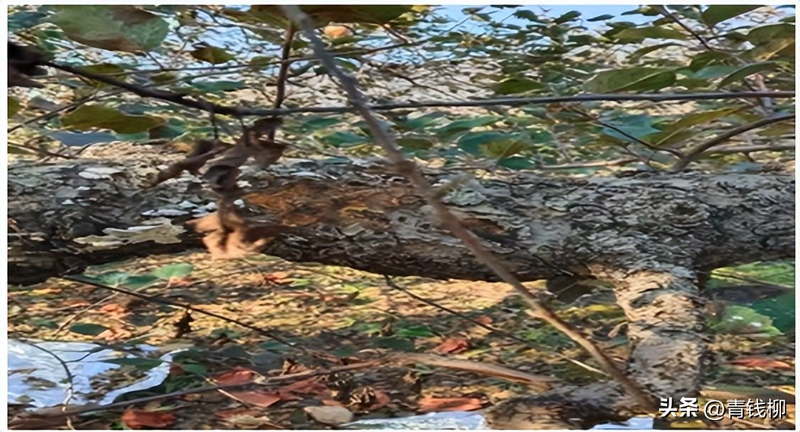
Figure 4
5. 3 pest control
Golden moths devour apple leaves and fruits, which lead to the decomposition of the fruit and the loss of its edible value, affecting the growth of apple trees and increasing yields. During the treatment period, 2. 5% bromocymethrin (bmp) should be administered in late april, when the larvae hatching period or the number of insects is high, to achieve effective control。
Shellworms are mainly hazardous to leaves, branches and fruit, and they can live on apple branches or fruit for the rest of their lives, extracting fruit tree nutrients and influencing the growth and development of fruit trees. At the end of june, 50% of the acetone 1,500 times the fluid and 20% of the ethylene cortex 4,000 times the fluid should be sprayed。
Conclusion
In conclusion, apple tree cultivation must be based on the use of high-yielding planting techniques, the selection of suitable gardens and scientific planning, the selection of suitable apple tree varieties, high-quality pollination trees and saplings, regular integration of fruit trees, rational fertilization, diversified, differentiated and effective measures to combat pests and pests, and the healthy growth of apple trees, improved apple quality and production. The increase in apple production and the improvement in quality not only meet the demand for apples by the general population, but also effectively increase the economic gains of fruit farmers and increase their productivity。