Research on technical optimization and practical application of pear gardening
Yang wei
The northern part of the country is situated on the southern edge of the high yellow-earth plateau, which is a semi-arid warm zone with abundant light and high temperatures, and is one of the fertile areas of pear cultivation. However, problems such as low soil organic content and water scarcity limit sustainable development of pear industry. In recent years, with the expansion of market demand, brands such as “pinzhou pear” in binzhou city and “pin river pear” in dry county have gained prominence, and pear gardening has tended to grow on an increasing scale over the years, but some of the orchards are poorly managed, with low rates of pear activity, late outcomes and poor pear fruit quality. It is therefore important for the economic efficiency of orchards to be improved through a systematic inventory and optimization of pear gardening techniques。
1 materials and methods
1. 1 overview of the test site
The test area is located in the bingzhou region of the northern river, where the climate is clear over four seasons, with an average annual precipitation of 549. 8 mm, an average annual temperature of 9. 7°c, an annual effective temperature of 3372. 3°c at 10°c, and a high temperature difference of 2210. 8 hours per day and night. Soil type is yellow, ph 7. 2-7. 8 and organic content 0. 8%-1. 2%。
1. 2 research methodology
The following technical points are systematically studied through literature analysis, field research and field experiments。
(1) park selection. • screening of suitable plots in combination with terrain, soil, water, light, etc。
(2) varieties configuration. The best variety combination and configuration were determined through pollination experiments。
(3) manner of planting. A comparison of the impacts of different row ranges, membranes, on survival rates。
(4) management measures. These include inter-clan work, water fertilizer management, pest control, etc。
2 key technical elements and optimization of practice
2. 1 park selection and planning
2. 1. 1 location requirements
Pear gardens in the northern part of the country should choose between areas below 800 metres above sea level, well-lighted and well-ventilated canals or tundra, while avoiding low-lying and dimpled areas. For soil, it is required to be deep (1. 5 metres of cylindrium), to be rich in soil, to be well ventilated and to have no industrial sources of pollution around the garden。
Campus planning
It is generally used to plant north-south, with a wide and narrow range of 4 metres x 2 metres, and 83 plants per acre, thus facilitating mechanization and ventilation. For areas with complex terrain, the method of “big bends, small bends” is used, and tree line lines are appropriately increased or reduced at too wide or too narrow a point, and then planted at long distances on line lines, while ensuring that the adjacent line is in the wrong position to avoid shade。
2. 2 typology selection and configuration optimization
2. 2. 1 primary plant varieties
Based on market demand, the main plant varieties are selected by the fruit tree research institute of shanxi province (the fruit tree research institute of the university of agriculture of nim shanxi). The species is characterized by strong growth of the larvae, resulting in a mediocre shift in the tree direction, a high budding rate and a moderate branch strength; the near-spherical shape of fruit, a lightly and fine wax of fruit, a red-dizzy or dark-red vertical stripe of the sun, a thin skin, a small heart, a white piece of fruit, a very small crucible, a very small stone cell, a very sweet fragrance and excellent taste。
2. 2. 2 powdered species configuration
In the same orchard, at least two varieties with the same or near maturity are selected and the following pollinators are recommended (table 1)。
Table 1
2. 3 slim selection and treatment technologies
2. 3. 1 standards for seedlings
The seedlings are grown by wild pear wood, which is 1. 2 metres high, 0. 8 centimetres in diameter above 5 centimetres of marriage interface, complete and 20 centimetres long, with 3 to 5 strips of sides spread evenly, without curls, without dry wrinkles, without cracks, without mechanical damage and without quarantine pests。
2. 3. 2 pre-treatment measures
The trees are screened and graded by quality before planting, ensuring that the thick, low and fine trees of a piece of land or of the same line are generally consistent. The roots of long or damaged tissues are trimmed before planting, and the principal roots of 15 to 20 centimetres are retained. The seedlings are immersed in 1 to 2 per cent of calcium phosphate plus micro-organisms, or impregnated for 12 to 24 hours with root powder plus micro-organisms, and are planted in mud, effectively contributing to the emergence of new roots and increasing the survival rate by 10 to 20 per cent。
2. 4 optimization of planting techniques
2. 4. 1 time of planting
The mibei region is suitable for construction in autumn and spring. It is desirable to plant it after the fall of the fruit tree and before the soil is frozen. The planting, due to the right temperature of the soil, the good state of the accelerator, the entanglement of the roots with the soil, can lead to a more integrated root and a new root in the year, with a high rate of activity in the spring the following year, a short, early and fast growth. While it is desirable to plant in the spring after the soil has been unfrozen until the seedlings have matured, the low temperatures, the poor state of the soil, the low rate of survival and the late gestation and long periods of slow-growing seedlings during this period require the timely refilling of the water。
2. 4. 2 building process
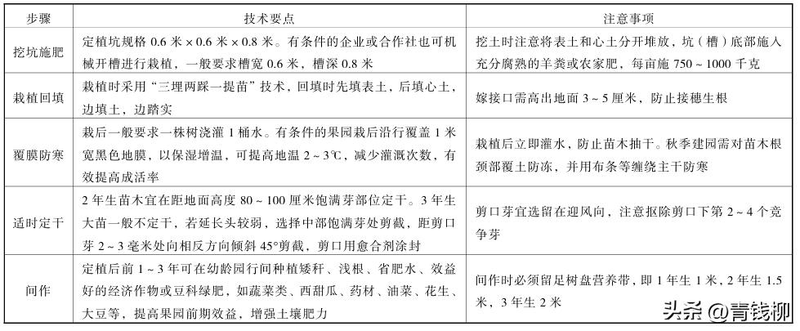
The construction process and attention are shown in table 2。
Table 2
3 results and discussion
3. 1 effects of technology applications
In 2020-2024, a follow-up survey was carried out on nine demonstration gardens, including the village of quia river, in the city of bingzhou, mebe region. The results of the technology applications are shown in table 3, where the rate of tree production, growth and early production have increased compared to traditional technologies。
Table 3

3. 2 problems and recommendations for improvement
3. 2. 1 soil management
The soil needs to be fertilized in depth at the time of the construction, and the tillage of the lands is about 20 centimetres in time for the harvest of the fruits each year. Based on soil fertility, variety, tree age, tree pattern, results and the combination of experience with fertilization, acres are recommended for organic fertilization of 2,000 to 3,000 kg and for green fertilizing crops such as soybeans, oilseeds, etc。
3. 2. 2 water management
Land parcels that are not irrigated are used to strengthen drought preparedness through farming, membranes and grass. Irrigated plots promote water-saving irrigation using such means as potable water, drip irrigation, integration of fat water and sub-drive irrigation。
3. 2. 3 pest management
The principle of “preventive, integrated and controlled” is upheld, and phytosanitary and forecasting are strengthened. In accordance with the pattern of disease and pest occurrence, biological control is actively carried out on the basis of agricultural, physical and mechanical control, rational use of chemical control and effective control of pest hazards and pesticide residues。
Conclusion
The study has significantly improved the quality of pear plantations in the meibe region by optimizing the configuration of main plant varieties and pollinators, treatment of seedlings, soil improvement and supporting technologies. It is recommended to further promote the “oxama+multiplely pollinating species” model and to strengthen the application of technologies such as soil improvement, water-saving irrigation and integrated pest and disease control to achieve efficient and sustainable development of the pear industry in the region。