


Analysis of the characteristics of the nango pear variety and efficient cultivation techniques
- ginger
Nango pear is a product of the national geography of the city of riaoning, known for its colourful fruit, its sweet taste and its fragrance. In recent years, many good varieties of fruit, colour, sugar acid content and resistance have been selected through sprouts and hybrids, which have further enriched the resources of varieties and enhanced industrial potential。
The cultivation and diffusion of good varieties requires science-based cultivation management techniques. The production and quality of nango pear, which has certain requirements for light, temperature, moisture and soil conditions, are affected by planting measures. In order to promote the healthy development of the industry and achieve efficient synergy between variety characteristics and planting techniques, this paper presents a description of the sexual differences in the range of excellent species in the south pear series and summarizes key plant techniques ranging from gardening, integration to fruit management, and green control of pests and diseases, with a view to informing production practices。
1 introduction to good varieties
1. 1 cultivated varieties
A variety of seedlings in nango pear have been grown mainly through matrimony, with long periods of intensive breeding and planting, and with the effects of the natural climate, changes have been made in the evolution process and some of the high-quality south pear varieties have been discovered. At present, a wide range of red nango pears, brown nango pears, grand nango pears and large red fruit-type nango pears are widely used in production through artificial selection and experimental cultivation。
Two red sprouts were found in the production of nango pear, one southern pear (figure 1) and the other red pear. The species of southern red pear and southern pear look better than their pronto-fruit type, colour, sweetness, fragrance and higher value. The difference between the two can be moderate, between 0. 43% and 0. 50%. The difference is the single fruit weight, which is about 86 g for the southern pear and 110 g for the red pear; the difference in soluble solid matter content is significant, 17. 3 per cent for the southern pear and 14. 78 per cent for the southern pear; the colour of fruit is red, but the amount of luminous pear is twice as high as that of normal southern pear。
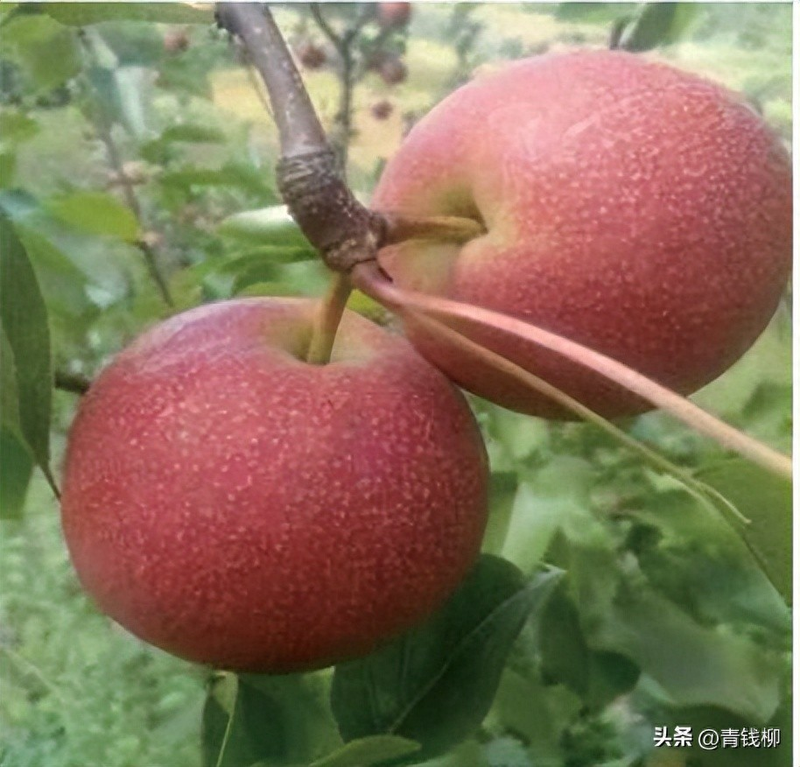
Figure 1
Pears are a variety of brown sprouts of southern pear that occur in production. The difference between single fruit weights, soluble solids content, sodium acid content and common southern pears and southern red pears is not significant; due to the general commercial nature of the plume, the area cultivated in production is small。
Grand nango pear is a sprout-type species of southern pears, with flat-shaped fruit, thin skin, juicy fruit, with a single fruit weight of approximately 126 g, with a cleavage of fruit skins, usually 1 to 2; with low levels of soluble solids; with early maturity, high yield, but less resistance to cold than normal southern pears, and a thick stick。
Great nango pear is a sprouts of southern red pear, weighing 150 g for single fruit and about 24 g for grand nango pear. The red side of the fruit, similar to the southern pear, has a gutter, a sense of mouth and proximity to the large southern pear; soluble solids contain between pears and pears; the level of trimic acid is low compared to pears and pears; the resistance is poor, the fruit is general and no varieties are recorded。
1. 2 good breeds of hybrids
To date, seven new varieties have been developed through hybrid breeding using nango pear as hand-made material。
Sweet fragrances with a mother's and an apple's father's platter, strong resistance, sweet taste, a little redness in the yellow of fruit, juicy juicy, around 80 g of fruity fruit, close to the southern pear, three months of sitting and four months of storage。
A variety of pears with apples as mother and nango pear as father's hybrids, strong cold resistance, high yield, large fruit, small heart, sweet taste, fine meat, microfranchies; soluble solids at 14. 26 per cent, close to red nama pear for four months or more and storage for six months。
A variety of pears with a mother and a father's hybrid, with fresh food processing, weighs approximately 128 g on average; yellow green fruit skins, with a larger heart and a red-stunned skin; soluble solids at 14 per cent, close to the red pear, juicy juicy, sweet and sweet oral, suitable for deep-processed products such as canner food。
Three-fold varieties of fragrance fragrance, large fruit, 160g single fruit weight, with sand01 as mother and nango pear, juicy fruit, sweet taste, light red fruit, soluble solids close to 13 per cent, lower than red pear, 0. 30 per cent drip acid content, and five months of sitting fruit。
The variety of pears that have been chosen by mothers and fathers as hybrids is better resistant to disease than the southern pears, the fruit is larger than the vanilla pear, the fruit heart is smaller, the fruit weight is 200g, the fruit is juicy, sour sweet, the skin is red and yellow, the scent is thick, soluble solids are 15%, between the southern and southern pears, sitting for four months and storage for more than three months。
The variety of pear-based mother and father-to-father varieties of apple pears, anti-cold, anti-black star disease, large fruit, 180 g single fruit weight; yellow fruit, sweet and juicy, small stone cells; 0. 37% drip acid content, lower than ryanapple; 13% soluble solid matter content, lower than ryanapple; and more than four months of sitting fruit and more than one month of storage。
The varieties of red pear, which are the mother and southern pears, are highly resistant, particularly to the effects of the disease, are large, have about 200 g of single fruit, have red fruit, are juicy, sweet and sweet, and have microsamples; they contain 0. 38 per cent of the graded acid, which is lower than the red pear; and they contain 13. 28 per cent of the soluble solids, which are lower than the red pear。
2 plantation technology
2. 1 growing conditions of nango pear
Temperature. The growth temperature of nango pear is relatively low, and the area under cultivation is mainly mountainous, with an average annual temperature of about 8°c and light, resulting in a high quality of nango pear planted on the sun。
Water. With a sweet and juicy southern pear, the fruit contains more than 90 per cent of the water, and therefore the soil is chosen for water holding capacity, preferably in areas where irrigation is convenient, to ensure the moisture needed to grow the trees in the south, and to prevent poor growth due to lack of water and poor quality of the fruit。
Soil. The southern pear tree needs to grow in fertile, deep and gaseous sandy soils. Soil requirements are neutral to micro-acid, ph 6. 0 ~ 7. 5, and trace elements such as manganese, iron, zinc are lacking in the alkaline environment and are not suitable for the growth of southern pear trees。
Light. Nango pears are very happy, their ability to use light cooperation increases with the length and intensity of the light, so it is advisable to choose the slopes of the sun and to control the distance between their lines in a rational manner; under the conditions of sufficient light, the branches of the south pear are strong, the leaves are green and bright and the fruit is full of juice。
2. 2 nango pear cultivation techniques
It's a sapling garden. Orchards are programmed into several production areas, which are larger than 6. 67 hm2, depending on the terrain, climate, soil, etc., and are not suitable for more than 10 hm2, with a reasonable configuration of transport roads, irrigation facilities, drainage facilities and fruit collection sites, which are conducive to fruit harvesting, distribution and transport. The local orchard is generally located in the mountains, soil and water are not resistant to river erosion, making it more difficult to plant the slopes. It is necessary to provide protection against rain erosion at the time of construction. It takes more than 2,500 h of sunday time and 600 mm of precipitation per year. Mountain sand soils are conducive to the growth of the root system but are less fertile, and they need to be supplemented by bottom fertilizers. Prior to the construction of the park, a healthy tree was selected, with the main choice being a sapling of over three years with a strong, high-yielding and stable sex, with no pests or disease-free species; a sandy soil with easy irrigation, a mountain of the sun or a fertile soil, which is relatively shallow, can be refilled in a way that increases soil thickness and fertility, generally exceeding 80 cm in depth; and a range of 3 m x 5 m, with a cultivation den standard of 1 m x 1 m x 0. 8 m and refilling soil mixed with bottom fertilization of 2 to 1 and 15 kg in general. In the process of planting, straw or maize straws are fed to the bottom of the pit at a depth of about 20 cm, and tree seedlings are placed into the planting den and then refilled with soil, the roots should be slightly higher than the surface. The planting is done in a timely manner; the seedlings are phased in for about a week, with the second watering as required; and the third watering is done in a timely manner after two weeks, each with the soil to prevent drought and the loss of walls. When the seedlings grow to around 10 cm in the spring, drip irrigation equipment is laid around the roots to supplement the water fertilizers with integrated drip irrigation management; dry bags of planted southern pears are set up to facilitate work, and the bags are removed from the buds, while drone sprays are administered to prevent and treat pests; pollination trees generally choose the same varieties as southern pears, with the same relative and power, with long-lived hours, with a large amount of pollen, with a ratio of 5 to 1。
Reasonable orthopaedic trim. After planting, the tree seedlings are based on the principle of “growing with trees”, with more branches, not overcuting, keeping young trees strong, keeping as many branches as possible, and keeping an eye on ventilation. The period of the poignant fruit must be sustained, with the result branches carefully trimmed, the dense branches removed and the medium and long branches used to cultivate new ones. The old tree needs to be re-emerged, using techniques such as retrenchment, swirling, etc. To extend the years of results. It's 90 cm or so, with two to three full buds at the top. In three years, the main extension of the larvae center will be shorter. Around 45 cm, the main extension branch of the southern pear tree centre within five years is treated on the basis of production needs, usually in cases where the number of main branches is sufficient, if the upper branches are active and opt for short drops. When the upper branch is strong and the lower side is strong, the upper branch is elected to head; the upper branch is elected to head to head when the upper branch is strong and the lower side is strong and weak. In order to ensure the growth advantage of the centre's dry work, the main branch of the main branch is being stretched or pressed as needed. During the growth of the south pear tree, the main methods of cutting are graft, sprouts, stripping, capping and cutting. The purpose of pull or crushing branches is to control their excessive growth, stimulate the formation of fresh buds, typically by treating dense new stalks and, for less dense stalks, cutting them off after leaving five leaves on their base. The saplings of the southern pears, which are four years old, tend to sprout at the centre where they are suitable for drying, to stimulate the branches and to keep the branches. The ripple of the three-year or so result tree, which primarily controls excessive growth, is generally treated in late may and early june for the main trunk and branch, with a depth of wood, the width of which is one tenth of the grossness of the main stem. In order to control the excessive growth of the south pear tree, a capping exercise was carried out in late july, with a short capping of the straight-to-meal branch on the back of the main branch, with the aim of inhibiting the growth of the booming sprouts. Erase the seedlings of the southern pears, prevent their growth and make them work. In addition to the reservation that the sprouts and troughs of the main branch had been suffocated in the second year, the sprouts and sprouts of the branches had been removed。
Flower fruit management. In order to ensure the normal flowering of the pear tree, it is generally chosen to pollute by a bee-laying method during the flowering period in late april, with a beehive per 0. 67 hm2 and a large amount of elemental, trace element and amino acid microfat applied before and after the flowering period. In order to increase the sitting rate, at least three leaf-faced fats were sprayed during the flowering season, mainly on a micromelanine-based and ablution-combinated application. In order to ensure the quality of fruit and the growth of fruit trees, three flowers are left in each bouquet, half a month later, and one fruit in each bouquet. In order to promote the colouring of the fruit, bio-organic fertilizers are to be applied in addition to the ventilation of the light, removing the shaded leaves one month before the fruit matures。
Pest control. Pear black star disease, decomposed disease, rotorine disease are the main causes of the southern pear, with about 70 per cent before flowering and 70 per cent during two critical periods, each of which is sprayed once, choosing 50 per cent of the methyl tobuzin humid powder 800 times more liquid, 40 per cent of the polymanganese zinc humid powder 1,000 times liquid and 40 per cent of the oxen cream 10,000 times more liquid to serve the purpose of prevention. Pear-eating, pear-eating, pear-eating, peach-eating, pear-eating, pear-like, pear-pilling are the main pests of the southern pear, and the pear tree is more harmful to the pear-eating, pear-eating, peach-eating, larvae-eating and critical periods of the pear-eating, where 2. 5 per cent of the larvae are sprayed in the early stages of winter larvae and in the transition period, 1,500 to 2,000 times as much as the emulsifiable concentrate; 2. 5 per cent of the pear-eedrin is administered in the case of the pear-nox, and 24. 5 per cent of the lice spray is administered in the case of pear, 1,500 times the verbs and 1,500 times the vervain. Green controls and improved fruit quality can also be introduced by introducing pest natural enemies, hormone traps or physical control。



