Which three parts make up the chain
Phaase locked loop, pll, usually consists of three parts:
Phase contrast (phase comparator/phase contractor): the phase comparator is used to compare the difference between the input signal and the feedback signal, and to output a controlled voltage or numerical value indicating the phase difference。
2. Voltage controlled oscillator, vco: the voltage control oscillator receives a control signal from the phase comparator and regulates its own oscillation frequency according to the voltage or numerical values of the control signal。
Feedback circuit: the feedback circuit gives the vco output signal back to the phase comparator, which is used to compare it with the input signal to generate a control signal for vco control。
These three parts interact and form a closed loop control system that locks or tracks the phase of the output signal with that of the input signal. The chains are widely used in the areas of clock synchronization, frequency synthesis, and digital modelling。
The work of the chain
The most basic locking-ring system consists of three basic modules: the phaase detector:pd, the loop filter (l00p filter:lf), which is the low-through filter, and the voltage coI'm sorry, i'm sorry. With these three modules, the basic chains can run. However, in the course of our actual use, the locking-up system will include modules such as frequency, frequency, mixer, etc. This can be compared to the minimum stm32 system and our actual use of stm32 development boards
Reference: https://www. Eepw. Com. Cn/article20202/455314. Htm
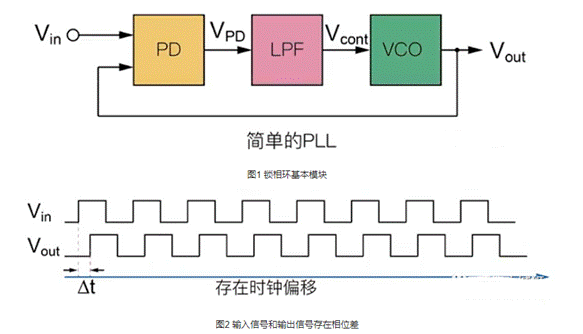
The analysis begins at the moment when the locking system starts, at which time the catheter has two input signals, one of which is the input reference signal vin and the other of the pressure-controlled oscillator's inherent oscillation signal vout。
At this time, because of the different frequency of the two signals, the phase difference is caused by the frequency difference, and if no operation is performed on the pressure-controlled oscillator, the phase difference accumulates, thus recombining the phase from zero to zero, which is a measure of the dead zone, although the phase is growing larger, but only the range of 0 to 2 gills can be measured, with the maximum of 2 gills measured, which results in the output voltage of the sensor to fluctuate within a given range。
Ideally, the phase differential between the two signals would remain within a 2-point radius and would not enter the measured dead zone. So, at the beginning of the system, the catheter detects a phase difference between two signals, which transforms the phase differential time signal into an error voltage signal output (the specific conversion process is explained by the catheter)。
By converting the loop filter into a voltage-controlled voltage voltage added to the pressure-controlled oscillator, the output frequency of the pressure-controlled oscillator vout gradually synchronized with the input signal vin until the frequency of the two signals was gradually synchronized and the phase differential was within the measurement error range, and the system stabilized。
The phase differential between the two signals does not accumulate to become large, but rather to remain relatively fixed. (not static in the conventional sense, but small fluctuations within the margin of error)。
What's the reason for the chain missing
The loss of locks (phase locked loop, pll) may be caused by:
1. Input signal interference: when the input signal is disturbed by noise, distortion, decay, etc., this may result in the phase comparator being unable to correctly compare the phase difference between the input signal and the vco feedback signal, resulting in a loss of lock。
2. Excessive frequency bias: pll may lose lock if there is a large deviation between the frequency of the input signal and the frequency of oscillation from the vco output, which is beyond the pll's tracking range。
3. Inadequate perimeter bandwidth: pll's loop bandwidth determines the speed at which it tracks the incoming signal and, if it is too narrow or too wide, can lead to pll being locked。
4. Phase compressor failure: the phase compressor is one of the key components of pll, which may cause pll to lose lock if the phase compressor fails or works abnormally。
5. Power noise and power: pll's power supply, if it is noise or unstable, may have a negative impact on pll components and lead to locking。
Temperature changes and environmental changes: temperature changes may lead to changes in the parameters of electronic components within pll, thus affecting pll performance and stability, leading to locking。
7. Other external disturbances: external factors such as electromagnetic interference, radiation interference and poor oscillator quality may also cause pll to lose locks。