On 18 april 2020, the journal progress in science published an online research paper entitled " the use of nanoprosecutors for near-infrared potassium ion imaging " , reporting on a collaborative study by the centre for innovations in brain science and intelligence technology of the chinese academy of sciences (institute of neural sciences), the shanghai centre for brains and brains studies, the dugulin research group of the national focus laboratory for neural sciences, the kukshi study group and the swordsing and wenbo research group of the shanghai institute of silicate in the chinese academy of sciences. The study developed a potassium ion fluorescent nanoprobe, which can be triggered by near-infrared light, and successfully monitored the dynamics of neuroactive potassium ion concentrations in the brain of zebra fish and mice。
Changes in cell potassium ion concentrations directly reflect changes in neuroelectric activity, which in turn affects neurons ' excitement and synaptic neurons. Therefore, changes in potassium ion concentrations can react to neuroactivity anomalies from another side and potassium ion imaging becomes a new means of studying the function of the nervous system and its anomalies. In many monitoring methods, fluorescent imaging has a unique advantage in obtaining non-intrusive temporal and spatial information on changes in the dynamics of ocular ion concentrations, thus revealing the interaction of neurons in the brain at multiple scales. However, existing potassium ion probes can only be activated with ultraviolet or visible light, as they are easily absorbed and dispersed in living tissues and can only be applied to the shallows of the brain. In addition, existing potassium ion probes are less intrusive and have a low choice, which makes it particularly difficult to distinguish between sodium potassium ion and prevents monitoring of the specificity of potassium ion. There is therefore an urgent need for the development of new potassium ion fluorescent probes with near-infrared stimulation at a higher penetration depth and specific responses to potassium ion。
To this end, scientists have carefully designed and prepared a spherical nanometer probe with a hull structure of three layers (upper-transformation of luminous nanoparticles@ potassium ion induction probe@ potassium ion selectivity film) with a total diameter of about 85 nm. The kernel conversion of luminous nanoparticles can be converted close to infrared light into visible light, which serves as an inspiration for the mid-level potassium ion fluorescent probe. The 2 nm thick film in the outer layer allows only potassium ion to enter and exit the nanoprospecting needle, which greatly enhances the anti-disturbation properties of the probe against other anion in the body (e. G. Sodium ion, calcium ion, etc.), so the film gives the probe a choice of potassium ion at a very high height。
To further validate the usefulness of the above-mentioned new potassium ion nanoprospectors, scientists have used the nanoprospectors to detect the dynamics of potassium ion concentrations in the brain in the migraines and zebra epilepsy models. Concert proliferation inhibition is considered to be the cause of migraines. In addition to large-scale neural discharges, the expansion within the cortex was accompanied by strong changes in potassium ion concentrations during the process. The temporal and spatial patterns of changes in potassium ion concentrations are not clear because of the difficulty of preparing ion-selective electrodes and the fact that signals can only be collected at very few locations at the same time. Using newly developed high sensitivity and special potassium ion probes, researchers observed changes in potassium ion concentrations in the form of plane waves, inspired by near-infrared light, providing new technological means for better understanding mechanisms for containment of cortical dispersion。
In the area of epilepsy studies, it has been argued that the increase in the concentration of potassium ion outside the cell is not only a result of the severe discharge of the neurons, but also one of the causes of epilepsy and transmission. However, this view has been difficult to verify due to the lack of sensitive and unique probes. In the epilepsy zebra fish model, studies have documented neuron activity and changes in potassium ion concentrations through double-colour imaging, and have found that higher levels of potassium ion can be observed in brain areas without epilepsy intense neuroactivity, thus supporting the role of potassium ion proliferation in the development and transmission of large-scale neuroactivity。
The study also provided new ideas for the design of other ion-specific probes inspired by near-infrared light and opened up new methods for real-time dynamic monitoring of ion activity in neurons。
This work was carried out by dr. Liu jiayan of the dugulin group, vice-researcher sang chun feng, and assistant researcher pan limin of the shanghai institute of silicate, under the joint guidance of the du jiolin researcher, the bear chic researcher and the swordwood researcher and the dok wenbo researcher of the shanghai institute of silicate. Dr. Lu bin, dr. Wu yongjie, dr. Feng zheng, mr. Plum ming, dr. Chen zheng, dr. Zhang yong wei, and mr. Bhujin also made important contributions. This work is financed by the china institute of science and technology, the national natural science fund board, the ministry of science and technology, the chinese academy of sciences and the shanghai city. (china daily, shanghai branch)
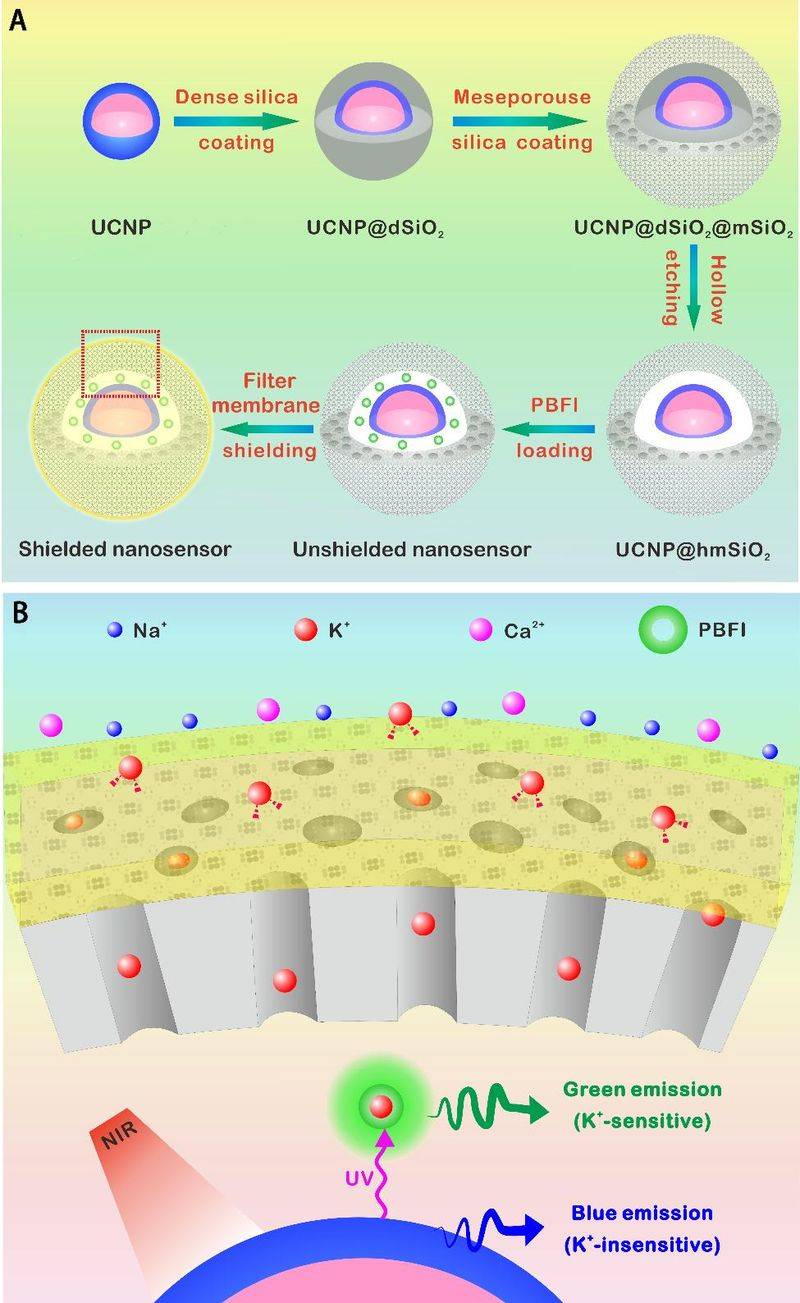
Figure : design of potassium ion nanoprospectors and sensors. (a) preparation of potassium ion nanoprospectors. The upper luminous particle nayf4:yb/tm@nayf4:yb/nd is continuously covered by a layer of solid silicon dioxide and a layer of meso-perfect silicon dioxide. The cavity structure left by the carving of solid silicon dioxide can contain potassium ion fluorescent indicators. Finally, a thin membrane with a potassium ion specificity on the outer surface is the potassium ion nanosensor. (b) sensor mechanisms for potassium ion nanometer probes. The outer membrane allows only potassium ion to enter and exit the nanoprospecting needle, while excluding other anion. At near-infrared light, ultraviolet light from kernel conversion of light particles can act as an incentive light for potassium ion fluorescent indicators, thus giving the probe a function of near-infrared light。