


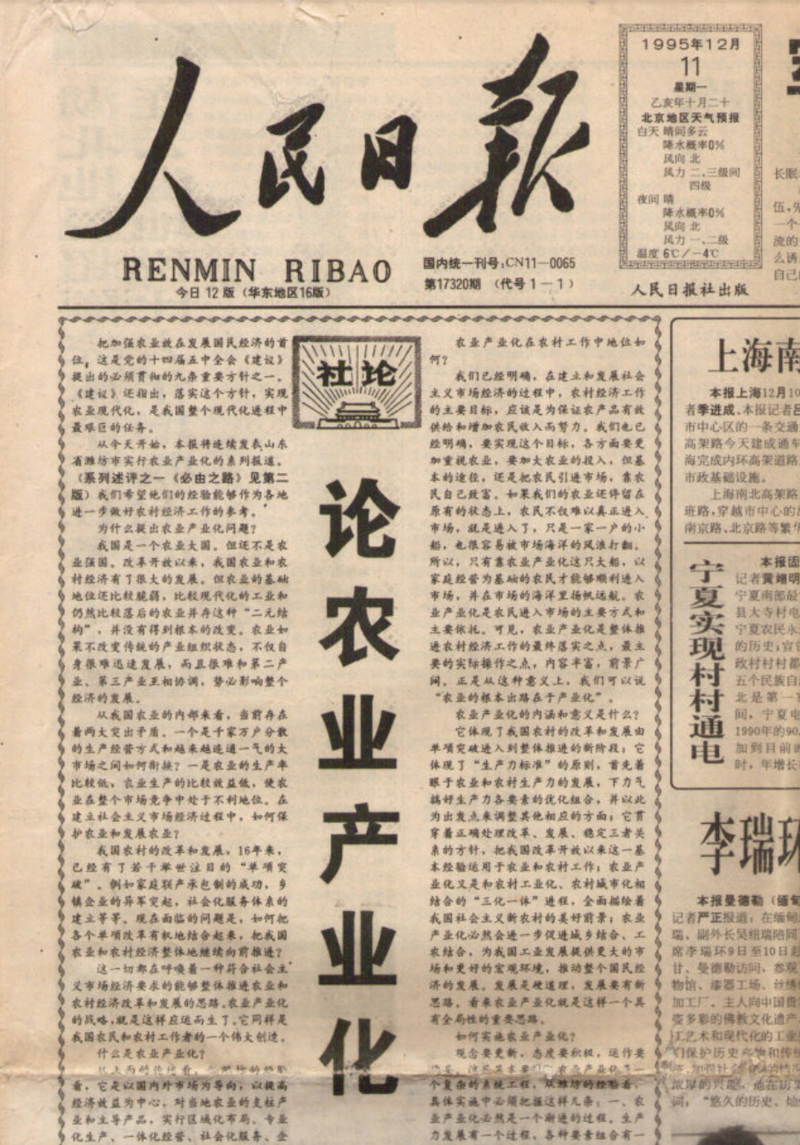
On 11 december 1995, the first edition of the newspaper the daily people’s journal published an editorial entitled “industrialization in agriculture”, with three reviews in super-conventional space. For the first time, the system made it clear that “industrialization in agriculture is a great creation for farmers and rural workers in the country”, stating that “the fundamental way forward in agriculture is in industry”. This historic announcement, which pushed the ordinary city of shandong qianjong to the forefront of china's agricultural reform, also marked a completely new stage in the modernization of chinese agriculture。
Time travels, 30 years pass. As we look back at the 2025 historic node, for the past 30 years, the tsang factory has written a great deal of practice about modern chinese agriculture — from “small farmers” to “large markets”, from “one-area exploration” to “national models”, from “industrial revival” to “global integration”. This journey has not only changed the face of rural farming, but has also provided valuable experience in modernizing agriculture in china and the world。
"industrialization" awakening
In the 1980s, household co-contracting responsibility significantly liberated rural productivity, food production rose every year and farmers ' incomes increased significantly. However, a new paradox followed: how does the decentralization of “thousand families” match the “twilightly changing” markets? The “selling” of agricultural products turns out to be “buying” and the “crowding and cutting” circle plagues agricultural development。
At the time, the head of the local council recalled that “the farmers were faced with a number of problems that could not be handled by a single household and that they urgently needed effective services from the party councils at all levels and from all sectors”
The factory didn't wait to see。
The cities took the lead in organizing the “commodity economy big sing” by setting up service centres for agricultural skills, agro-machinery, livestock, etc., and setting up townships, bundling projects, and implementing service accountability at the various levels; under the leadership of the party secretary wang lo yi, san yuan city, 17 party members took the lead in building winter-style vegetable sheds and launching the “green revolution” on vegetable cultivation in northern china; the cold kiosk region developed “one village, one village and one village” to activate the distinctive economy
These bottom-up reform explorations, while taking different forms, point in the same direction: how to organize dispersed farmers and match agricultural production with market demand。
On 25 may 1993, it was a day worth remembering. The zhongqiao city council and the municipal government issued the opinions on further strengthening the leadership of the rural socialist market economy in accordance with the requirements of the industrialization of agriculture, the first official document of the chinese local party council on industrialization of agriculture。
The document clearly states: “the organization of industrial agricultural production must be market-oriented and cost-effective, relying on leading and scientific and technological progress, with a regionalized distribution of agriculture and the rural economy, specialized production, integrated management, social services and entrepreneurship”. This marks a shift from practical exploration to theoretical self-consciousness。
At the beginning of 1994, the industrialization of agriculture was incorporated in the shandong provincial council, document 1, and the experience of zhongshan was replicated throughout the province. On 11 december 1995, the daily people's journal published the editorial " on industrialization in agriculture " , and published three reviews of " the way to make a new pattern of relationships " , " a broader and more intense thinking " , with an extra-conventional page. The review states: “the agro-industrialization of the factory has begun and has taken several successful steps, where people have seen the promise of a new socialist countryside ...”
The editorials and series of reviews of the daily people's journal have given rise to strong reactions, bringing the experience of the workshops to the national level。
Since then, the “treasureway” has become the “ways of necessity” for national agricultural reform. In 1997, the party's 15 major reports proposed the active development of agricultural industrialization, which was included for the first time in the party's report。
The path to practice: the birth and evolution of the three patterns
The evolution of the urban model is a microcosm of rural reform in china. For decades, it has experienced four changes。
Phase i (mid-1980s): “commodity economy chorus”. (c) establishment of a system of services at the county, village and village levels in response to the production business challenges faced by farmers after the “large-scale job”。
Phase ii (1987-1992): “integration of trade, industry and agriculture”. Innovative extension of processing enterprises to rural areas, contracts with farmers, the establishment of production bases, and the creation of new economic operating mechanisms for production, processing and circulation of “triples”。
Phase iii (1990s): implementation of “industrialization of agriculture”. The capture of the rural economy, like the capture of modern industries, has led to a pattern of industrialization of “market-driven, base-based farmers”。
Phase iv (since 2007): rural communityization and “three districts” sharing. With a community-based approach, supported by a production park and a ecological landscape, farmers are allowed to “live in the community, work in the park, leisure in the landscape”。
The “lifelight model” led to a vast green revolution。
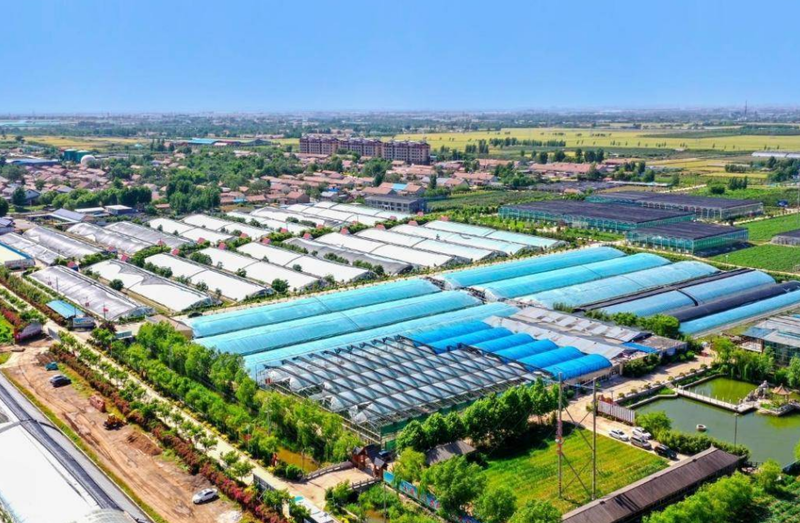
Lifelight models are characterized by a whole-industry chain development centred on the vegetable industry。
Phase i (initial phase of reform and opening-up - 1989): a breakthrough in the construction of wholesale markets for vegetables has led to a shift in vegetable production towards a commodity economy。
Phase ii (1989-2000): “green revolution” was launched throughout the country, marked by the development and promotion of winter-heating vegetable sheds。
Phase iii (2000-2002): building bridges between farmers and high-tech agricultural technologies, marked by the international vegetable science and technology fair in china。
Phase iv (2013-present): in line with the requirement of “technical wings for agriculture”, all efforts have been made to develop farming industries and to integrate the application of modern agricultural technologies。
The model is a systematic integration of the experiences of municipalities at the municipal level。
Phase 1 (1984-2002): a review of the experiences of cities, lifelights, etc., has led to a clearer agricultural industry。
Phase 2 (2003-2010): implementation of the strategy of industrialization, standardization and internationalization of agriculture, leading, market-driven and science- and technology-led “triple-led”。
Phase 3 (2011-2012): adjust the requirements for the development of modern agriculture to “safety, quality, efficiency, brand”。
Phase iv (2013-2018): accelerate agricultural branding, scaling up, standardization and internationalization of “four”。
Phase v (2019 to date): the deployment of the “six integration promotion operations” around innovative upgrading of the “three models”。
The “three models” have different drivers and different paths, but the kernel and the essence are connected. “the essence of the `three models', according to secretary liu, is the promotion of a wider and higher-level optimized distribution of factors in agricultural production, which, in the final analysis, is the emancipation of productivity and its development.”
The way forward: from “agriculture cities” to “agriculture strong cities”
Thanks to the three models, for 30 years, a report card was handed over in sundy。
The total value of agricultural, forestry and fisheries production increased from less than 10 billion in 1995 to 135,870 million yuan in 2024, the first largest in the province, more than one tenth of the province and 1 per cent of the country。
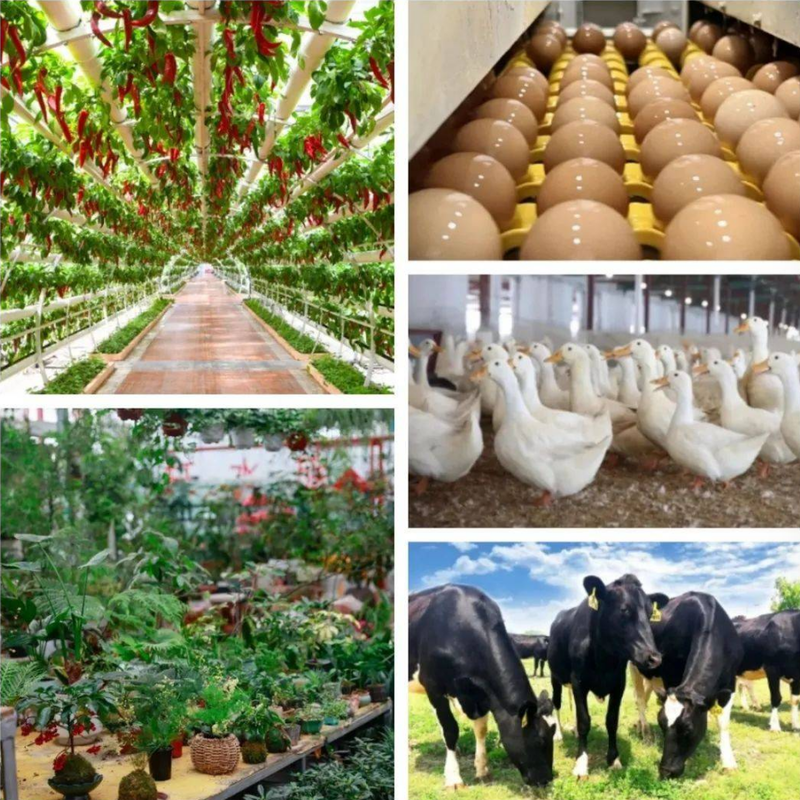
They produce 500 billion-class industrial chains of vegetables, livestock, flowers, agricultural machinery, maize, and 10 billion-class industrial chains of ginger, fruit, seeds, cows, etc。
Twenty-nine leading agricultural enterprises and 112 professional farmers' cooperatives were elected to the “national top 500”, the highest number in the country's metropolitan area。
Total food production amounted to 9,034 million pounds, vegetable production to 14,180,000 tons and meat and egg milk production to 2,09 million tons, filled with “grains of the great powers” and “national baskets”。
Behind these figures is the profound transition from “scaling expansion” to “quality change”。
Scientific and technological empowerment: the construction of the beijing university institute for modern agricultural research, the national centre for vegetable quality standards, the national centre for the innovation of livestock slaughter quality “one house, two centres” and the contribution of agricultural science and technology has reached 70. 6 per cent, which is 7. 4 percentage points higher than the national rate。
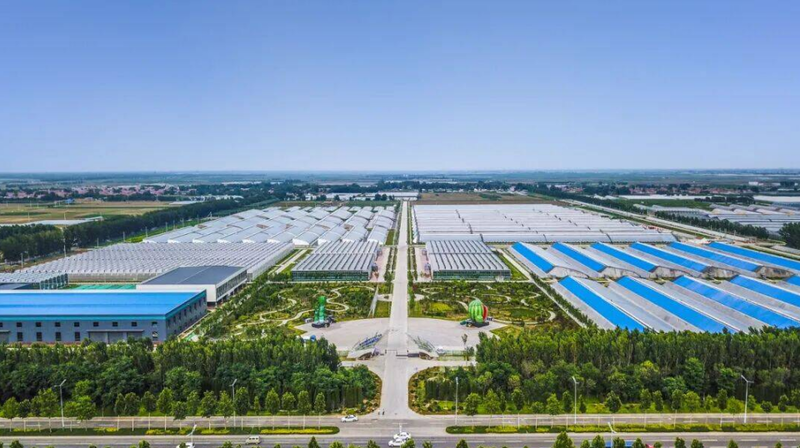
Upgrading of facilities: the winter-heating vegetable shed has evolved from its first generation in 1989 to its present seventh generation, with more than 120 patents in the solar glass greenhouse, 50 per cent more energy-efficient than in the netherlands。
Wisdom agriculture: the establishment of the brain that runs the three farmers, the creation of the country's first innovative application base for the zone chain + vegetables, and the application of technology for networking in nearly 80 per cent of the solar greenhouses。
As the first country in the country to have an integrated pilot zone for agricultural development, the innovative development of the “three models” of the masonry has also led to changes in the pattern of national agricultural openings. The city-wide agricultural export enterprise has grown to more than 700 enterprises, with 141 countries and territories selling agricultural products abroad; agricultural exports reached $16,375 million in 2024, surpassing 100 billion in six consecutive years; and international fairs such as the forum of ministers of agriculture of china and the international congress on the integrated use of salted lands have been held, with the “three models” continuing to go out and become “a beautiful window” and “a powerful engine” for bringing about the results of china's agricultural and rural modernization。
Roads to china: from “industrialization of agriculture” to “rural revitalization and integration”
If the first two decades have been the 1. 0 era of “industrialization of agriculture”, in the last 10 years the factory has reached the 2. 0 stage of “rural revitalization and integration”。
In 2018, the general secretary of xi confirmed the “three models” two times when he participated in the shandong delegation during the national two conferences, noting that “since the reform and opening up, shandong has created a number of experiences in rural reform and development, and that the integration of trade, industry and agriculture has emerged from cities and workshops, resulting in the formation of city models, workshops and lifelight models”
This important recognition has given a strong impetus to the development of the farming industry. In 2019, the board of agriculture and rural affairs of shandong province issued the recommendation on innovative upgrading of the “three models” for the rural renewal of the ziru pilot district; and in 2024, the ziqiang municipal council and the municipal government issued the opinion on the comprehensive upgrading of the development of integration and the higher qilu pilot district for the rural renewal of the ziru pilot district, systematically proposing the “six main integration promotion actions”。
The whole chain of industrial integration: the strengthening of the lead, the development of 500 leading agricultural enterprises, 200 farmers' cooperatives and 100 family farms, and the promotion of the “5+10+n” rural rich industry matrix。
Integration between urban and rural areas: breaking down institutional barriers and creating a virtuous circle of talent, land, finance, industry and information gathering in rural areas。
• integration of the whole spectrum of governance: building strong grass-roots party organizations, promoting “three-tier” integration, sustaining the prosperity of rural culture and building a new era of village integrity。
Integrating science and technology: improving the support system for the “1+2+n” platform, accelerating innovation in modern farming and promoting the intellectual transformation of agriculture。
• reform of the integration of the full elements: work on living land articles, highlighting the operation of villages, promoting open development and stimulating the dynamism of rural resource elements。
Full-cycle integration of services: development of diversified services, expansion of services, improvement of the service chain and development of model agricultural services workshops。
The deputy mayor of rushan, the standing committee of zhongqiao city, explained: “the integration that we promote is not a simple combination of one, two, three, but rather a combination; it is not a physical combination, but a chemical reaction. The aim is to make agriculture a dynamic industry, to make farmers attractive occupations and to make rural areas a beautiful home for comfort.”
The path of enlightenment: 30 years of the sanno philosophy
Over the past three decades, the farming industry has taken root in a unique “tri-farm” philosophy。
— respect for grass-roots wisdom. From wang loi's winter huts to “village integration”, from the “industrial integration” of the city's foreign trade to the construction of rural communities, the wisdom of the people has always been the source of change and development。
“any successful reform is the result of respect for grass-roots creation and the learning of popular experience.” as a long-term researcher on the model of the mill。
— seize the boundaries of government and markets. The zhuang community has always insisted on a combination of government and market leadership. The government is re-establishing the platform, creating the environment, providing services, rather than making a big deal of it, making a difference。
“it is clear to the government that what it does, and what it does in the market, it will not interfere.” this clear border perception is an important guarantee for the success of the formula。
— stick to the concept of integration and sharing. Farmers' income generation has always been central to the work of the “three farmers” to enable farmers to share value-added gains from the industrial chain through improved benefit-linking mechanisms。
At present, the per capita disposable income of rural residents is 29212 yuan, and the ratio of urban to rural residents is reduced to 1. 84:1, which is better than the provincial and national average. The total rural collective assets amounted to $6,6853 million, and the total collective income of 6535 villages exceeded $100,000。
— to keep up with the innovations. From the “commodity economy chorus” to the “trade, industry and agriculture integration”, from the “industrialization of agriculture” to the “revitalization and integration of rural areas”, the development of the mills has been constantly enriched and refined in the light of the changing stages of development。
“the life of the three models lies in the evolution and innovation of the times.” the comrades of the city council stressed。
“strengthened, strong; a new journey begins with a mission like a mountain.” this is not just a summary of the past, but a commitment to the future。
From the “industrialization of agriculture” to the “revitalization of rural integration”, from the “three models” to the “six grand integration”, the quilang factory has been at the forefront of rural reform in china. In the new journey, the agricultural powerhouse will continue to take on the role of “head-to-head and head-to-head” in exploring new paths and models for the modernization of rural agriculture throughout the country. As secretary-general liu jianxian said: “we believe that with the support and guidance of all sectors of society, the farming industry will grow stronger, the countryside will become more beautiful and the farmers will become happier.”
It's 30 years old. At the historical node of the “1455” planner, the “155” planner, the vibrant and charming city, continues to write a new chapter in china's modernization of agriculture, in the spirit of the “choven chandhe, the new, the open and the strong.”。
Thirty years is a milestone and a new starting point. The story of the industrialization of chinese agriculture continues to be written; much remains to be done to modernize agriculture in china. But with explorers and practitioners such as qianjiang, we have every reason to believe that the future of chinese agriculture will be brighter; tomorrow in rural china will be better。



