


The prevention of birth defects and the improvement of the quality of the population at birth are important tasks in the overall planning of the population and in the integrated resolution of population problems. In 2010, the national population and family planning commission and the ministry of finance jointly launched a pilot project for free pre-pregnancy health screening (hereinafter referred to as the national free pre-pregnancy pre-pregnancy project), and by 2012 the region had covered 60 per cent of the country's districts (municipalities and districts). The results of the pilot exercise, which was carried out through the joint efforts of the family planning and financial sectors at all levels of the population, have been significant, and have played a positive role in raising the population's knowledge and awareness of eugenicity, reducing the risk factors that affect eugenicity and improving the quality of the population at birth, which has been sincerely welcomed by the population. In order to further implement the 18-year spirit of the party, to make this policy more accessible to the general public and to provide a favourable demographic environment for the full realization of a well-being society, the national commission on population and family planning and the ministry of finance have decided to implement the national free preconception prenatal quality programme throughout the country since 2013. The relevant job announcements are as follows:
I. The importance of comprehensive and free pre-conception screening for eugenic health
As a country with a large population, there is a large number of birth defects, with the total number of new births occurring in the country being nearly 1 million per year, or between 4 and 6 per cent of the total number of births. Birth defects have a serious impact on the quality of the population born, the quality of the labour force in the future, the improvement of the country's overall national capacity and international competitiveness, and the achievement of the strategic goals of sustainable economic and social development and the full realization of social well-being. The introduction of free pre-conception screening for eugenics has helped to prevent birth defects at their origin, improve the quality of the population at birth, transform it into a country with strong human resources and create a favourable demographic environment for harmonious and sustainable economic and social development。
Having a healthy and intelligent child is the common aspiration of every family. Birth defects impose a heavy mental and economic burden on families and have a direct impact on the quality of life and family well-being. The introduction of free pre-pregnancy health screening, the introduction of preventive measures before pregnancy, the reduction of the risk of birth defects at the source, the promotion of pre-natal deficiency prevention, and the achievement of pre-pregnancy and group prevention are innovative developments in the country's prevention model. The national project to promote free pre-conception eugenics will benefit more people of reproductive age and will benefit future generations. It is a major livelihood project and a concrete initiative of the population, the financial sector, and people-centred approaches to scientific development。
Ii. Objectives, scope of implementation and basic requirements of the national free pre-pregnancy project
(i) project objectives。
General objective: to establish a free pre-pregnancy health check-up system that will provide every pregnant couple with free pre-pregnancy check-ups, which will effectively reduce the risk of birth defects and improve the quality of the birth population。
Annual targets for 2013:
1. More than 80 per cent of pregnant couples in rural areas have knowledge of the scientific knowledge of eugenics
2. The initiative and self-consciousness of pregnant couples in rural areas to attend free pre-pregnancy eugenic health check-ups is increasing and coverage of the target population is gradually reaching more than 80 per cent
At all levels of government, greater emphasis has been placed on prevention of birth defects and improvement of the quality of the population at birth, and relevant departments have worked closely together to explore mechanisms for “government leadership, sectoral cooperation, expert support, popular participation”
The risk of birth defects is gradually decreasing and the quality of the population at birth is gradually improving。
(ii) scope of implementation in 2013。
In 2013, the national free preconception probity project was launched in all districts (municipalities and districts) throughout the country。
Some remote districts that are not eligible (including sichuan province**,**, 29 districts of coolshan state, 39 districts of the tibet autonomous region, changdu, shannan, ikkaze, natra, ali, and one district of the xinjiang production and construction corps) were suspended from project implementation this year, pending the gradual introduction of free pre-pregnancy health check-ups as soon as conditions are ripe。
The list of 1076 new project districts (municipalities and districts) in 2013 is contained in annex 1, together with a list of three pre-2012 project districts (municipalities and districts) (see annexes 2-4)。
(iii) target population。
The target population for free pre-pregnancy health check-ups shall be:
1. Couples that are in compliance with fertility policy and that prepare for pregnancy
At least one of the spouses is an agricultural population or is defined as a rural household
At least one of the spouses has a local domicile or a non-local domicile of both spouses but has lived there for more than six months。
(iv) services content。
Free pre-pregnancy health check-ups such as eugenic health education, medical history inquiries, medical examinations, clinical laboratory examinations, video screening, risk assessment, counselling and so forth are provided to pregnant couples planning. Specific services can be found in the guidelines for technical services for the pilot work of the national free preconception prenatal health screening project (preliminary) (endo 2010) no. 31, hereinafter referred to as the technical services code。
Free pre-pregnancy eugenic health screening is carried out in accordance with the principles of scientific norms and informed consent. In strict compliance with the requirements of the technical services code and the pre-pregnancy health examination - health education guide, medical examination guide, clinical testing practice guide, gynaecology ultrasound guide, eugenic counselling guide (for more details, see the circular of the office of the national commission for the family planning of the office of the national commissioner for the publication of the five guides to the pre-pregnancy health examination series (physical science and technology 2010 - 66))。
(v) services。
The services of free pre-pregnancy health check-ups are provided by the technical family planning services at the county level, with the participation of the same level of health care. The technical family planning services at the district level are required to fully utilize the mobile family planning services and reach out to the communes, where family planning service providers and village family planning staff work together. In cases where technical family planning services at the county level do not obtain a licence to practise at a medical institution, the same level of public health service shall be entrusted with a free examination and the costs shall be settled at the same rate。
The district family planning department is responsible for identifying and supervising local health check-up points prior to free pregnancy。
(vi) the principle of free service。
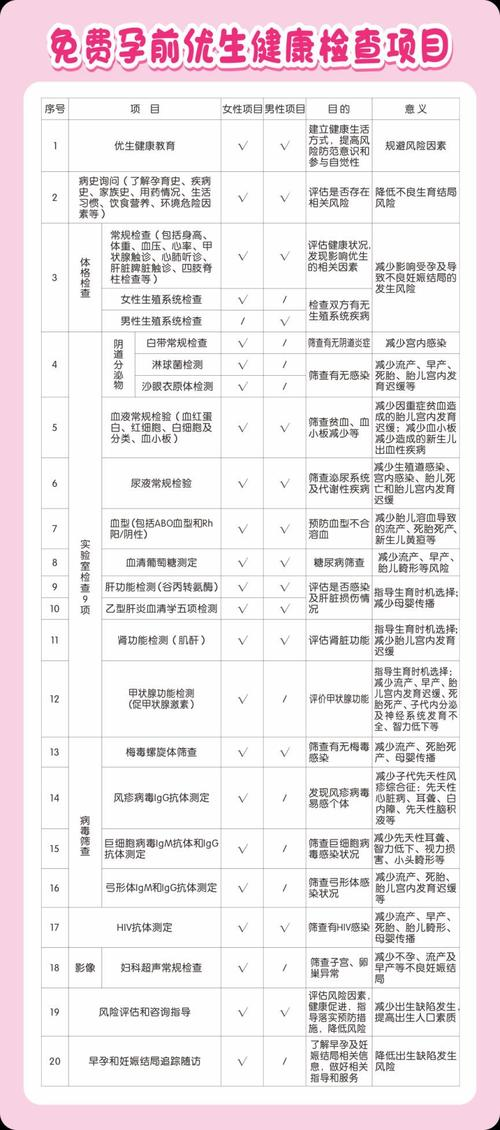
The eligible target population receives a free national pre-pregnancy health check-up every child. If re-inspection is required, a pre-conception eugenic health examination may be performed at the expense of the doctor。
In principle, pregnant couples who are eligible for a mobility programme receive free pre-conception health check-ups at their place of residence, settle in their place of residence and have the same services as the resident population。
(vii) earmarked funds and funding criteria。
The state accounting standard for the cost of free pre-pregnancy health check-ups per pregnant couple is $240, which is financed jointly by the central and local budgets. Of these, 80 per cent are borne by central and 20 per cent by local finance; 50 per cent by central and 50 per cent by local finance; and 20 per cent by central and 80 per cent by local finance. Locally financed funds are mainly provincial。
The provincial budget and finance departments may increase the number of services provided in accordance with the high incidence of birth defects in the country and determine the criteria for the settlement of the cost of free pre-natal health check-ups in the region. On the basis of guaranteeing basic service content, local settlement standards exceed $240 and are covered by local finances; where local settlement standards are below $240, the central fiscal balance offsets the central fiscal burden of the following year。
At the same time, the local financial authorities, at all levels, are required to allocate funds for the national free preconception pre-pregnancy project in the same-level family planning sector, in conjunction with practical work, for training of personnel, technical guidance, quality control, awareness-raising, etc。
Specific regulations for the management of funds earmarked for free pre-conception screening are set out in the circular of the ministry of finance of the national commission for population and family planning on the issue of a (pilot) scheme for the management of funds earmarked for the pilot national pre-pregnancy screening project (fencist no。
Iii. Working procedures for the national free preconception prenatal prenatal project
(i) target population identification。
1. Village-level family planning specializes in collecting information on pregnant couples (including mobile populations) who are eligible for the scheme within the jurisdiction and submitting lists to the village-level pedagogic offices。
2. A list of pregnant couples eligible for the programme in the district is reviewed by the county pedagogic office and reported to the district population unit. Relevant departments, such as civil affairs and public security, can be actively coordinated and relevant information identified。
3. The district-level family planning department verifies the identification of free-of-charge clients in the bailiwick and issues a certificate for free-of-charge eugenic services。
(ii) free services。

The district point service is responsible for providing free pre-pregnancy screening services for pregnant couples. The technical family planning services at the commune level, in cooperation with district-level points, carry out pre-pregnancy health screening, provide health education and counselling for the general population, and conduct follow-up visits to early pregnancy and pregnancy outcomes. Family planning services at the village level assist district and village level services in health education and advocacy and mobilization。
(iii) information-gathering management。
Data on the number of free pre-pregnancy eugenic health examinations, results, early pregnancy and the outcome of pregnancy are transmitted monthly to the district-level family planning units. The data are reported on a case-by-case basis by the district population unit. The provincial units aggregate and verify provincial data on a monthly basis and report to the national population and family planning commission。
(iv) funding。
Case-by-case settlements are implemented. Each month, the district-level points service reports to the district-level population birth control department on the number of examinations and on the project, and provides a list of funds for the state free pre-conception health check-ups, which, after review by the district-level population birth control department and approval by the financial department, are allocated by the district-level finance department within five working days to the district-level points service. The district population unit maintains all original materials and documents for verification。
Iv. Effective implementation of the national free preconception health screening programme
(i) effective strengthening of organizational leadership. At all levels, the family planning and financial sectors actively seek the attention of the pnc government by establishing a working leadership group to strengthen sectoral coordination and work together. The safeguards are to be effectively implemented by integrating free pre-pregnancy eugenic health screening into the overall planning and deployment of the government to guarantee and improve the livelihood of the population. The head of the family planning department of the population is responsible for ensuring the success of the national free pre-pregnancy project。
(ii) carrying out sectoral responsibilities in good faith. The national population and family planning commission and the ministry of finance are responsible for the organization, coordination, supervision and management of projects, the management of macro-policies, the operation of funds and the development of working systems and norms. The local family planning departments are responsible for the implementation of local projects, the preparation of work plans, the coordination of the implementation of safeguards, the management of technical services, the training of personnel and the strengthening of quality control. The local financial authorities are responsible for the accounting of earmarked funds, the disbursement of funds, etc., to ensure that the funds are fully and on time and that all funds are strictly monitored。
(iii) extensive awareness-raising. To make full use of the various forms of radio, television, newspapers, networks and leaflets, and to increase awareness of the importance of free pre-conception eugenic health screening, which is known and understood by the public, to raise public awareness of eugenicity and to create a favourable social environment and public opinion. The network of family planning systems is being used to increase the awareness of newly married and married expectant couples through specialized lectures, face-to-face counselling, etc., to develop a healthy and civilized lifestyle, to promote the active participation of the population and to increase the coverage of the target population for free pre-pregnancy eugenic health screening。
(iv) investing in quality control. At all levels of the population and family planning sector, efforts are being made to train personnel, build quality management systems and continuously improve the quality of projects. The services involved in pre-pregnancy health check-ups are guided by the need to develop sound quality management systems, establish job responsibilities and improve the accuracy of health education, medical examinations, risk assessment and counselling. The clinical laboratory shall establish a quality management system and quality assurance measures for the entire process of pre-test, mid-test and post-test clinical tests. The clinical test project shall be conducted in accordance with a standard test method, and the instruments, reagents and consumables used shall be approved by the food and drug supervisory authority, which shall carry out careful internal quality control on a daily basis, participate regularly in the inter-room quality evaluation and give priority to laboratory biosafety management。
(v) construction of two centres. The technical guidance functions of the national and provincial testing quality monitoring centre and the preconception quality data centre are fully utilized to ensure project quality and upgrade service levels. The national centre for monitoring and monitoring the quality of technical services for family planning is responsible for the technical aspects of the management of the quality of clinical testing in the national population's family planning system, for the training of personnel, for directing services to perform indoor quality control and for conducting periodic in-room quality evaluations. The provincial technical services testing quality monitoring and monitoring centre for family planning is responsible for the monitoring and management of the quality of clinical tests in the province (districts, municipalities), staff training, on-site guidance, etc., and conducts at least two in-house quality evaluations per year。
The national centre for pre-pregnancy quality data is responsible for the collection, aggregation, analysis and development of information systems, operation, maintenance and data security for the first two batch of 220 free pre-pregnancy health screening services in the counties. Provincial centres for pre-pregnancy quality data are responsible for the collection, aggregation, analysis and development, operation, maintenance and data security of information on pre-pregnancy health services in all project districts of the province (districts and municipalities)。
(vi) strengthening oversight and inspection. At all levels of the population, the financial sector should strengthen its monitoring and oversight of the implementation of the programme, technical services, quality control and the use of earmarked funds, in order to ensure the health of the project. The implementation of the national free preconception prenatal quality project must be promoted with a high sense of responsibility and purpose, with a view to ensuring quality and integrity. It is important to monitor the strict compliance of the targeted services with the standards of service and to ensure that all screening services for pre-pregnancy eugenics are carried out in good faith. To effectively strengthen the management of earmarked funds, no agency or individual should retain, crowd out or divert funds to ensure that funds are earmarked. Institutions and individuals who violate the relevant provisions will be subject to due diligence in accordance with the law。



