2025 c. A. Common sense
The 205 national examinations have been considerably adjusted in terms of the number of topics and questions, and the number of subjects judged by common sense has changed from 20 to 15, with a reduction of 5. Whereas there were 20 common sense judgments, there were 8-10 political theories, and only 10-12 other common sense knowledge points. Now, with the addition of political theory sections, there has actually been an increase in the number of issues beyond political theory in common sense judgements and the importance of common sense has increased。
The principal examiners of common sense shall know the basic knowledge to be learned and the basic ability to use it to analyse the judgement, focusing on the level of knowledge of the social situation in the country and the basic qualities of integrated management, including legal, historical, cultural, scientific and technological, geographical, economic and medical aspects. Then we'll look at the local city, provincial, law enforcement, three-volume common sense criteria。
Part. 1
National and local level
Point distribution
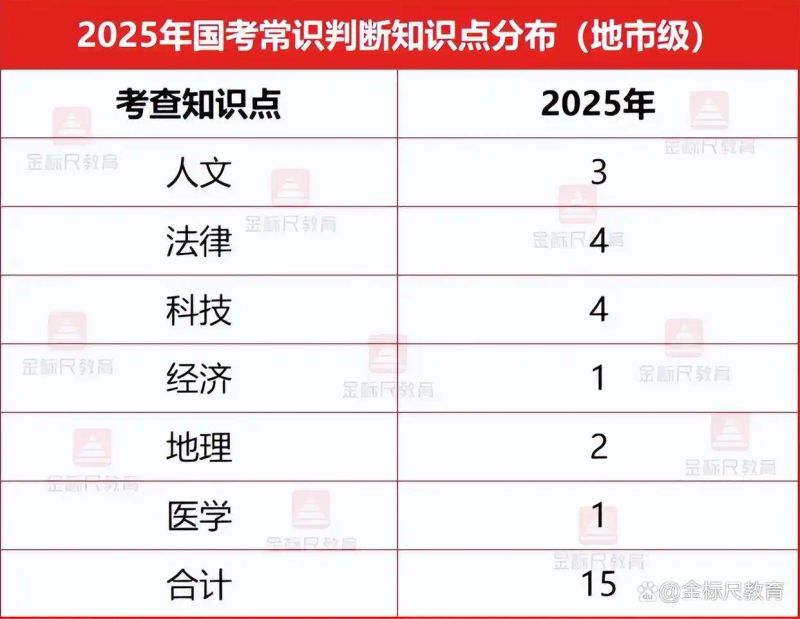
A total of 15 questions were examined by the 205 state (local and municipal) examinations, with the following breakdown:
Difficulty analysis
In general, the 2025 state examinations (at the municipal and municipal levels) are more extensive and difficult. Here's a specific analysis
(a) legal literacy: a total of four subjects examined are case-by-case, requiring candidates to understand the law in practical terms, with moderate difficulty
Scientific and technical commons: a total of four questions, dealing with two physicss, one biology, one chemistry, are the points of knowledge to be met during a regular review, which is difficult。
Common sense of the human person: a total of three subjects are examined, with a more detailed examination and a more extensive and difficult examination。
General knowledge of geography: a total of two subjects examined are chinese humanities and geography. Question 1 of the common economics review is relevant to life and is not difficult。
Medical commons: one is more professional and more difficult, but is better off with fewer questions。
Title characteristics
(i) legal literacy: case studies combined with a strong understanding
Legal literacy takes the form of a case-by-case assessment of compliance with the requirements of the law and the ability to understand it is more demanding. The 205 state examinations (at the local and municipal levels) examined administrative law, civil law, company law and consumer protection law, with reference to the scope of administrative review, ownership, disclosure of state business credit information, consumer protection, both the traditional focus of the old law and the new law, and the whole approach was novel and flexible. In their review, the candidates focus on the preparation of regular legal literacy points and on the content of the new law。
(ii) science and technology commons: living together with life
Science and technology are relatively well represented in 2025 state and municipal examinations, focusing on physical, chemical and biological integration. The 2025 state examinations (at the local and municipal levels) examined physicists and their scientific and technical knowledge of key achievements, fungi, fibre materials and the movement of ships. Two of these issues are presented in the gold ruler course。
(iii) common sense of humanities: history and literature
Humanities are examined in a total of three subjects in 2025 state and municipal examinations, covering cultural sites, history of qinhan, literature and literature。
(iv) geography: china's human geography is predominant
A total of two subjects were examined in 2025 state and municipal examinations, covering basins, chinese humanities and geography. It is worth noting that geo-common sense, which combines some common sense with the subject matter, is not difficult。
(v) economic and medical commons: dedicated terminology cha
Economics in the 2025 state examination (at the municipal and local levels) look at economic concepts by describing the perception of the economy in life among different groups of people. They relate to commonly used economic concepts such as money supply, the rmb exchange rate, vat, GDP, etc. Medical literacy is more professional, with a major examination of medical examination methods。
Part. 2
Vice-provincial state
Point distribution
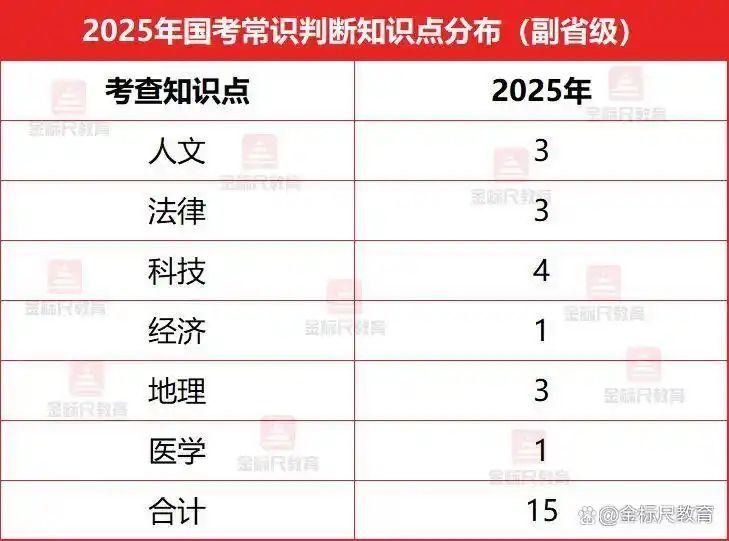
Of the total of 15 examinations conducted in 2025 (subprefectures), 7 were the same as in 2025 (municipality level) and 7 were the same as in 2025 (law enforcement category). The specific points are distributed as follows:
Difficulty analysis
The 2025 state examination (sub-provincial) is relatively extensive and difficult. Here's a specific analysis
(b) scientific and technical commons: 4 questions, including 2 physics and 2 biology, are difficult
(a) legal literacy: the three topics examined are analytical and difficult
(a) common sense of the human person: three questions: a detailed examination of the content, a broad and difficult examination
(a) geo-common sense: three questions, medium difficulty
(a) economic commons: one question, macroeconomics, medium difficulty
Medical commons: examination 1 is more professional and more difficult。
Title characteristics
The scientific and technical, legal and humanistic characteristics of the common sense and judgement sections of the 205 state and departmental (sub-provincial) examinations are the same as those of the local and municipal tests。
(i) general knowledge of geography: all the world looks at it
A total of three subjects were examined in 2025 state examinations (sub-provincials) on human geography, celestial bodies, natural geography, re-analysing of the forms of examination, which required the extraction of information and analysis from the subject matter or options, and a comprehensive examination of the subject matter in the light of humanities。
(ii) economic and medical knowledge: ad hoc terminology study
One in 2025 (sub-provincial) on economics and medicine. Economic commons examines macroeconomics and measures to expand domestic demand, drawing on the report on the work of the government of 2024. Medical examination methods are examined by the medical commons and are more specialized。
Part. 3
State examination, law enforcement level
Point distribution
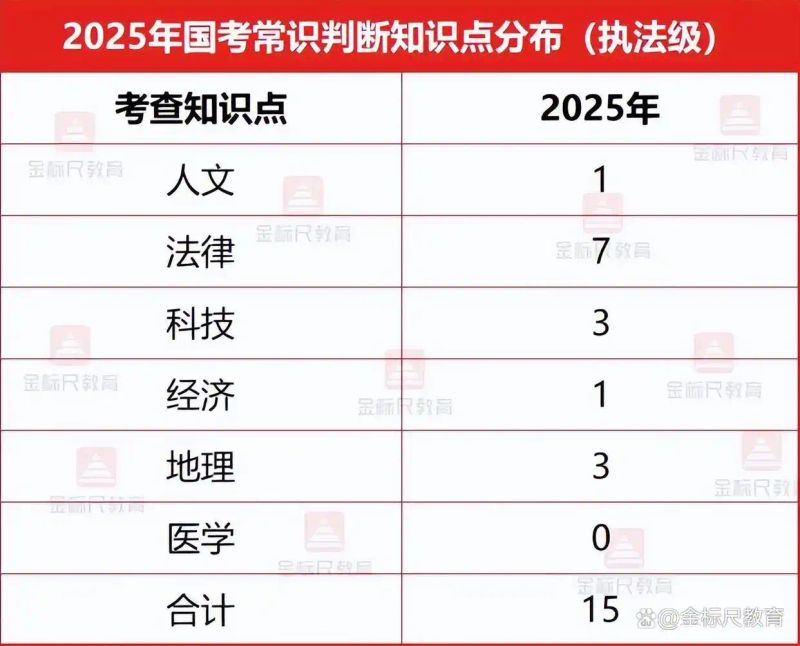
Of the total of 15 questions examined in 2025 state (law enforcement) examinations, 4 are the same as in 2025 state (municipal) examinations, with the following breakdown:
Difficulty analysis
The 205 national examinations (law enforcement) are more extensive, focused on analytical understanding, and are mediumly difficult. Here's a specific analysis
Legal commons: a total of seven questions were examined, six in case form, requiring candidates to understand the law in practical terms。
Scientific and technological commons: a total of three questions, one physics, one biology, one chemistry, are difficult。
Common sense of the human person: the first question, the rules for sporting events, is not difficult。
Geographical commons: a total of three subjects are examined, focusing on natural geography, and need to be analysed and understood。
Economic common sense: the first question is relevant to life and is not difficult。
Title characteristics
(i) legal literacy: case studies combined with a strong understanding
Legal literacy takes the form of a case-by-case assessment of compliance with legal requirements, as well as a specific understanding of the provisions of the law, which requires greater understanding of the law. The 205 state examinations (law enforcement) examined legislative acts, food safety laws, administrative law, criminal law, civil law, consumer protection law, with regard to legislative competence, administrative review, false litigation, ownership, contracts, consumer protection and food safety management. The law is extensive and detailed. Candidates are expected to improve their analytical understanding of legal knowledge when they review the law。
(ii) science and technology commons: living together with life
Science and technology commons were examined in a total of three subjects in the 2025 state examination (law enforcement category), which were conducted around physics, chemistry and biology. 205 state examinations (law enforcement) examined the relationship between physics, fibre materials and greenhouses. Science and technology know-how is mainly about life and life。
(iii) geo-common sense: natural geo-gravity analysis
In the 2025 state examination (law enforcement) there are three questions on geologic age, celestial bodies, physical geography, the form of examination, the form of examination, the form of examination, the information to be drawn from the subject matter or the options for analysis and thought, and the method of the subject matter is to be examined in a comprehensive manner, taking into account humanities。
(iv) humanities and economics: closely linked to life
In the 2025 state examination (law enforcement) humanities and economics, one question is closely related to life. The humanities test examined sports competitions and the economics test examined common economic concepts。
2025 kawako common sense judgement
Major adjustments have also been made to the subject matter and volume of the study, with the number of subjects judged by common sense changing from 15 to 10, with a reduction of 5。
Although the number of subjects has been reduced, the scope of the study is still broad and broad, such as theoretical, geographical, biological, scientific and sporting aspects, with a focus on cultural commons at the legal level; and the sichuan province's general-knowledge section, which is mainly concerned with the correct selection of the selected topics, has only four questions, the distribution of which is illustrated below:
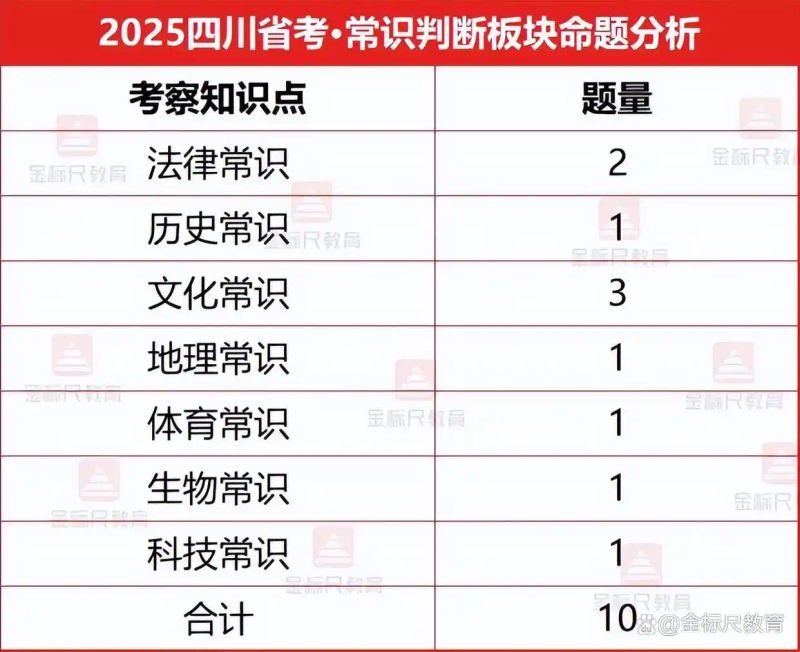
These are some of the most recent tests that have been shared for today on common sense judgment in the 2025 cv. In general, common sense is more relevant, the points of reference are more extensive, and a systematic review of the priority sections can be conducted at the time of the review, and fewer will save time. In preparing legal literacy, the knowledge points are to be fully combinised and accurately remembered, the rule of law and case law are to be read in conjunction with analysis, and the content of the new law is to be seen; in preparing scientific literacy, the knowledge base is to be understood and reviewed; and in preparing geographic literacy, the physical geography is to be studied and the analytical thinking learned。