Chemical oxygen demand (cod) is a core indicator of the total volume of reductive pollutants in water bodies whose detection accuracy and efficiency are directly related to the scientific and time-bound monitoring of the water environment. Traditional cod testing methods, represented by heavy chromic acids, have long dominated water quality monitoring with mature principles and stable performance. Uv spectroscopy technology, as a new rapid detection technique, with advantages such as no chemical reagents, speed of detection, has received wide attention in the field of environmental monitoring in recent years. This paper provides a scientific basis for the selection of technologies for different monitoring needs by systematically comparing the traditional chromium acid-based cod sensors with the uv spectroscopy-based cod sensors in terms of principles mechanisms, detection performance, applicable scenarios, environmental impacts and economic dimensions。
I. Comparative mechanisms
The difference in the nature of the two technologies stems from the core logic of cod testing, which relies on the chemical oxidation reaction to quantify the contaminant content, and the indirect quantification of the ultraviolet spectral technology based on the optical properties of the contaminants, which determines the subsequent division of performance。
(i) traditional chromium-acid cod sensors
The technique is based on the test of the quality of water, chemical oxygen quality, heavy chromate act (gb 11914-89). The core principle is that, under strong acid conditions, potassium chromiumate is the oxidizer, silver sulphate is the catalyst and, after some time after the heating of the back flow, reductive substances (e. G. Organics, sulphides, sub-iron salts, etc.) in water are oxidated with potassium chromium acid, and excess potassium chromium acid is determined through the standard solute drops of sulphate, calculated on the basis of consumption of potassium chromate. The core structure of the sensor consists of the reaction pool, the heating unit, the dripping system and the detection unit, which is automated through the automation of reagent additions, the heating of reflows, dripping, endpoint determination, etc. The total quantity of all reductive substances in the water column capable of being oxidized with potassium chromiumate was detected in full conformity with the test principles of the standard manual method and the data were highly traceable。
(ii) uv spectroscopy cod sensors
The technology is based on lambert-bill's law and indirectly detects cod using the absorption properties of organic matter in aquatic bodies for specific wavelength ultraviolet light. Most organic molecules contain co-singled double-keys, benzene rings, etc., with strong uv absorption of 254 nm wavelengths, while inorganic reductive substances (e. G. Cl-, s2-, etc.) have weaker absorption of this wavelength. The sensor calculates the results associated with cod values by firing 254 nm ultraviolet light and 546 nm visible light (used for calibration of haze interference) to detect the inhalation of the water to both beams, respectively, in conjunction with pre-defined calibration models. Some high-end sensors will also introduce multiwave long detection techniques to further reduce the impact of suspension, colour, etc., and increase detection accuracy. Its core advantage is that rapid reagent-free analysis is achieved through direct optical signal detection without the need to destroy samples。
Key test performance comparisons
Test performance is the core evaluation indicator of the sensor, which compares the five key dimensions of the detection range, accuracy, accuracy, response speed and ability to resist interference, with data derived from the technical parameters of the mainstream commercial sensor and from the validation results of authoritative testing agencies。
(i) scope and accuracy of detection
The detection range of the traditional chromiumate-based cod sensors is usually 10-10000 mg/l, with some high-range models extending to 20,000 mg/l and low-range models as low as 5 mg/l. The accuracy is excellent, with a low concentration range (>100 mg/l) and a relative standard deviation (rsd) of ≤2 per cent, and a low concentration (5~100 mg/l) of 5 per cent, meeting the detection needs of different concentrations of water (e. G. Domestic sewage, industrial wastewater, surface water). This advantage stems from the thoroughness of the chemical oxidation response, which can accurately quantify the total reductive material provided that the response conditions (temperature, time, catalyst) are met。
The conventional detection range of uv spectroscopy cod sensors is 0~5000 mg/l, with partial models extending to 0~10000 mg/l, but low concentration segments (ii) accuracy and traceability
The accuracy of the traditional chromiumate-based cod sensor is widely recognized, and its detection principles are fully consistent with national standard methods, and results can be traced directly to national measurement standards. The relative error of this type of sensor vis-À-vis manual standard methods is usually 5 per cent in comparison tests by authoritative institutions, which meet scenarios that require high levels of data accuracy, such as environmental monitoring and pollution permit verification. In addition, the oxidation efficiency of the various reduced substances is stable, independent of the type and structure of organic matter, and the detection results are more stable。
The accuracy of the uv spectral cod sensor depends on the calibration accuracy of the calibration model. Prior to use, calibration is required using standard samples similar to the water matrix to be tested, and if the calibration sample differs significantly from the organic composition of the actual water body, this leads to significant deviations in the results. In the absence of targeted calibration, the relative error with the standard method may be as high as 10% ~ 20%. Although a number of water quality models (e. G. Surface water models, household sewage models) are embedded in some sensors, it is not possible to fully cover the complex and variable industrial wastewater matrix. In addition, the method is not capable of detecting reductive substances (e. G., partially saturated alkanes) that do not absorb 254 nm of ultraviolet light, which results in less systematic detection results and less traceability。
(iii) response speed
The speed of response is one of the most significant indicators of the two technical differences. The traditional chromium acid-based cod sensor, due to the need to complete reagent additives, heat reflows (usually 2h, fast model reduced to 30min), drip-fixing, etc., has a long test cycle, usually 30min ~2h for single tests, and does not meet real-time monitoring needs and is more suitable for off-line detection or timing monitoring of bulk samples. Even rapid oxidation techniques developed in recent years (e. G. Microwave heating, ultrasound assisted oxidation) are difficult to reduce the detection cycle to less than 10min。
The uv spectroscopy cod sensor does not require a chemical reaction process. Once the sample enters the test pool, it can complete the sorbence detection and data calculation in seconds to minutes. The response rate is extremely rapid and the detection cycle is usually 10s ~5min, allowing real-time online monitoring of cod in the water column. This advantage makes it irreplaceable in scenarios such as emergency monitoring (e. G. Pollutant spills), real-time regulation of sewage treatment plants, timely feedback on water-quality change trends and rapid data support for pollution control and process adjustments。
(iv) interference resistance
The main disturbance factor for the traditional chromiumate-based cod sensor is cl-, which is oxidized by potassium chromate to cl2, resulting in high detection results. In order to eliminate cl-disturbation, the sensor usually uses mercury sulphate as a shelter, covering up to 2000 mg/l. For high-chlorine wastewater (cl - > 2000mg/l), dilution or chlorine gas correction is required, which reduces interference but increases detection steps and errors. In addition, suspensions and colours in the water column have less impact on detection results, as samples are subject to filtering before detection, and the determination of the drop-point (e. G., level drop-down) is poorly coloured。
The uv spectroscopy cod sensors are more complex, including mainly suspensions, colour, turbidity and inorganic ion. Suspended floats and turbidity disperse ultraviolet light, resulting in a high detection of irradiation; chromosomal substances (e. G. Dyes, curate) may cause additional absorption of 254 nm ultraviolet light and interfere with the detection of irradiation of organic matter. While most sensors use double wavelength (uv+visible light) correction techniques, which partially eliminate dissipation of turbidity and suspensions, the effect of correction is limited for high tuning (>100 ntu) and high colour water bodies. In addition, some inorganic ion (e. G. No3-) has a weak absorption of 254 nm ultraviolet light, which in high concentrations of no3-water bodies (e. G., contaminated water from agricultural surface sources) leads to high detection results。
Overview of intellectual products
A high-precision uv absorption cod sensor is a water quality monitoring device based on uv254 uv254 uv-vis sorbent photometric analysis and the southern great patent algorithm to accurately reduce the interference of suspensions with cod monitoring. The product uses wideband semiconductor electrons, which can effectively eliminate ultraviolet interference in the sunlight and guarantee measurement stability. Sensors clean their own windows, supporting a variety of clean models and frequency flexible settings, adapted to complex scenarios such as sewage networks; and having the capability to customize structures, wavelengths, ranges and programs, covering low (0~250 mg/l), medium (0~500 mg/l), high (0~1000 mg/l) multiple range specifications with resolution up to 1600 ntu. Its shell uses 316 l stainless steel (support pom, peek custom), protection level ip68, work temperature range 0-50°c, data transfer via rs485 interface and modbus protocol, with low utility until ≤0. 2w is not rotated. Compared to traditional chemistry, the sensor has the advantage of being sensitive, fast, low-cost, low-powered, reagent-free and has been optimized over the years and applied to complex water quality monitoring scenarios。

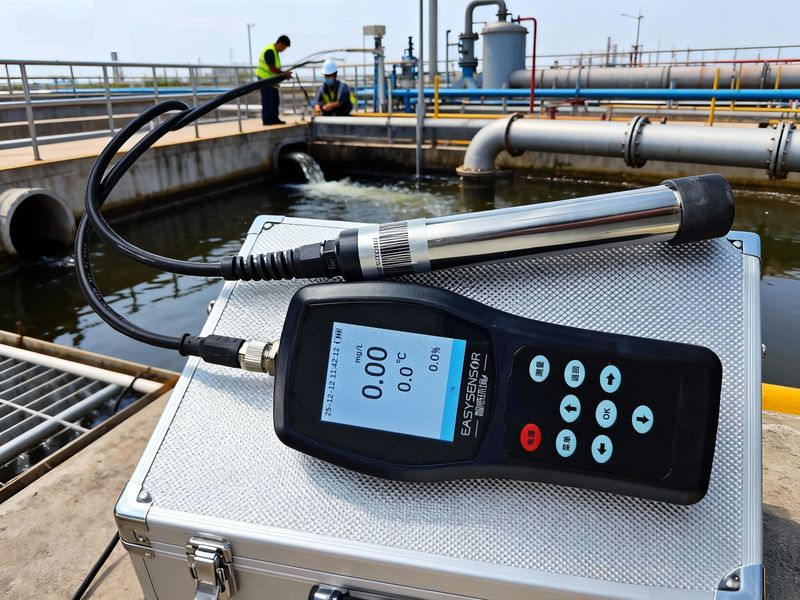
Portable fluorescent fluorescent oxygen instruments in the intellectual environment are based on optimized fluorescent central techniques, carrying self-developed non-expendable high-performance fluorescent film, counteracting the dissolved oxygen concentration by detecting fluorescent signal phase differences caused by oxygen molecules, without electrolytic fluids and frequent calibration, addressing pain points such as traditional electrodes, oxygen consumption, pollution-prone points from their sources, rapid response speeds (t90 /2000/40s), measuring precisions of ± 0. 1 mg/l in the 0-20 mg/l scale range, and automatic compensation for temperature and even salinity from built-in high-precision sensors, which can stabilize at temperatures of -20°c ~ 50°c and complex conditions such as high salt, acidine, etc. The instrument, which is also equipped with an industrial-grade fixed installation and light quantitative handheld equivalent, not only has an industrial-grade design for anti-conservation sealing, anti-pollution, fixed monitoring needs in the chemical, pharmaceutical and water treatment industries, but also portable features such as water-protective grade 500g, ip68 and above, suitable for aquaculture inspections, field emergency monitoring, etc., while supporting the real-time uploading of data and management of multi-equipment networks, helping a wide range of areas to optimize soluble oxygen precision monitoring and process optimization and significantly reduce transportation costs。